
II. Hope, Recovery, Reform:
The Great Depression &
FDR’s New Deal
1933 – 1939
1.FDR’s New Deal: The Domestic Program That Remade America2.The Banking Crisis: Ordeal of a Nation, Test for a New President
3.A New Deal for Farmers: Franklin D. Roosevelt and Rural America
4.Lights Across the Countryside: The Tennessee Valley Authority
5.Franklin D. Roosevelt, Conservationist: An Early Initiative in Sustainability
6.Putting People to Work: Job Creation and Work Relief in the New Deal
7.A Friend of Labor: Franklin D. Roosevelt and Worker Rights
8.Work for Artists, Arts for America: Federal Project Number One
9.Social Security: A Safety Net for Americans
10.Frances Perkins: Advocate for Working People, at Franklin D. Roosevelt’s Right Hand
11.Harry Hopkins: Franklin D. Roosevelt’s Closest Adviser
12.Franklin D. Roosevelt, New Yorker: The New Deal in the Empire State
13.African Americans and the New Deal: A Historic Realignment in American Politics
14.Marian Anderson at the Lincoln Memorial: A Great Singer Makes Civil Rights History
15.Women and the New Deal: Gaining Ground in Politics and Public Life
16.A New Kind of First Lady: Eleanor Roosevelt in the White House
17.Running for President: Franklin D. Roosevelt as Campaigner in Chief
18.Is It Constitutional?: The New Deal and the Supreme Court
19.The New Deal Democrats: Franklin D. Roosevelt and the Democratic Party
20.Chief Executive: Franklin D. Roosevelt, Congress, and the Presidency
21.Talking to the People: FDR, Radio, and the Press
 Download PDFs
II. Hope, Recovery, Reform:
The Great Depression &
FDR’s New Deal
1933 – 1939
1.FDR’s New Deal: The Domestic Program That Remade America
2.The Banking Crisis: Ordeal of a Nation, Test for a New President
3.A New Deal for Farmers: Franklin D. Roosevelt and Rural America
4.Lights Across the Countryside: The Tennessee Valley Authority
5.Franklin D. Roosevelt, Conservationist: An Early Initiative in Sustainability
6.Putting People to Work: Job Creation and Work Relief in the New Deal
7.A Friend of Labor: Franklin D. Roosevelt and Worker Rights
8.Work for Artists, Arts for America: Federal Project Number One
9.Social Security: A Safety Net for Americans
10.Frances Perkins: Advocate for Working People, at Franklin D. Roosevelt’s Right Hand
11.Harry Hopkins: Franklin D. Roosevelt’s Closest Adviser
12.Franklin D. Roosevelt, New Yorker: The New Deal in the Empire State
13.African Americans and the New Deal: A Historic Realignment in American Politics
14.Marian Anderson at the Lincoln Memorial: A Great Singer Makes Civil Rights History
15.Women and the New Deal: Gaining Ground in Politics and Public Life
16.A New Kind of First Lady: Eleanor Roosevelt in the White House
17.Running for President: Franklin D. Roosevelt as Campaigner in Chief
18.Is It Constitutional?: The New Deal and the Supreme Court
19.The New Deal Democrats: Franklin D. Roosevelt and the Democratic Party
20.Chief Executive: Franklin D. Roosevelt, Congress, and the Presidency
21.Talking to the People: FDR, Radio, and the Press
Download PDFs
1. FDR’s New Deal: The Domestic Program That Remade America
The Great Depression of the 1930s laid bare the many ways in which Americans’ fates were connected. And yet when Franklin D. Roosevelt took office in 1933, the federal government—potentially the mightiest representative of the people’s common interests—had long been confined to a relatively passive function. State governments and an unregulated marketplace determined the country’s direction.
FDR’s New Deal changed that. He believed that if a quarter of American workers were jobless, the federal government could hire them to do useful work—build schools and plant trees, for example. If farmers couldn’t make a living from their crops, the U.S. government could support prices by subsidizing growers to reduce supply. The federal government could secure rights for American workers in private industries and establish a national insurance system—Social Security—to keep them from destitution in old age. It could preserve American landscapes through the National Park Service and encourage a rich indigenous arts tradition by sponsoring American artists. The U.S. government could regulate banks and it could extend credit to homeowners, farmers, and businesses.
With its “alphabet soup” of agencies, the New Deal did all this and more. It affected Americans’ everyday lives in practical and far-reaching ways. Though this expanded role for the federal government was controversial—it remains so today—in the perilous 1930s, as a global economic crisis fomented reactionary responses on one hand, revolutionary impulses on the other, the New Deal represented a moderate path based on the notion that all Americans have a stake in one another and in their country.
 The New Deal, a 1934 mural by renowned artist Conrad Albrizio, placed in a New York City art school. Franklin D. Roosevelt’s domestic agenda had as its basic goal to make the federal government serve the general welfare, promoting citizens’ well-being and protecting them from economic exploitation and the denial of opportunity based on prejudice. FDRL
 Workers hired by the temporary Civil Works Administration (CWA) paint the gold dome of the Colorado State Capitol in Denver, 1934. The CWA’s success at putting Americans to work inspired the New Deal’s largest single endeavor, the Works Progress Administration, which employed millions of Americans in jobs that ranged from building roads to teaching impoverished adults to read and write. National Archives
 Two New Deal programs, the Works Progress Administration and the Public Works Administration, funded construction of San Francisco’s iconic Golden Gate Bridge, pictured here shortly after its opening in 1937. The New Deal literally and figuratively connected Americans—through infrastructure like bridges and roads, and by establishing shared experiences of citizenship through such programs as Social Security. LOC
2. The Banking Crisis: Ordeal of a Nation, Test for a New President
Franklin D. Roosevelt took office just as the American banking system spun into chaos. Americans had already lost hundreds of millions of dollars in savings as banks across the country failed. Now many states had closed their banks against the stampede of depositors desperate to withdraw their cash.
FDR treated the situation like the emergency it was. Working around the clock with an eager Congress, during his first week in office the new president closed banks nationwide, pushed through a bill to inspect and reopen them in an orderly manner (with plenty of currency issued by the federal government), and went on the radio to explain his solution to the people and ask for their cooperation. “Together we cannot fail,” he said. It worked. People redeposited their money. Many Americans concluded, with enormous relief, that they had put a leader in the White House.
 Depositors gather in the rain outside New York City’s Bank of United States after its failure in December 1930. Heavily invested in real estate and its own stock, the bank was the first major banking institution to fail after the stock market crash of 1929. Many depositors were Jewish immigrant garment workers, who lost their life savings. LOC
 Franklin D. Roosevelt delivers his first inaugural address at the East Portico of the Capitol, March 4, 1933. Widespread bank failures had added a terrifying new dimension to the Depression’s vast unemployment. FDR addressed specifics in his speech. “There must be a strict supervision of all banking and credits and investments,” he said, “so that there will be an end to speculation with other people’s money; and there must be provision for an adequate but sound currency.” He also buoyed the country with his confidence: “This great Nation will endure as it has endured, will revive and will prosper.” LOC
 A cartoon by Tom McCoy, New York Herald, March 5, 1933. Depicted here as an engineer at the helm of a speeding train, Franklin D. Roosevelt kicked off an extraordinary period of legislative activity with his work on the nation’s banking crisis. His first one hundred days in office saw the passage of sixteen major bills. FDRL
3. A New Deal for Farmers: Franklin D. Roosevelt and Rural America
When Franklin D. Roosevelt became president, America’s farmers were in dire straits, able to fetch a mere pittance for their products after years of falling prices and displaced in droves by property foreclosures and a withering Great Plains drought. FDR saw farming as essential to American culture. He also believed that the country’s economy could not recover so long as its farmers remained paralyzed as both producers and consumers.
The New Deal responded in ways that would lift farm incomes and influence rural life for generations. To address the oversupply of farm products that drove down prices, it established the first subsidies to farmers to limit their acreage in certain staple crops. Through the Farm Credit Administration, which exists today, it refinanced farm mortgages at lower rates and for longer terms. It provided loans to poor tenant farmers to purchase land. It also financed the construction of electrical distribution systems in the countryside and helped rural families install wiring and modern plumbing in their homes and farms.
 A farm foreclosure sale in Iowa in the early 1930s, with military police on hand to prevent farmers from intervening. Foreclosures on farms that had been in the same family for generations were widespread in the Depression. Outraged communities sometimes revolted, gathering at foreclosure sales to block bidders from participating. LOC
 Franklin D. Roosevelt visits a North Dakota farm family receiving federal emergency relief allocated to drought states, August 1936. By February 1935, more than 20 percent of rural families in the Great Plains were receiving this help. FDR believed farming was an essential part of the American way of life as well as key to the recovery of its economy. LOC
 Two farmers sit on the steps of the County Activities Building in Fort Payne, Alabama, in September 1941, discussing the “cotton marketing cards” that show they did not exceed the year’s allotment for cotton acreage under the New Deal’s Agricultural Adjustment Act (AAA). The AAA set a precedent for managing the supply of farm products by subsidizing farmers to limit production. In 1941, in response to an oversupply of cotton in the market, American cotton farmers voted in a referendum to assess a penalty on the sale of cotton by farmers who had planted more than allowed under the voluntary AAA limits. US Dept of Agriculture
4. Lights Across the Countryside:The Tennessee Valley Authority
Electricity was the great technological boon of the early twentieth century, driving economic development, saving labor at home and work, and improving public health through such advances as refrigeration. But by the time Franklin D. Roosevelt became president in 1933, electrification was a story of haves and have-nots. The sprawling private utility companies that controlled the nation’s power supply didn’t see much profit potential in extending service to poor farmers. In the Tennessee Valley of the upper South, for example, fewer than one in ten homes had electricity.
FDR tackled this problem by insisting that the electricity-generating capacity of America’s great rivers belonged to its people and should be used to generate affordable public power. The New Deal’s Tennessee Valley Authority, with its series of hydroelectric dams, would serve as the model; by the time of FDR’s death in 1945, it had brought light, literally, to three-quarters of the Tennessee Valley.
 Workers at the site of Norris Dam, the first major project of the Tennessee Valley Authority (TVA), November 1933. Behind them are a warehouse and bridge under construction. Like so much of the New Deal, the TVA served more than one purpose; these workers were building structures that would serve the public over the long haul—while collecting wages in the depths of the Great Depression. LOC
 Workers erect electrical lines across sparsely populated countryside, using seed loans from the New Deal’s Rural Electrification Administration (REA). Private utility companies had been reluctant to invest in the construction of infrastructure to serve poor rural areas. U.S. Department of Agriculture
 A farm woman uses an electric clothes washer, with power supplied by one of the new farmers’ electrical cooperatives created with New Deal financing, early 1940s. When it came to domestic chores, electrical appliances were an enormous labor saver. People no longer had to heat water for washing, bathing, and cooking, scrub soiled laundry by hand, or haul great blocks of ice to keep food cool. LOC
5. Franklin D. Roosevelt, Conservationist: An Early Initiative in Sustainability
Franklin D. Roosevelt was a “green” president long before America adopted the term or embraced the sensibility. He saw the country’s wild landscapes and abundant natural resources as the wellspring of American prosperity and was determined to safeguard this legacy for future generations.
FDR launched the nation’s first green jobs program (the Civilian Conservation Corps) and spawned the modern wildlife preservation movement by calling together preservationists in a 1936 conference. He brought millions of acres of land under federal protection as national parks, forests, and wildlife refuges. His administration addressed the environmental disaster known as the Dust Bowl by promoting soil-conserving farming practices and planting great swaths of trees to serve as windbreaks. At a critical time in the nation’s history, with settlement now reaching from sea to sea, FDR encouraged Americans to see the natural resources of their New World continent as resilient, yes—but not inexhaustible.
 Civilian Conservation Corps (CCC) enrollees clearing land, around 1934. The CCC—popularly known as “Roosevelt’s Tree Army”—was perhaps the nation’s first green jobs program. It sent unemployed Americans to work in national parks and forests clearing brush and dead vegetation, planting trees, building firebreaks, and improving campsites. National Archives
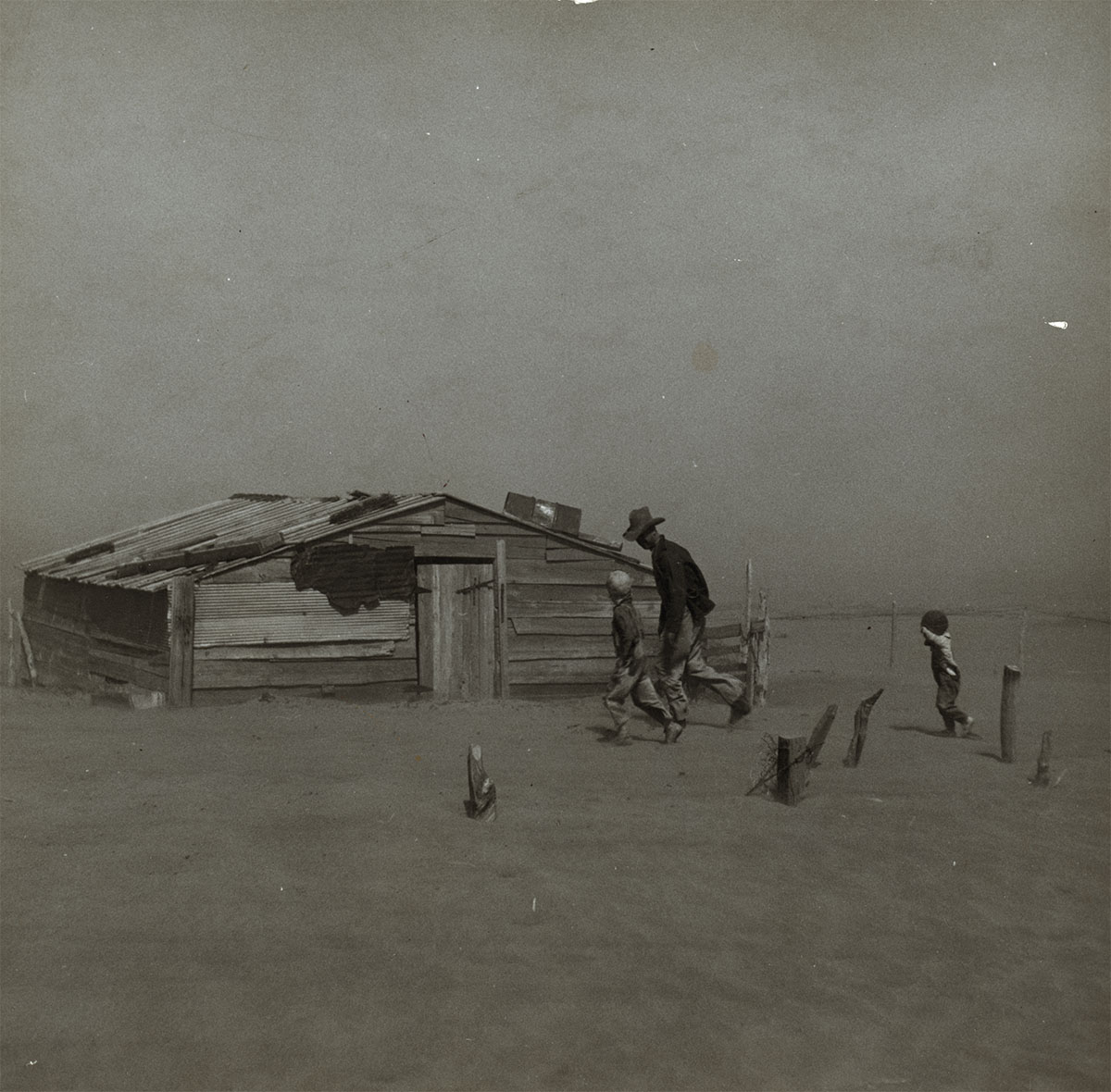 A farmer and his sons lean into the wind in a ferocious dust storm, Cimarron County, Oklahoma, April 1936. The New Deal’s response to the Dust Bowl—a problem that did not respect property lines—emphasized the novel idea that all Americans had an interest in promoting conservation practices on private land. “The Nation that destroys its soil,” as Franklin D. Roosevelt wrote in 1937, “destroys itself.” LOC
 A 1930s Works Progress Administration poster to promote wildlife preservation, featuring the trumpeter swan. In 1941, when the U.S. Army proposed to site a training ground near a refuge that the president and his officials had created in southwest Montana to protect the rare trumpeter swans’ habitat, Franklin D. Roosevelt wrote to his secretary of war, “The verdict is for the Trumpeter Swan and against the Army. The Army must find a different nesting place!” LOC
6. Putting People to Work: Job Creation and Work Relief in the New Deal
When Franklin D. Roosevelt took office in 1933, roughly one in four American workers was out of a job, leaving many families with no income at all. The traditional sources of aid—private charities and local governments—provided meager assistance in the best of times and were wholly unprepared to address the suffering of the Great Depression. At his March 4 inauguration, FDR promised to treat this situation like the national emergency it was.
Under his administration, the federal government for the first time acted to help the unemployed not primarily by stimulating business, but more directly by extending a critical lifeline to jobless Americans. This effort took three basic forms: direct relief to those in need in the form of checks or goods such as food; government sponsorship of large-scale construction projects such as dams, airports, and highways; and direct federal hiring of millions of unemployed citizens.
This last approach—work relief—was a defining innovation of the New Deal and found its fullest expression in its largest program, the Works Progress Administration (WPA). Established in 1935, the WPA became the nation’s largest employer. A WPA paycheck sustained millions of Americans in hard times. But the spirit of the program lay equally in the useful work they performed—work that lives on across the country today in public swimming pools and parks, schools and courthouses, books and murals.
 Civilian Conservation Corps (CCC) boys ready to release beavers in a forest watershed where their dams will conserve water and prevent erosion, Salmon National Forest, Idaho, 1938. A brainchild of Franklin D. Roosevelt, the CCC enlisted the U.S. military to build camps where jobless Americans would live and work on projects to protect the country’s natural resources. It was among the New Deal’s most popular programs. FDRL
 Construction of an officers’ club with rock quarried by Civil Works Administration (CWA) workers at Fort Snelling, Minnesota, a military installation that would serve as a reception center for recruits during World War II. In the 1930s, the century-old Fort Snelling underwent a major renovation carried out by workers in New Deal work-relief programs—the Works Progress Administration and Civilian Conservation Corps as well as the CWA. FDRL
 The Triborough Bridge (later renamed for Robert F. Kennedy) connecting Queens, Manhattan, and the Bronx, 1991. Franklin D. Roosevelt dedicated the bridge, built with funds from the Public Works Administration, in July 1936. “Not much more than a hundred years ago,” he said, “my own great-grandfather owned a farm in Harlem, right across there [indicating], close to the Manhattan approach of this bridge. But I am quite sure that he never dreamed of the bridge.” LOC
7. A Friend of Labor: Franklin D. Roosevelt and Worker Rights
Franklin D. Roosevelt believed that both a strong democracy and a functioning economy rest on the ability of ordinary Americans to work on terms that afford them a decent life. To achieve that condition, FDR thought, workers needed rights and protections in the capitalist marketplace. FDR’s administration established the legal right of American workers to form unions and bargain with employers over pay and work conditions. It created a federal minimum wage and set a ceiling on the number of hours employers can require people to work. It outlawed the use of child workers, a practice that had trimmed labor costs at a terrible price. “No business which depends for existence on paying less than living wages to its workers,” said FDR in 1933, “has any right to continue in this country.”
 “Sit-downers” occupy a General Motors plant in Flint, Michigan, during a momentous six-week strike in 1936–7. After a grueling forty-four days and at Franklin D. Roosevelt’s urging, GM management recognized the union. The strike helped establish the fledging United Auto Workers union (founded in 1935) and led to the first union contract for American auto workers.
 A steelworker with smelter in the background, Chicago, Illinois, 1949. After the right to organize was secured by the National Labor Relations Act, union membership expanded in a robust manufacturing sector, contributing to the growth of a secure middle class during the post–World War II period. LOC
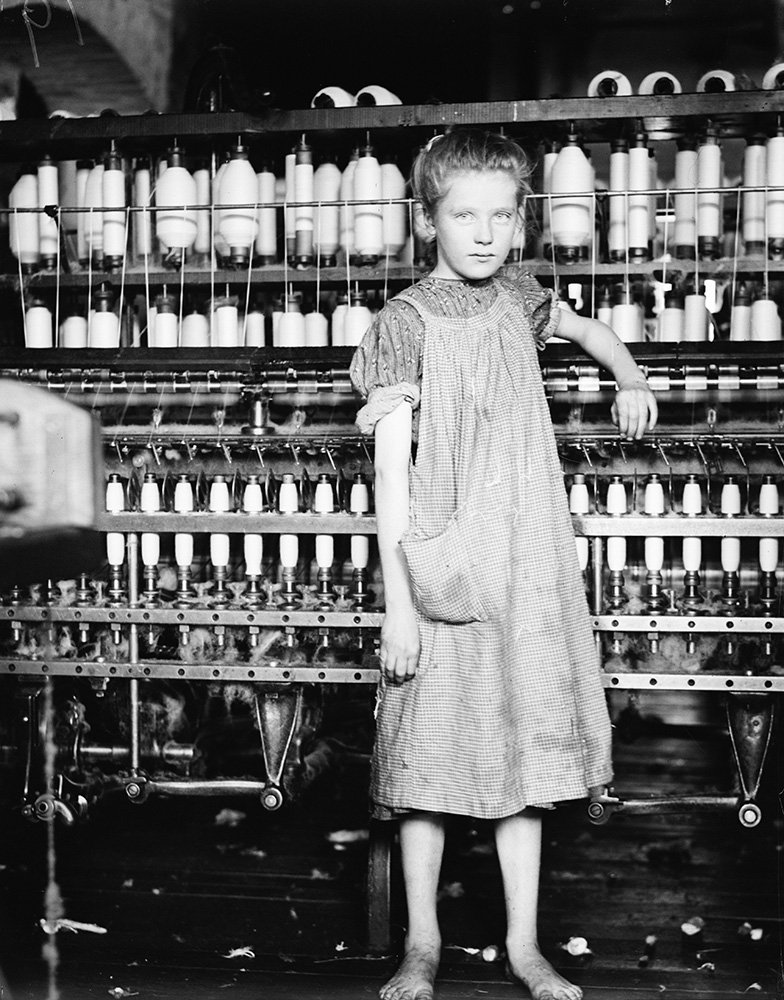 Addie Card, a young girl at work as a spinner in a Vermont cotton mill, February 1910. Children like her were desirable employees because they came cheap. By 1920, some 13 percent of textile workers were under the age of sixteen. The Fair Labor Standards Act not only made it illegal to exploit the labor of a child but also set a minimum wage for adult workers. The goal: to prevent situations in which people worked to the limit of endurance for wages that would scarcely sustain them. LOC
8. Work for Artists, Arts for America: Federal Project Number One
Is an out-of-work painter or writer so different from a jobless construction worker? Not to the pragmatic New Deal relief administrator Harry Hopkins. “Hell,” he said, “they’ve got to eat just like other people.”
The arts work-relief program Hopkins launched in 1935 under the Works Progress Administration was one of the New Deal’s most inventive. Federal Project Number One hired visual artists to create bold murals for public spaces and vivid Art Deco posters promoting everything from disease prevention to city zoos. It enlisted writers to collect narratives from former slaves and compose travel guides to diverse American locales. Theater workers staged plays and orchestras performed in venues across the country for free or at a very low admission price. Music and literacy instructors taught millions of classes.
The arts program gave critical early support to such celebrated American talents as novelist Zora Neale Hurston and actor-director Orson Welles and brought the arts to masses of Americans, expressing, in the process, the humanistic values at the heart of the New Deal. As Franklin D. Roosevelt said in 1939, “Art in America has always belonged to the people and has never been the property of an academy or a class.”
 Zora Neale Hurston at the New York Times Book Fair in 1937, the year she published her celebrated work, Their Eyes Were Watching God. From 1935 to 1937, Hurston had worked as an interviewer for the Federal Writers’ Project, gathering folklife narratives in Florida. The federal project not only sustained Hurston, already a published writer, with a paycheck, but also deeply influenced her most famous novel, which centers on the life of Janie Crawford, a rural African American Floridian in the early twentieth century. LOC
 Edward Laning (seated) and assistants at work on the mural The Role of the Immigrant in the Industrial Development of America, January 1937. Sponsored by the Federal Art Project, the mural transformed the main wall of the dining room at New York Harbor’s Ellis Island—then operating as a major immigration station—into a dramatic portrayal of the immigrant experience in America. Archives of American Art
 A poster for the Federal Theatre Project’s (FTP) production of It Can’t Happen Here at New York City’s Adelphi Theatre. The production opened a week before the 1936 presidential election in cities around the country. Critics raved and audiences were exhilarated by its message that alert citizens are critical to the defense of civil liberties. LOC
9. Social Security: A Safety Net for Americans
The passage of the Social Security Act of 1935 was one of the most hard-fought and important achievements of Franklin D. Roosevelt’s New Deal. The act established the beginnings of a social safety net for all Americans—a hedge against destitution in a newly mobile, wage-based economy in which the traditional safeguards of family and community did not suffice.
FDR had been adamant that the act’s two main provisions—Social Security and unemployment benefits—should be a form of insurance financed by workers and employers. “We put those taxes in there so as to give the contributors a legal, moral, and political right to collect their pensions and their unemployment benefits,” FDR said in 1941. The Social Security Act also created the first federal welfare for poor children (later called Aid to Families with Dependent Children, dramatically restructured in 1996) and aid for public health clinics.
FDR believed there was more to be done. In his January 1944 State of the Union speech, he proposed an “economic bill of rights” that would expand the rights of citizenship beyond traditional civil liberties such as free speech to encompass a right to necessities such as employment at a living wage, health care, housing, and education. “Individual freedom cannot exist without economic security and independence,” FDR asserted. His so-called G.I. Bill of Rights partially fulfilled this vision. Passed in June 1944, its tuition grants and subsidized loans gave millions of returning World War II veterans the chance to go to college and buy a home, farm, or business. Thanks in part to the G.I. Bill, a burgeoning American middle class would live as free people in the broader sense FDR had defined.
 Franklin D. Roosevelt signs the Social Security Act, one of the most enduring accomplishments of his presidency, on August 14, 1935. Flanking FDR are some of the people who helped make it happen: from left to right, Robert Doughton, the North Carolina congressman who introduced the bill in the House; Robert Wagner, the senator from New York who was instrumental in drafting it; Michigan congressman John Dingell, who helped pass Social Security and would go on to be the chief advocate of what many considered its logical follow-up, a national health insurance program; Secretary of Labor Frances Perkins, who headed Social Security’s drafting committee; Senator Pat Harrison, who shepherded the bill through the Senate Finance Committee as chairman; and Representative David J. Lewis, the former Maryland coal miner who sponsored the bill along with Senator Wagner. LOC
 Jobless workers sign up for unemployment benefits after the passage of the Social Security Act. Only one state had enacted unemployment insurance when the federal law passed in 1935, spurring the creation of unemployment compensation plans in all states. The plans initially covered less than two-thirds of the country’s wage and salary workers, but today nearly all these workers are eligible for jobless benefits. LOC
 A poster promoting the Social Security program, reflecting changes in 1939 that extended benefits beyond the covered worker to include a beneficiary’s dependents and survivors. This meant a new security for the American family after decades in which the death or old age of a breadwinner could split families and send dependents to the poorhouse. FDRL
10. Frances Perkins: Advocate for Working People, at FDR’s Right Hand
From a young age and for many years, Frances Perkins devoted her life to securing basic protections for all Americans who work a job: Social Security, unemployment insurance, the minimum wage, and limits on work hours, to name a few prominent examples. Franklin D. Roosevelt put her in the position to get that job done, first as newly minted New York governor by hiring her to head the state labor department, then by appointing her U.S. secretary of labor when he entered the White House in 1933.
Perkins was the first woman in American history to hold a cabinet-level appointment; she became the country’s longest-serving secretary of labor. FDR supported his outspoken and at times controversial labor chief through a number of storms, including a 1939 attempt by the House Un-American Activities Committee to impeach her. FDR believed in Perkins and shared her goals for America. Perkins in turn said she went to Washington, DC, “to work for God, FDR, and the millions of forgotten, plain common working men.”
 Frances Perkins, in a portrait taken around 1932. She was outspoken and prescient as New York’s top labor official, calling a press conference in early 1930 to announce that President Herbert Hoover was dead wrong in insisting unemployment was starting to ease; it was getting worse, she said. LOC
 Frances Perkins, U.S. secretary of labor, meets with U.S. Steel workers in Homestead, Pennsylvania, to answer questions about New Deal labor policy, 1933. The mayor of Homestead had thrown the meeting out of the town hall when Perkins insisted on admitting men he considered “undesirable Reds.” FDRL
 Frances Perkins, Franklin D. Roosevelt, and Eleanor Roosevelt on a train bound for FDR’s home-away-from-home in Warm Springs, Georgia, 1935. Perkins worked with the president closely for many years, and after his death would call FDR “the most complicated human being I ever knew.” LOC
11. Harry Hopkins: Franklin D. Roosevelt’s Closest Adviser
Harry Hopkins was a rumpled, no-nonsense social worker trained in hardscrabble working-class neighborhoods of New York City. In the opening years of the Great Depression, he ran Governor Franklin D. Roosevelt’s model relief program for the jobless of New York State, and in 1933, he followed FDR to the White House to administer the New Deal’s federal relief programs.
Hopkins, like FDR, believed that “the dole,” especially when dispensed in the shaming atmosphere that often prevailed in programs for the poor, gave the American worker bread at the expense of his or her dignity. Hopkins’s answer—to create government-sponsored jobs performing work of lasting value—found its fullest expression in the very centerpiece of the New Deal, the Works Progress Administration (WPA).
Alone among New Dealers, Hopkins also played a key part in helping FDR meet the challenge of World War II. He was the president’s emissary and closest adviser on wartime diplomacy. Underlying all these roles was Hopkins’s intense personal devotion to the president. FDR trusted him like no one else. The two became like family to each other.
 Harry Hopkins arrives in Washington, DC, on September 24, 1938, after a trip to Los Angeles to survey the results of devastating flooding in the area. Hopkins’s massive work-relief program, the Works Progress Administration, would hire workers to rebuild roads, sewers, and other infrastructure damaged in the flood. This was the crux of the work-relief approach that Hopkins pioneered: the government creating jobs for Americans who desperately needed them, doing work that would benefit American communities. LOC
 The White House wedding of Harry Hopkins to Louise Macy, July 1942. Franklin D. Roosevelt served as best man to Hopkins, who had been living at the White House. Eleanor Roosevelt would write in her My Day column, “After the wedding breakfast, everybody scattered, and I devoted the afternoon to work on my mail, as I had no appointments until five o’clock.” FDRL
 After traveling to the Casablanca Conference to meet with British prime minister Winston Churchill, Franklin D. Roosevelt celebrates his sixty-first birthday aboard an airplane with Harry Hopkins (opposite), military adviser Admiral William Leahy (at his right), and the airplane’s captain. Hopkins was FDR’s chief administrator of New Deal relief efforts, his closest wartime counselor, and a trusted friend. LOC
12. Franklin D. Roosevelt, New Yorker: The New Deal in the Empire State
While preparing to run for an unprecedented fourth term in 1944, Franklin D. Roosevelt confessed that what he really wanted was to return to private life and the place of his birth, Hyde Park, New York. “All that is within me cries out to go back to my home on the Hudson River,” he wrote with an uncharacteristic note of personal longing. He would be buried there before the year was out.
New York State was deeply marked by FDR’s life, not only because it was his home—he lived by turns in Hyde Park, New York City, and Albany—but also because it was the place where, as governor, he tested what would become his New Deal for America and found a cadre of brainy, idealistic public servants who would help him implement it in the nation’s capital.
Birthed in Depression-era New York, the New Deal in turn stimulated a great renewal in the state and especially in New York City, the recipient of fully one in seven dollars spent by the massive Works Progress Administration. America’s most populous city is today a showcase for the New Deal’s legacy, from the massive Robert F. Kennedy Bridge to LaGuardia Airport, from the thirteen-panel mural exalting American workers at the Bronx central post office to the nation’s first federally financed public housing project, First Houses, on Manhattan’s Lower East Side.
 Visitors in front of the Central Park Zoo restaurant, September 1942. In the 1930s, Works Progress Administration (WPA) workers had refurbished the zoo, along with a host of other New York City parks and cultural and infrastructural landmarks. An astounding one in seven WPA dollars was spent in the city, with famed New York City Parks Commissioner Robert Moses marshaling the federal dollars to tremendous effect. LOC
 The McCarren Park Pool in Williamsburg, Brooklyn, July 1944. One of eleven pools built across New York City by the Works Progress Administration and opened in 1936, McCarren was designed to accommodate 6,800 swimmers. It closed in 1984 but was rehabilitated and reopened to swimmers in 2012. NYC Municipal Archives
 A view of the southern end of Springwood, the house in Hyde Park, New York, where Franklin D. Roosevelt was born and raised and to which he returned throughout his life. He chose to build his presidential library and museum on the property not far from the house. The Springwood estate is also FDR’s burial place. FDRL
13. African Americans and the New Deal: A Historic Realignment in American Politics
In the 1920s and early 1930s, the Democratic Party had yet to break from a long association with white supremacy and its various tools—whites-only primaries, Jim Crow laws imposing racial segregation, the Ku Klux Klan. African Americans, unsurprisingly, voted Republican. But in his reelection of 1936, Franklin D. Roosevelt won 71 percent of the black vote in a historic political realignment whose legacy persists today—testament to the change New Dealers brought to Washington, DC, and to the Democratic Party.
FDR was the first president to invite African Americans to the speaker’s podium at the Democratic Convention and to perform at the White House. He appointed dozens of African Americans to administrative posts. Eleanor Roosevelt stood out as the first presidential wife to work for racial justice hand in hand with civil rights groups such as the National Association for the Advancement of Colored People. As for the New Deal, African Americans responded to FDR’s populist, pragmatic concern for ordinary Americans when they began to see evidence that it included them. Though it cannot be said that the New Deal treated black Americans equally—programs were often segregated and blacks concentrated in lower-paying jobs, for example—they, too, would see their communities rebuilt and modernized, find opportunities to create and enjoy art, and go to work in the government-sponsored jobs that sustained millions of American families in desperately hard times.
 Enrollees in one of the New Deal’s first jobs programs, the Civilian Conservation Corps (CCC), study radio code at a camp in Kane, Pennsylvania, 1933. The CCC hired black workers but assigned them to segregated camps. FDRL
 African American girls learn tennis in a recreational program of the National Youth Administration (NYA), 1936. With civil rights champion Aubrey Williams as its head and African American educator Mary McLeod Bethune its director of African American affairs, the NYA launched a special program in 1937 focusing on job-skills training for black youth. FDRL
 First Lady Eleanor Roosevelt broadcasting for a program, “My People,” on WOL, a black radio station in Washington, DC, 1943. A committed proponent of racial justice, ER made frequent contact with black Americans—she met with African American leaders, visited black communities, and endorsed black-led projects and campaigns in her columns and speeches. She also brought African American leaders to the White House and helped them get the ear of the president.
14. Marian Anderson at the Lincoln Memorial: A Great Singer Makes Civil Rights History
In 1939, when the conservative Daughters of the American Revolution (DAR) refused to let the world-famous singer Marian Anderson perform in the group’s concert hall in Washington, DC, simply because she was black, people of the nation’s capital rose up against America’s long tradition of racial segregation. First Lady Eleanor Roosevelt, with the support of her husband, became their most influential champion, canceling her membership in the DAR to clasp hands with the National Association for the Advancement of Colored People and other antisegregationists.
Anderson’s supporters found an even more exalted venue for her performance than the DAR’s Constitution Hall—the Lincoln Memorial. On Easter Sunday 1939, standing before the memorial’s famous statue of a seated Abraham Lincoln, the Great Emancipator, and facing a vast, racially mixed audience, Anderson was nearly overcome with nerves. But the words of her opening selection floated over the crowd clear and full of feeling: “My country, ’tis of thee, sweet land of liberty…”
 A view from the Lincoln Memorial, with the Reflecting Pool and Washington Monument in the distance, as Marian Anderson performs to an estimated seventy-five thousand people of all races. The dramatic, long-awaited concert took place on April 9, 1939—Easter Sunday. LOC
 Eleanor Roosevelt’s February 26, 1939, resignation letter to the Daughters of the American Revolution (DAR). Although ER had never been an enthusiastic member of the DAR, she took a big political risk quitting the group so publicly and associating herself and, by extension, the presidency with the cause of racial justice and integration. She would write in her My Day column on February 27 that she had debated the move, usually preferring to work for change within an organization, but had decided that in this high-profile case, to remain a member would imply her approval of an action she strongly opposed. FDRL
 Marian Anderson in 1939. Anderson was not an activist by experience or inclination, but a creative genius wholly committed to her music. The New York Tribune called her “an artist of extraordinary devotion, intensity, and self-effacement.” FDRL
15. Women and the New Deal: Gaining Ground in Politics and Public Life
When Franklin D. Roosevelt was elected governor of New York in 1929, his predecessor Al Smith observed that men might readily take advice from a woman— but not orders. FDR hired Frances Perkins to head his state labor department anyway. “I’ve got more nerve about women and their status in the world than Al has,” he said with a chuckle.
Indeed, as president, FDR enlisted a diverse cadre of activist women (including Perkins) to serve as key figures in building the Democratic Party and shaping the New Deal. Female New Dealers embraced the administration’s initiatives to empower ordinary working Americans while pushing always for greater recognition of women’s needs in work-relief programs for the jobless, Social Security benefits, and labor-rights legislation.
In a time when women were largely confined to the lowest-paying jobs, New Deal laws establishing the right to unionize and a minimum wage helped many earn a living wage. Though not in the same proportion as men, needy women got jobs created by the ambitious Works Progress Administration, from teaching art classes to weaving rugs. American women, who only in 1920 had gained the right to vote, emerged from the 1930s with a far more prominent role in public life, and ready to go to work in unprecedented numbers to arm their nation for war.
 Social Security Board member Molly Dewson, left, with Secretary of Labor Frances Perkins, January 22, 1938. Dewson, an astute Democratic Party operative whom Franklin D. Roosevelt nicknamed “the little general,” had lobbied FDR to appoint Perkins as the first woman ever to hold a cabinet post. LOC
 An African American domestic worker feeds a child in her charge in Atlanta, Georgia, 1939. Household workers often labored long hours for low pay in relative isolation. Their exclusion from many of the New Deal’s worker benefits, from Social Security to the minimum wage, was a serious shortcoming that disproportionately affected black women. Social Security was extended to these workers in 1954. In 1974, domestics came under the minimum-wage and overtime rules first established in the Fair Labor Standards Act of 1938. LOC
 Mary Ankrom, mother of six, works on a locomotive at the engine house of the Pennsylvania Railroad in Pitcairn, Pennsylvania, May 1943. While New Deal laws of the 1930s establishing a minimum wage and the right to unionize especially helped women in low-paying industries like garment manufacturing, the war years saw sharply increased demand for women’s labor and produced better-paying jobs. Ankrom made fifty-eight cents an hour, nearly twice the minimum wage. LOC
16. A New Kind of First Lady: Eleanor Roosevelt in the White House
In her 1961 autobiography, Eleanor Roosevelt wrote that she had been a solemn, shy child. “Looking back,” she observed, “I can see that I was always afraid of something: of the dark, of displeasing people, of failure.” Yet when ER entered the White House as First Lady in 1933, she had emerged as a woman ready to project her singular voice and unerringly progressive values to every corner of the nation.
As First Lady, ER held press conferences, wrote prolifically for publication, gave speeches, traveled and visited with citizens in their homes, and read and answered a copious stream of letters. In a manner as practical as it was insistent, ER pressed for racial integration, gender equity, human rights around the world, and government programs that would lift people out of poverty, support contemporary art, and give America’s elderly and jobless a modicum of security. It seemed to many that a deep well of compassion inspired ER’s courage. Polls at the time of her death in 1962 revealed the former First Lady to be one of the most admired women in the world.
 Eleanor Roosevelt at the White House, early 1930s. Although she did not relish the role of hostess, ER did enjoy opening the White House to new groups, from public school students in Washington, DC, to female journalists to the African American contralto Marian Anderson. LOC
 In Depression-era Scotts Run, West Virginia, this sooty coal mine tipple was the children’s favorite playground. Eleanor Roosevelt visited with the area’s impoverished coal-mining families in 1933 and was instrumental in establishing a controversial model community for them. She would attend the community’s high school graduations year after year. LOC
 Eleanor Roosevelt in New Caledonia with Army General M. F. Harmon and the U.S. Navy’s Admiral William Halsey Jr., commanders in the South Pacific Area theater of war. ER was there to visit military hospitals, and wrote feelingly in her column about the wounded “boys” from back home and what they had to say to their First Lady. “As we traveled from place to place in New Caledonia,” she wrote, “we passed many trucks loaded with men from every branch of the service, both white and colored. I tried to wave to them and say hello, and was much amused to hear behind me on occasion, ‘Hello Eleanor!’“ National Archives
17. Running for President: Franklin D. Roosevelt as Campaigner in Chief
Unlike many of the world’s leaders during the global crises of the 1930s and 1940s, Franklin D. Roosevelt assumed and retained his office by asking Americans, every four years without fail, to vote for him. The legitimacy conferred by America’s rough-and-tumble campaign seasons and orderly elections was especially important at a time when authoritarianism was taking root around the world—and for an American president who served longer than any other before or since.
FDR ran for president four times. Twice, in 1932 and 1936, he won by historic landslides. In 1940 and 1944, he racked up impressive absolute majorities in the popular vote. FDR was a political fighter, a people charmer, and an optimist in the gloomiest of circumstances—all assets on the campaign trail. But the truth is these qualities only made FDR more objectionable to those who disagreed with his policies. Americans put FDR in the Oval Office for twelve years (his last term cut short by his death in 1945), first because most supported the bold domestic program he introduced with the New Deal and, later, because they trusted him to lead the country through World War II.
 Franklin D. Roosevelt speaking from a platform during an early political campaign, his failed run for the vice presidency, 1920. FDR was by nature personable, energetic, and positive—all major assets on the campaign trail. LOC
 A campaign button for 1936 heralding “Four More Lucky Years” with Franklin D. Roosevelt as president. The slogan emphasized the sense of hope Americans felt as the energetic New Dealers revolutionized the country and their programs brought jobs and signs of progress. As for FDR, he had his own good-luck charms—a lucky fedora he wore on the campaign trail, and his lucky dish, scrambled eggs, traditionally enjoyed while awaiting election returns. FDRL
 Franklin D. Roosevelt campaigns for reelection at Chicago’s Soldier’s Field, October 28, 1944. In his last campaign, FDR actively contradicted rumors that he was deathly ill. In fact, he had less than six months to live, but was single-mindedly focused on bringing World War II to a victorious finish. FDRL
18. Is It Constitutional?: The New Deal and the Supreme Court
Franklin D. Roosevelt felt strongly that government could regulate the economy with commonsense measures to protect Americans’ interests as citizens of a proud democracy and not mere “industrial cannon fodder.” But the Supreme Court of the 1930s did not agree. For decades, the court had treated private enterprise as all but immune to federal oversight, rejecting federal limits on the exploitation of child labor and state minimum-wage laws, to say nothing of the industry-wide wage and price codes authorized by the New Deal’s 1933 National Industrial Recovery Act or the farmer subsidies to curtail production set forth in the Agricultural Adjustment Act of the same year. The court struck down both these hallmark New Deal laws, among numerous others.
Indeed, by the election of 1936, which carried FDR and his party to an overwhelming victory, the Supreme Court seemed ready to read the Constitution as an absolute bar against New Deal policies. In 1937, a frustrated FDR made a move that, ironically, would prove one of the most unpopular of his presidency. His proposal to restructure the highest court in the land for essentially political purposes met with stiff opposition and died in Congress. But that same year, the Supreme Court’s jurisprudence underwent a historic—and timely—shift. Jurists began to uphold New Deal laws, allowing the federal government to set a federal minimum wage, ban child labor, establish Social Security, and guarantee workers’ right to unionize.
 Two girls in New York City wear banners saying, in English and Yiddish, “Abolish Child Slavery!” in a photo likely taken during a labor parade on May 1, 1909. Workers did not perceive a friend in the Supreme Court of the early twentieth century. The court struck down a federal child labor law in 1918 and a District of Columbia minimum wage for women and children in 1923. LOC
 The Supreme Court as it was constituted when Franklin D. Roosevelt came to office in 1933 and introduced the New Deal. Left to right: Owen Roberts, Pierce Butler, Louis Brandeis, Willis Van Devanter, Chief Justice Evans Hughes, George Sutherland, Harlan Fiske Stone, and Benjamin Cardozo (not pictured is James McReynolds). FDR’s first appointment did not come until August 1937 when he named Hugo Black to the court. Smithsonian Institution
 Charles E. Wyzanski Jr., a young Department of Justice attorney, leaves the Supreme Court building on May 24, 1937, after scoring a historic victory for the New Deal: a high court ruling affirming the Social Security Act of 1935. LOC
19. The New Deal Democrats: Franklin D. Roosevelt and the Democratic Party
In the dreary Depression year 1932, Franklin D. Roosevelt’s appeal as the candidate of change and action helped him become the first Democrat in eighty years to win an absolute majority of the popular vote—and to establish Democratic majorities in virtually every region of the country. FDR’s New Deal and the 1936 landslide reelection that followed its introduction consolidated this historic shift in voting patterns.
FDR broadened the Democratic Party, pulling together a coalition that included labor unions and progressive farmers, the big city machines of the North along with the traditionally Democratic South. FDR’s candidacy energized Jewish and Catholic voters, and he brought African Americans into the party for the first time. This New Deal coalition—joined around the basic idea that government can take an active part in protecting Americans from destitution, economic exploitation, and the denial of opportunity based on prejudice—dominated American political life through the 1960s.
 Franklin D. Roosevelt with Democratic Party official James Farley, 1935 or 1936. After securing the party’s nomination for president in July 1932, FDR the candidate had made Farley—his campaign manager—chairman of the Democratic National Committee. Farley would head the National Committee throughout the 1930s and play an important part in strengthening the party and winning elections for FDR. LOC
 In the Democratic Party’s campaign for 1936, two women present a display illustrating the abundance of 1936 compared with the painfully lean year of 1932. The New Deal Franklin D. Roosevelt had rolled out in the four intervening years was popular with the public, helping FDR win by a landslide in 1936 and consolidate the party’s base, which now included the great majority of working people. FDRL
 An Italian American billboard for Franklin D. Roosevelt’s reelection in 1940. FDR had cobbled together a Democratic coalition that brought together traditional Democrats—immigrant communities of the Northeast, for example—with new Democrats, including African Americans, western progressives who had voted Republican, and newly enfranchised women. FDRL
20. Chief Executive: Franklin D. Roosevelt, Congress, and the Presidency
Franklin D. Roosevelt took an extraordinarily active approach to working with Congress. He introduced much important legislation, exercised the presidential veto with unprecedented frequency, and often went straight to the American people to raise support for his initiatives in Congress.
In the first years of his administration, with Congress eager to attack the suffering of the Great Depression, FDR’s approach yielded a program that changed the role of government in American life: the New Deal. After conservative Democrats split from the president’s coalition in 1938 and helped put the brakes on his domestic program, FDR nevertheless won Congress’s persistent backing as commander in chief during World War II. The active way FDR led as president—admired by many, criticized as egotistical by others—elevated the office itself, making the White House a more prominent institution in American government and the president a more salient symbol of the United States, at home and around the world.
 Franklin D. Roosevelt addresses Congress, 1933. When he assumed the presidency, FDR found a Congress eager to work with him to ameliorate the country’s desperate economic condition. “The admirable trait in Roosevelt,” said one supporter in the Senate, “is that he has the guts to try.” Congress passed sixteen major bills in FDR’s first one hundred days in office. LOC
 Franklin D. Roosevelt addresses the nation in a fireside chat to propose a recovery plan in the midst of a sharp economic downturn, October 12, 1937. “Sometimes,” the president said, “I get bored sitting in Washington hearing certain people talk and talk about all that Government ought not to do—people who got all they wanted from Government back in the days when the financial institutions and the railroads were being bailed out in 1933, bailed out by the Government.” The following spring, the president would win congressional approval for a large stimulus package including billions in work relief and public construction. LOC
 A poster rallying voters to elect Franklin D. Roosevelt—“Our Friend”—to a fourth term in 1944. The longest-serving president in American history, FDR elevated the office itself, making the president both a symbol of America and, frequently, a source of major policy initiatives. The poster is by the artist Ben Shahn, for the political arm of the Congress of Industrial Organizations, a labor organization. Ben Shahn
21. Talking to the People: FDR, Radio, and the Press
Franklin D. Roosevelt was good at talking to people. That was how he gathered information on the many subjects he had to master as president, and it was how he conveyed both his policies and the spirit of his leadership to the American people.
FDR mastered the popular new media of the day—radio especially, but also film in the form of newsreels shown in movie theaters—to project his confidence and warmth to communities across the nation. Millions tuned in to his radio “fireside chats,” a shared ritual that brought Americans together in bewildering times and set a precedent for presidents addressing them directly.
In addition, though a majority of newspaper publishers and editors did not support the New Deal, FDR’s response—one future leaders would emulate—was not to withdraw but on the contrary to circumvent intermediaries wherever possible, inviting reporters to twice-weekly press conferences and abolishing a requirement that they submit questions in advance. FDR was the first president to establish such a strong personal media presence, creating the image of a leader at once quite human and larger than life.
 Franklin D. Roosevelt at a shipboard press conference at Port of Spain, Trinidad, during his goodwill cruise to South America, December 11, 1936. FDR made himself highly accessible to the media, a way of establishing the presidency as a key clearinghouse of information. It also encouraged fair, thorough coverage of his administration. FDRL
 This cartoon by Fred Seibel appeared in the Richmond Times-Dispatch on March 23, 1933, just weeks after Franklin D. Roosevelt’s first inauguration. Whether approving or critical of his policies, depictions of FDR tended to show him as a vigorous figure. In Seibel’s drawing, a nondisabled FDR strides forth to address the troubles of the day, wearing his characteristic smile. FDRL
 Franklin D. Roosevelt delivers a radio greeting to the Boy Scouts of America—and to the country—on February 7, 1938. FDR created a sense of intimacy in his broadcast addresses that joined Americans to one another. Here, he urged scouts to learn “all about other people—your neighbors and their problems, the people who live in the other end of town and their problems, the people who live in the next town and their problems, those who live in the next State and their problems—in other words, the problems of every part of the United States.” LOC
Download PDFs
Download the in-depth history as a pdf to print, save, and share.
1.FDR’s New Deal: The Domestic Program That Remade America
2.The Banking Crisis: Ordeal of a Nation, Test for a New President
3.A New Deal for Farmers: Franklin D. Roosevelt and Rural America
4.Lights Across the Countryside: The Tennessee Valley Authority
5.Franklin D. Roosevelt, Conservationist: An Early Initiative in Sustainability
6.Putting People to Work: Job Creation and Work Relief in the New Deal
7.A Friend of Labor: Franklin D. Roosevelt and Worker Rights
8.Work for Artists, Arts for America: Federal Project Number One
9.Social Security: A Safety Net for Americans
10.Frances Perkins: Advocate for Working People, at Franklin D. Roosevelt’s Right Hand
11.Harry Hopkins: Franklin D. Roosevelt’s Closest Adviser
12.Franklin D. Roosevelt, New Yorker: The New Deal in the Empire State
13.African Americans and the New Deal: A Historic Realignment in American Politics
14.Marian Anderson at the Lincoln Memorial: A Great Singer Makes Civil Rights History
15.Women and the New Deal: Gaining Ground in Politics and Public Life
16.A New Kind of First Lady: Eleanor Roosevelt in the White House
17.Running for President: Franklin D. Roosevelt as Campaigner in Chief
18.Is It Constitutional?: The New Deal and the Supreme Court
19.The New Deal Democrats: Franklin D. Roosevelt and the Democratic Party
20.Chief Executive: Franklin D. Roosevelt, Congress, and the Presidency
21.Talking to the People: FDR, Radio, and the Press
II. Hope, Recovery, Reform:
The Great Depression &
FDR’s New Deal
1933 – 1939
Hope, Recovery, Reform includes twenty-one chapters on
events of the 1930s, from how the New Deal put Americans
back to work to FDR’s groundbreaking media presence.
click the “In Brief” button at upper right.
click the chapter arrow at lower left.
1. FDR’s New Deal:
The Domestic Program
That Remade America
It was a cold, bleak day in the nation’s capital when Franklin D. Roosevelt placed his left hand on a three-hundred-year-old family Bible and, after closing the oath of office with the words “so help me God,” gripped the podium and prepared to address the American people for the first time as their president.
Many of the faces looking back at FDR wore a “terror-stricken look,” as incoming secretary of labor Frances Perkins would recall. On March 4, 1933, the Great Depression was at its appalling nadir.
But as FDR promised “action and action now,” people in the crowd began to stomp their feet in enthusiastic assent. When he proclaimed that “our greatest primary task is to put people to work” and assured the audience his administration would treat the economic crisis “as we would treat the emergency of a war,” some onlookers wept with relief. After the speech, nearly half a million Americans wrote FDR to wish him success in the great effort ahead.
The New Deal was first and foremost a response to the calamity of the Depression. But over the course of a decade, it came to encompass a multifaceted domestic policy that transformed the role of the federal government, improved the lives of countless Americans immediately and for generations to come, and marked the American landscape with an array of new public features, from swimming pools to hydroelectric dams.
The first one hundred days
In the first hundred days of his administration, FDR had the political winds at his back; a hopeful nation and Democratically controlled Congress pledged their support. In turn, FDR and his team brought enormous vigor and drive to these first days in the White House. They worked day and night forging solutions that were muscular, pragmatic, myriad, and largely untried.
The day after his inauguration, FDR closed the nation’s banks to halt a disastrous bank panic, and he set advisors working on a bill to reopen solvent institutions. Three days after inauguration, he had dozens of farmers boarding late-night trains to Washington, DC, to advise him on a bill to buoy sagging farm incomes. The approach: pay farmers to reduce plantings of certain crops, curbing the oversupply that had driven down prices. The bill, passed in May, was “in the nature of an experiment,” FDR told the press. “If the darn thing doesn’t work, we can say so quite frankly, but at least try it.”
The same day FDR signed the farm bill, he approved an ambitious program of federal grants for cash relief of the destitute jobless—the first of its kind. Its administrator would be the social worker Harry Hopkins. Within two hours, working in a crowded hallway, Hopkins gave out more than $5 million in grants to state agencies; he urged governors to wire their requests immediately. To those who criticized his haste, Hopkins replied dryly, “People don’t eat in the long run. They eat every day.”
Together, in their first one hundred days, FDR and his team racked up a record unmatched by any administration before or since, winning passage for sixteen major pieces of legislation.
The Second New Deal
The work continued in what many have called the Second New Deal of 1935. In some cases, this entailed midcourse adjustments to earlier approaches. By 1935, for example, the administration had labored to help the unemployed and lift the economy through large-scale public-works projects, on the one hand, and cash relief on the other. But one of its most popular ventures had been the temporary Civil Works Administration, which helped the unemployed by giving them jobs. In May 1935, FDR built on this model by creating the Works Progress Administration (WPA). The largest program of the New Deal and one of its most successful, the WPA gave millions of people a desperately needed wage and built useful new facilities in nearly every American community.
The Second New Deal also saw passage of the Social Security Act establishing federal retirement benefits, unemployment insurance, and the first federal welfare program for the poor—all ways to not only gird individual Americans against future hard times, but also protect the economy from the drastic reductions in consumption that occur when the people find themselves penniless.
FDR won the election of 1936 in a historic landslide; a mere eight electoral votes (those of Maine and Vermont) went to his opponent. The people had thunderously affirmed their support for the New Deal.
New challenges
The year 1937 brought a loss of momentum. FDR, thinking the worst was past, had cut back on government spending. The so-called Roosevelt recession followed. Meanwhile, FDR’s unpopular postelection proposal to appoint additional Supreme Court justices—a bald attempt to override a court that had proved hostile to New Deal policies—split the Democratic Party and emboldened Republican opponents.
Though New Deal lawmaking slowed, in ‘37 and ‘38 the administration nevertheless pushed through legislation to promote the construction of public housing, offer loans to tenant farmers, and establish a federal minimum wage.
Looking back and ahead
Some programs worked better than others. Despite government refinancing and delayed foreclosures, for example, the farm foreclosure crisis continued unabated until World War II. Assessing the New Deal in 1938, FDR frankly admitted that insufficient knowledge and the need to experiment had led to inconsistencies of method.
But one thing is certain: by the end of the ‘30s, the United States was no longer a nation prostrated by fear and despair. Americans had gone to work by the millions to feed their families, create new social institutions, and build the national infrastructure. They knew their own strength.
The New Deal left the country far better equipped to face the next calamity—World War II—and set the stage for the G.I. Bill, a tide of postwar prosperity, and the broadest middle class the world had ever seen.

An Accompanying Historical Resource For Franklin D. Roosevelt Four Freedoms Park


