I. Becoming a Leader
FDR Before the Presidency
1882 – 1933
1.Franklin D. Roosevelt’s Models: Theodore Roosevelt and Woodrow Wilson2.An Uncommon Partnership: Franklin D. and Eleanor Roosevelt
3.Polio and Paralysis: Franklin D. Roosevelt’s Disability
4.Governing New York: Laboratory for the New Deal, Platform for FDR
5.America at the Crossroads: The Election of 1932
6.The Long Transition: From Election Day to Inauguration Day
 Download PDFs
I. Becoming a Leader
FDR Before the Presidency
1882 – 1933
1.Franklin D. Roosevelt’s Models: Theodore Roosevelt and Woodrow Wilson
2.An Uncommon Partnership: Franklin D. and Eleanor Roosevelt
3.Polio and Paralysis: Franklin D. Roosevelt’s Disability
4.Governing New York: Laboratory for the New Deal, Platform for FDR
5.America at the Crossroads: The Election of 1932
6.The Long Transition: From Election Day to Inauguration Day
Download PDFs
1. Franklin D. Roosevelt’s Models: Theodore Roosevelt and Woodrow Wilson
Franklin D. Roosevelt knew he wanted to be president well before he ran for his first political office—New York State senator—at the age of twenty-nine. He assiduously cultivated both the credentials and the qualities he thought he needed to succeed in public life, and there were two men who served as important role models for him.
One was his fifth cousin Theodore Roosevelt, who, old enough to be FDR’s father, entered the White House not long after FDR began college at Harvard. FDR admired TR’s forceful personality and reformist politics, and emulated his career trajectory from Harvard to the U.S. Navy to the governorship of New York and on to the presidency.
FDR’s other model was Democrat Woodrow Wilson. FDR campaigned for his 1912 election as president and served under him as assistant secretary of the navy. He shared Wilson’s aspiration to bring the United States into engagement with the world through an international peace organization—and learned a valuable lesson from Wilson’s failure to build support for the fledgling League of Nations in Congress and among the American public.
 President Theodore Roosevelt in Yellowstone National Park, created in 1872, the first national park in the world, 1903. TR expanded national parks and wildlife refuges. His distant cousin, Franklin D. Roosevelt, followed his example some thirty years later. LOC
 A poster illustrating the 1912 presidential campaign, which featured Theodore Roosevelt (left) on the Progressive ticket, Democratic candidate Woodrow Wilson (center), and incumbent William Howard Taft, a Republican. TR split the Republican vote and helped Wilson win election. As for the young New York state senator Franklin D. Roosevelt, he adored his relative TR but campaigned vigorously for Wilson—and received an appointment in his new administration. LOC
 President Woodrow Wilson at his desk with his wife, Edith Bolling Galt Wilson, at his side, June 1920. Wilson had suffered a massive stroke in October, for all practical purposes bringing to an end his campaign for United States support of the planned League of Nations. Franklin D. Roosevelt, Wilson’s assistant secretary of the navy, shared the president’s enthusiasm for the international peacekeeping body and learned much from Wilson’s mistakes. LOC
2. An Uncommon Partnership: Franklin D. and Eleanor Roosevelt
The relationship of Franklin D. Roosevelt and Eleanor Roosevelt began as the courtship of two young people raised in the same elite New York social circle. Over the next four decades, it became something far more unusual. Married in 1905, the couple’s bond withstood the loss of an infant son in 1909, ER’s discovery in 1918 of FDR’s infidelity, FDR’s permanently disabling bout of polio in 1921, and the rigors of a political career that began in the New York State Senate and ended with twelve years in the White House.
During the 1920s, each came to embrace a degree of independence in their marriage that was unusual in their time and might be considered unorthodox even today. While ER continued to perform the duties of a political wife, the pair increasingly spent time apart pursuing separate projects and friendships. By the time they reached the White House in 1933, though, it was clear they both had the instinct for action in those troubled times—that both possessed the drive, as well as the gifts, to lead in their different roles. Theirs was a political partnership based on mutual respect, and marked also by love.
 Eleanor Roosevelt in her wedding dress, 1905. ER’s uncle, President Theodore Roosevelt, gave the bride away at her New York City wedding to Franklin D. Roosevelt, also a distant relation. The couple would honeymoon in Europe and receive as a gift from FDR’s mother, Sara, a townhouse adjoining her own on East Sixty-Fifth Street in Manhattan. FDRL
 Franklin D. Roosevelt, Eleanor Roosevelt, their five children, and FDR’s mother, Sara, in a family portrait taken in Washington, DC, June 1919. Their family was now complete, and FDR’s career established. FDRL
 Franklin D. Roosevelt and Eleanor Roosevelt aboard a campaign train during FDR’s 1932 run for the presidency. Though born to privilege, the two had endured their share of trials, from the loss of a child to marital infidelity to FDR’s paralyzing bout with polio. Their bond was no longer romantic, but what they did share—enormous drive, curiosity, open-mindedness, and the will to make a difference in the world—formed the basis of a political partnership that endured forty years. FDRL
3. Polio and Paralysis: Franklin D. Roosevelt’s Disability
In the summer of 1921, Franklin D. Roosevelt, a charismatic, athletic, and successful thirty-nine-year-old, was stricken with a painful illness that left his legs permanently paralyzed. It would have been customary for him to live out his years at home as a wealthy invalid. In his battle to instead regain his health and spirits and resume his trajectory in public life, FDR displayed the seemingly inborn fortitude that, in years to come, would help America overcome towering obstacles. Yet people who knew FDR said the struggle also changed him. “The man emerged completely warm-hearted, with a new humility of spirit,” his secretary of state, Frances Perkins, would recall.
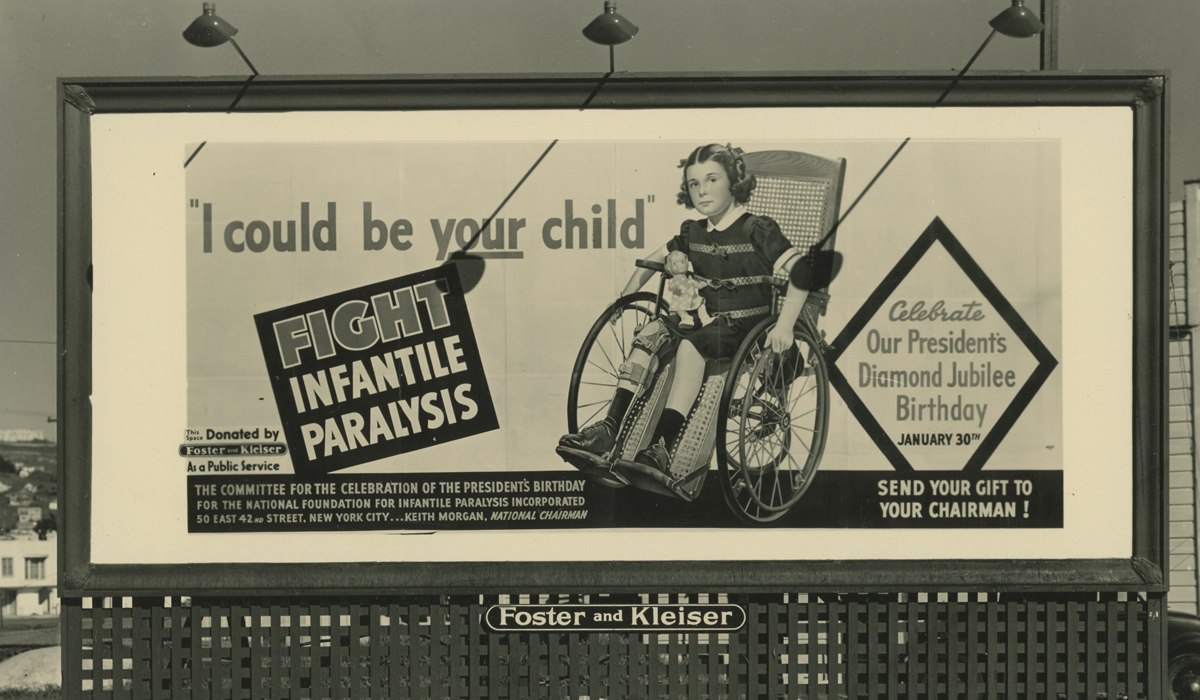
FDR created the New Deal and led America through World War II while contending with a serious disability. In a time when being called “crippled” was a kind of erasure, he concealed the extent of this disability from the public. Yet he also devoted himself very publicly to fighting polio and helping others disabled by it, explicitly identifying himself with people in wheelchairs. FDR’s example remains powerful today: a man who could not stand or walk unassisted was one of the world’s most dynamic and influential leaders.
 Franklin D. Roosevelt receiving physical therapy in an indoor pool, Warm Springs, Georgia, 1928. FDRL
 Franklin D. Roosevelt visits The Pines, formally known as West Virginia Foundation for Crippled Children, May 12, 1935. Though the president made some effort to conceal the extent of his own disability in public, he did not distance himself from others with disabilities. On the contrary, he made a point of reaching out to them directly, and identified himself with them by giving his energies and powerful name to the fight against polio. FDRL
 Franklin D. Roosevelt, with the help of an aide and a cane, makes his way forward to address a dedication ceremony at the birthplace of Woodrow Wilson in Staunton, Virginia, May 4, 1941. Speaking of the war the United States would soon join, FDR assured his audience that the ideals of freedom would triumph over the sword. “Physical strength,” he said, “can never permanently withstand the impact of spiritual force.” FDRL
4. Governing New York: Laboratory for the New Deal, Platform for FDR
After spending his forties out of office recovering from polio and adapting to the disability it caused, Franklin D. Roosevelt became governor of New York just before turning forty-seven in January 1929. At fifty, he would be elected president of the United States.
FDR’s home state served as a testing ground for New Deal initiatives; there, he introduced state old-age pensions, a model relief program for jobless New Yorkers, and an initiative to harness the Saint Lawrence River to produce public power. Many of the people FDR hired to implement state programs and advise him as governor—labor chief Frances Perkins, relief administrator Harry Hopkins—would join him in Washington, DC, and become architects of the New Deal. In the governorship, FDR also developed the direct approach to the public through radio addresses and frequent appearances that would prove so effective in the White House.
Indeed, as FDR’s governance segued into his 1932 campaign for the presidency, he increasingly communicated on a national stage. Governor FDR criticized President Herbert Hoover’s hands-off approach to the nation’s economic ills as ineffectual and inhumane, shaping his own vision of a government that would act “along definitely constructive, not passive lines” for the people’s good.
 Franklin D. Roosevelt nominating Al Smith for president, June 1928. After the convention, FDR would return to Warm Springs, Georgia, feeling he needed more time to regain his strength and mobility after being paralyzed by polio in 1921. But party leaders would soon persuade him to run for governor. FDRL
 Franklin D. Roosevelt reads election returns in an afternoon paper at his campaign headquarters in New York City’s Biltmore Hotel, November 1930. The election, in which FDR won a second term as governor, was the first Roosevelt landslide, reflecting the public’s enthusiasm for his progressive policies—and FDR’s own skill as a campaign strategist. FDRL
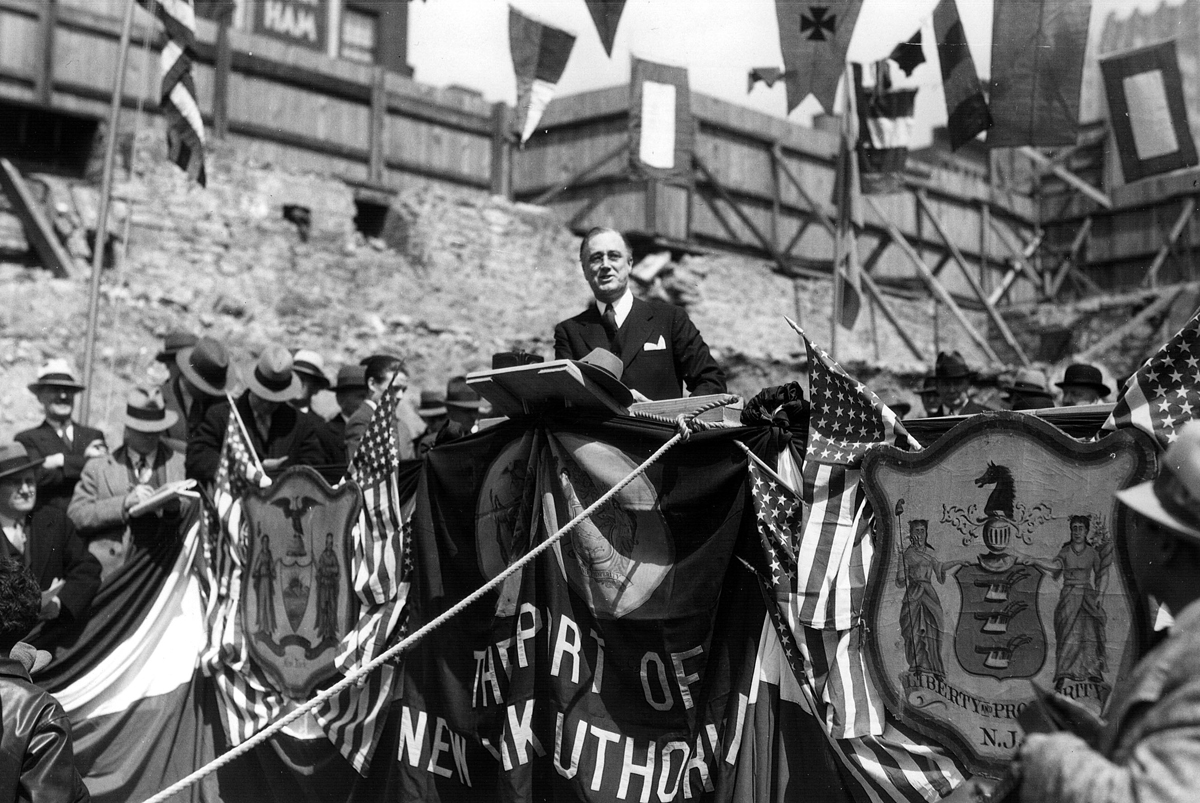 Governor Franklin D. Roosevelt dedicates a New York Port Authority freight terminal in Manhattan, April 30, 1931. FDR was gaining attention as an advocate for unemployment insurance and a federal old-age pension plan. He also had assailed President Herbert Hoover’s “Pollyanna attitude” toward the worsening economic depression—a point that struck a chord with many Americans—and would soon launch a model program of relief (including work relief) for unemployed New Yorkers. FDRL
5. America at the Crossroads: The Election of 1932
The year 1932 was a fractious and perilous time in America. The nation was in the grip of the worst economic crisis in its history, and no one knew for sure what could be done to set things right. Americans did understand that they faced a fork in the road: they could reelect Herbert Hoover and stay with a relatively conservative course of nonintervention in the economy, or they could go with Franklin D. Roosevelt’s “New Deal” for America. Voters didn’t yet know all the details of the plan—neither did FDR—but its ethos seemed to come through in a campaign that was dynamic, defied tradition, and unfolded to the strains of an exuberant theme song, “Happy Days Are Here Again.” In the end, 57.4 percent of voters and forty-two of forty-eight states went for FDR.
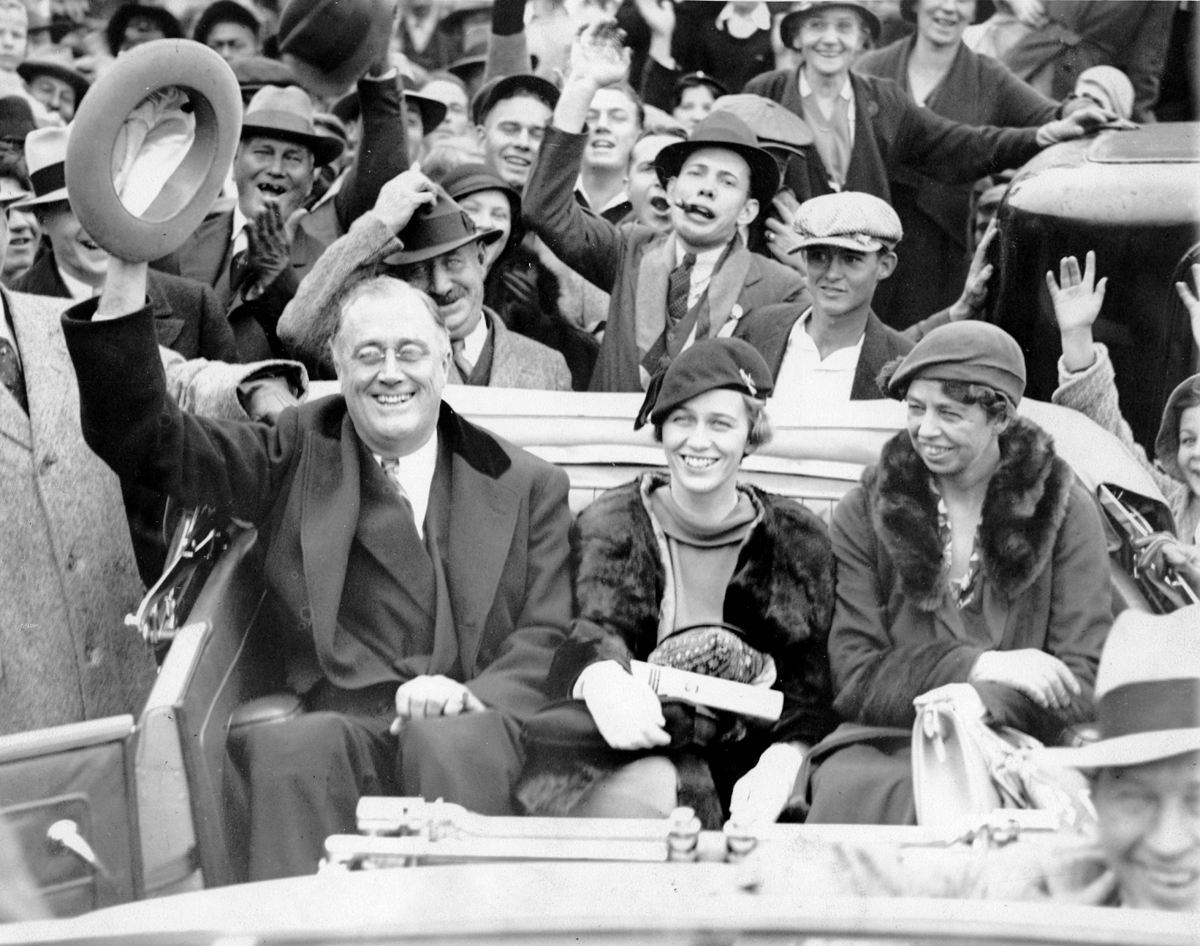
 Franklin D. Roosevelt campaigns for the presidency in 1932. Traveling in an open car allowed FDR to speak with people and project his active, smiling presence even though polio had left him unable to walk or stand without assistance. FDRL
 Shopfronts in Worcester, Massachusetts, below a banner urging voters to choose Franklin D. Roosevelt in the upcoming state primary. FDR would approach the midsummer Democratic Convention with a commanding lead in delegates. His weakness was among New England progressives. FDRL
 Franklin D. Roosevelt campaigns in Topeka, Kansas, a little more than two months after accepting his party’s nomination in Chicago. FDR had proposed actions to ease the widespread suffering of the Depression: bring down mortgage rates, prevent foreclosures, reduce farm surpluses, regulate the stock and bond markets, repeal Prohibition, cut the federal payroll by 25 percent, and provide relief for the needy unemployed. FDRL
6. The Long Transition: From Election Day to Inauguration Day
The presidential election of November 1932 was a landslide for Franklin D. Roosevelt. But FDR’s inauguration would not take place until March 4, 1933. Americans eager for fresh leadership would have to wait four agonizing months, as the nation’s economy tumbled to its lowest point in the worst economic crisis of its history. Banks failed. Homeless and hungry families shivered through a bitter winter. Sitting president Herbert Hoover hesitated to act boldly on his own authority and pressed FDR, unavailingly, to voice support for his policies. The Hoover-appointed President’s Committee on Social Trends warned of “violent revolution.” But finally the orderly transfer of power for which American democracy is known took place on a chill, damp day in the nation’s capital. FDR told the assembled crowd he would address mass unemployment as urgently as one might meet the emergency of war. “The only thing we have to fear,” he famously said, “is fear itself.”
 A family living in miserable poverty in Elm Grove, Oklahoma, 1930s. The severe dislocations and deprivations of the Great Depression inspired Americans to call insistently for change and led many to welcome Franklin D. Roosevelt’s New Deal. LOC
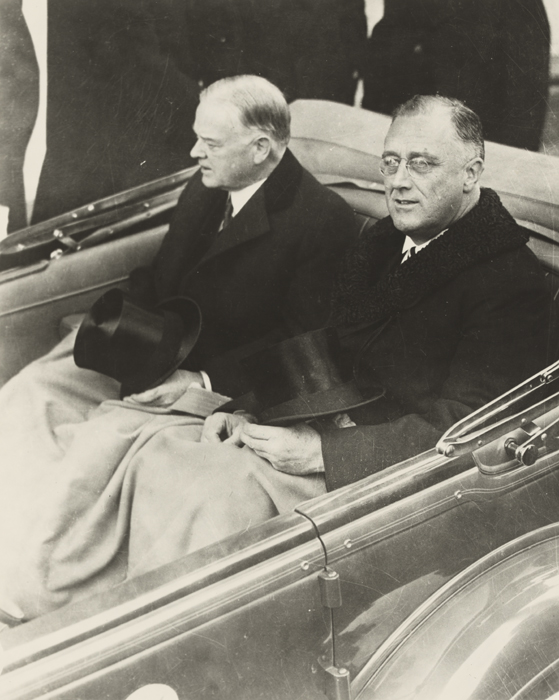 Franklin D. Roosevelt and Herbert Hoover en route to the U.S. Capitol for FDR’s swearing-in as the new president, March 4, 1933. Relations between the two men were unusually wary even for political rivals. Hoover had dispensed with the traditional preinaugural White House dinner for the Roosevelts in favor of a perfunctory afternoon tea. LOC
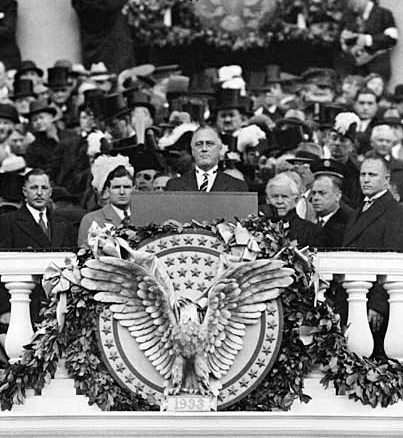
 Franklin D. Roosevelt’s inauguration at the U.S. Capitol, March 4, 1933. The American people had awaited new leadership during four long months, as nationwide unemployment reached an agonizing peak. Some in the crowd wept with relief at FDR’s confident inaugural speech. “The only thing we have to fear,” he famously said, “is fear itself.” LOC
Download PDFs
Download the in-depth history as a pdf to print, save, and share.
1.Franklin D. Roosevelt’s Models: Theodore Roosevelt and Woodrow Wilson
2.An Uncommon Partnership: Franklin D. and Eleanor Roosevelt
3.Polio and Paralysis: Franklin D. Roosevelt’s Disability
4.Governing New York: Laboratory for the New Deal, Platform for FDR
5.America at the Crossroads: The Election of 1932
6.The Long Transition: From Election Day to Inauguration Day
I. Becoming a Leader:
FDR Before the Presidency
1882 – 1933
Becoming a Leader includes six chapters,
on topics from FDR’s marriage to Eleanor
to his tenure as governor of New York State.
click the “In Brief” button at upper right.
click the chapter arrow at lower left.
1. FDR’s Models:
Theodore Roosevelt
& Woodrow Wilson
Theodore Roosevelt, who was president from 1901 to 1909, and Woodrow Wilson, who occupied the office from 1913 to 1921, inspired, guided, and taught Franklin D. Roosevelt. TR, a distant cousin some twenty-five years older than FDR, showed him how a president could dominate the American political landscape and, through the force of his personality, redefine the presidency and America’s place in the world. Wilson’s regulation of corporate trusts, banks, and the money supply showed FDR how effective a president could be as legislator. FDR watched their triumphs and learned even more from their failures. These two leaders, more than anyone, helped shape FDR’s vision as president.
FDR followed the examples of TR and Wilson because he shared their fundamental strengths and values. As historian Geoffrey Ward has noted, all three men possessed “an unfeigned love for people and politics, an ability to rally able men and women to their cause, and an unbounded optimism and self-confidence.” They all rejected the notion that “the mere making of money should be enough to satisfy any man or any nation” and accepted “a sense of stewardship” of the nation’s land and resources. Even more important, all three brought active, indeed transformative, leadership to the presidency, taking “unabashed delight,” Ward writes, “in the great power of their office to do good.”
A Awe & Admiration: Theodore Roosevelt as Role Model
B Campaigning for Woodrow Wilson, Emulating Theodore Roosevelt
C
Theodore Roosevelt, Franklin D. Roosevelt,
and the National Park System
D
Franklin D. Roosevelt,
Woodrow Wilson,
and Presidential Leadership

 1. FDR’s Models: Theodore Roosevelt & Woodrow Wilson
CLICK titles for text and images for captions
1. FDR’s Models: Theodore Roosevelt & Woodrow Wilson
CLICK titles for text and images for captions
2. An Uncommon Partnership:
Franklin D. and Eleanor Roosevelt
By the time Franklin D. and Eleanor Roosevelt began their White House years, they had proven their commitment to each other and to the promise of democracy. They had endured the loss of a child, the sting of adultery, and talk of divorce. They had confronted polio and refused to let it confine their lives or limit their dreams. They had learned to manage an aching loneliness and inject a new candor and boldness into their marriage.
They also had seen a world scarred by war, an America polarized by suspicion and divided by religion and custom, and a failing economy that threatened to destroy the American dream.
How they responded to these private and public challenges—and what they learned from them—not only inspired FDR and ER to pursue an unorthodox marital partnership, but also deepened their understanding of human experience, sowing the seeds of the New Deal and the Four Freedoms.
A Becoming a Couple, 1905
B Into the Fray: Entering Politics and Government, 1910
C State Senator Roosevelt, 1910–12
D
The Roosevelts
Take Washington, 1913–15
E
Rising to the Emergency
of War—Separately, 1916–18
F A Marital Crisis, 1918–19
G A National Campaign, 1920
H Trial by Polio, 1921–28
I Return to Public Office, 1928
2. An Uncommon Partnership: Franklin D. and Eleanor Roosevelt
CLICK titles for text and images for captions
3. Polio & Paralysis:
Franklin D. Roosevelt’s
Disability
On the summer day in 1921 when Franklin D. Roosevelt first experienced the weakness of polio, this viral disease had Americans in the grip of fear. No one knew what caused it. No doctor could cure it. All people knew was that polio could paralyze a person overnight, that it struck children disproportionately, and that epidemics swept the country at intervals, usually during the summertime. Afraid they would catch it, Americans shunned “polios” just as they had isolated the victims of smallpox and other contagious diseases.
Moreover, when FDR lost the use of his legs at age thirty-nine, the disability rights movement lay long in the future, along with its central tenet that a decent society doesn’t just care for people with disabilities, but lowers barriers to their full participation in public life with high-tech assistive devices, accessible public spaces, and accommodations at school and work. In the 1920s and ‘30s, “cripples” were the objects of pity, often institutionalized or kept at home mostly hidden from view.
For FDR, the athletic, charming, and increasingly successful scion of a wealthy family, being struck with such a dread condition was a transformative experience. “I think probably the thing that took the most courage in his life,” Eleanor Roosevelt would say, “was his mastery and meeting of polio.” According to his longtime colleague Frances Perkins, FDR emerged from his confrontation with death and his struggle with disability a gentler, more compassionate person—a deeper man. Also, in his response to polio, FDR’s extraordinary mettle came forth. Winston Churchill famously remarked that “not one in a generation” could have done what FDR did, taking on, despite his bodily constraints, the arduous job of leading the country through the Great Depression and World War II.
Though in his public life FDR tried to conceal his disability and project physical strength—he was a man of his time—he did not permit his condition or the stigma attached to it to force his withdrawal from the spotlight, as his mother, Sara, counseled. He likewise kept his own counsel in medical matters, insisting against doctors’ prognoses (and some would say in a particularly stalwart form of denial) that he would walk again. But he didn’t wait for that to happen before plunging back into politics in 1928.
During his seven-year hiatus from government, and then as he rose from state to national to international leadership, FDR tackled the problems that come with disability, and the scourge of polio itself.
With few models to follow, he essentially designed his own accommodations, building wheelchair-accessible, one-story cottages for himself, first near the spa he frequented at Warm Springs, Georgia, and, later, on his family estate (Top Cottage) in Hyde Park, New York. During his early rehabilitation, he had the first of a series of cars, a Model T, modified with hand controls so he could drive around the countryside of rural Georgia.
Also in Warm Springs, FDR invested the bulk of his personal wealth (a larger part than ER thought wise) in an old inn, turning it into a world-renowned polio treatment center, the Georgia Warm Springs Foundation. In 1938 a fund-raiser for FDR’s newly created Institute for the Study of Infantile Paralysis led to the March of Dimes and the first private initiative to fund a major scientific program to eradicate a particular disease. The research it sponsored eventually produced the polio vaccine that consigned this terrifying illness to the American past.
FDR’s polio was not a secret. It was, to many Americans, something that he had overcome, and whether by recovery or adaptation hardly mattered—it showed his fitness to sail, steady as she goes, through calamity. And in the dreadful 1930s and ’40s, that was an asset the country could ill afford to squander.
A
Illness Strikes at Campobello,
August 1921
B Home to New York
C Eleanor Roosevelt & Louis Howe
D Sara Roosevelt
E A New Home, a Replenished Spirit
F Return to the Political Fray
G The March of Dimes
H Franklin D. Roosevelt and Basil O’Connor
I The Franklin D. Roosevelt “Walk”
J
Winston Churchill on
Franklin D. Roosevelt & Polio
3. Polio & Paralysis: Franklin D. Roosevelt’s Disability
CLICK titles for text and images for captions
4. Governing New York:
Laboratory for the New Deal
Platform for FDR
It was as governor of the Empire State that Franklin D. Roosevelt came into his own as the politician and leader his nation would elect four times to its highest office.
He began his campaign for the post some seven years after the summer day when polio struck a handsome, athletic thirty-nine-year-old FDR, paralyzing his legs and casting a shadow over what had seemed a charmed life. FDR emerged from his years of rehabilitation still unable to walk unaided, yet full of an unmistakable vigor. He was humbler but at the same time more confident, no longer the callow young state senator with the famous name whom many had found condescending, but the sort of man who could connect with all kinds of people.
In 1928, during his first run for governor, he would heave himself from his car to a standing position and deliver a pitch-perfect, homey speech, or arduously make his way toward a podium, smiling and looking people in the eye so they wouldn’t notice his slow progress. Perhaps this was something for which he had unwittingly prepared during much more relaxed drives around the back roads of Warm Springs, Georgia, in a Model T Ford modified for operation by hand controls. He would pull up to a drugstore, honk, and order a Coke, or drive up next to a field and discuss crops with the farmers. “He was a man that could talk to you,” one local recalled. “He had sense enough to talk to a man who didn’t have any education, and he had enough sense to talk to the best educated man in the world; and he was easy to talk to. He could talk about anything.”
If these were excellent qualifications for leadership, the governorship itself offered FDR a chance to try out a spate of progressive ideas, from prison reform to support for rural education and public utilities, but also delivered a lesson in the limits of executive power when matched against a resistant legislature dominated by the opposing party.
When, in the early ‘30s, the country’s economic distress began to assume alarming scale, the time had come for progressive ideas—and for FDR’s active style. While governor, his leading advocacy for creative, government-led solutions to the suffering of the Depression (and his critique of President Herbert Hoover’s desultory response) raised his national profile, indeed made him a strong candidate for the presidency.
“The country needs and, unless I mistake its temper, the country demands bold, persistent experimentation,” FDR said in a commencement address weeks before the 1932 Democratic Convention that would nominate him. “It is common sense to take a method and try it: If it fails, admit it frankly and try another. But above all, try something.”
Try something. This had been FDR’s instinctive response to polio. It was in his bones and would serve him well in the years ahead.
A Comeback Trail
B A Reluctant Candidate
C “Straight to the People”
D The Nation’s Governor
E Human Resources
F The Candidate of Change
4. Governing New York: Laboratory for the New Deal Platform for FDR
CLICK titles for text and images for captions
5. America at the
Crossroads:
The Election of 1932
In 1932 Americans faced a stark choice. They could vote to keep “the old order” in the White House, or they could choose Franklin D. Roosevelt’s “New Deal for the American people.”
FDR, the fifty-two-year-old governor of New York, argued that incumbent president Herbert Hoover’s policies had failed a nation plunged into despair by the Great Depression. FDR promised “bold, persistent experimentation” to unlock the paralyzed American economy and alleviate the people’s fear and suffering. Hoover’s policies of “Destruction, Delay, Despair and Doubt,” he insisted, were no way to run the nation.
Although most Americans expected Hoover to lose, tainted as he was by the country’s economic catastrophe, few anticipated the dramatic campaign that unfolded as the election season progressed. FDR broke with convention by flying to Chicago to accept the Democratic nomination in person. “Let it be from now on the task of our Party to break foolish traditions,” he told the cheering delegates. Defying tradition once again, he launched a national whistle-stop campaign, crisscrossing the nation, and delivered sixteen major speeches, each tied to a specific policy issue.
By election night, FDR had traveled roughly fifteen thousand miles. “Roosevelt the Robust” trounced the whisper campaign alleging his polio made him too weak to govern. Indeed, his dynamism emboldened voters. They wanted to believe in the hopeful words of FDR’s campaign song, “Happy Days Are Here Again.”
Voters understood that the election of 1932 represented a fork in the road. They could stay the course or insist that government respond more fully to the problems confronting the nation. Although Americans had only a general understanding of what the New Deal would entail, they voted overwhelmingly to give FDR and his program a chance.
A The Road to the Convention
B Securing the Nomination
C
Flying to Chicago:
A “New Deal” in
Style and Substance
D On the Campaign Trail
E Herbert Hoover Takes to the Stump
F Tallying the Votes
5. America at the Crossroads: The Election of 1932
CLICK titles for text and images for captions
6. The Long Transition:
From Election Day to
Inauguration Day
On November 8, 1932, Americans went to the ballot box and turned the electoral map blue for Franklin D. Roosevelt. The governor from New York carried all but six states and beat incumbent Herbert Hoover in the popular vote by 17 percent.
Voters, desperate for change as the Depression’s cruelest winter came on, had indeed wrought a historic transition, sweeping aside forty years of Republican majorities for forty years in which American politics would be dominated by the Democratic coalition FDR cobbled together—labor unions and city machines, Jews and Catholics, blacks and white southerners, industrial workers and farmers.
But the transfer of power was not accomplished in a stroke on Election Day. On the contrary, the transition between the Hoover and Roosevelt administrations was long and unusually bitter.
It was too long. In the next election cycle, a constitutional amendment ratified in early 1933 would shift Inauguration Day to January 20. But FDR’s swearing in took place on March 4—four months after the election—in keeping with a tradition that reached back to an era when presidents needed time to journey with their households to the nation’s capital.
Now, the country could ill afford the delay. The economy sunk to appalling depths as a lame-duck president and Congress, feeling hamstrung by the people’s mandate for change, hesitated to act—and the president-elect, loath to commit himself while lacking official authority, insistently declined to do so.
Highly wary and increasingly testy relations between the two leaders aggravated the logjam.
In notes, calls, and three sit-downs, Hoover repeatedly tried to persuade FDR to join him in making statements or taking action on specific issues. FDR balked. He saw no benefit in roping himself to the positions of a leader whose views and approach differed from his own—meanwhile tainting his fledgling administration by association with Hoover himself, the object of intense public resentment. Hoover, in turn, believed a fatuous FDR was playing politics while the nation went to ruin.
More than once these tensions played out in the press. On December 22, 1932, for example, Hoover, incensed at FDR’s refusal to work with him on the issue of European war debts, released their cabled correspondence to the press. Dueling public comments followed. Hoover: “Governor Roosevelt considers it undesirable for him to assent to my suggestions for cooperative action.” FDR: “It is a pity . . . that any statement or intimation should be given that I consider it undesirable to assent to cooperation.”
These contretemps did nothing for either man’s popularity. Henry Stimson, who was Hoover’s secretary of state and would become FDR’s secretary of war, said the war-debt exchange in particular made FDR “look like a peanut.” Editorial pages also criticized FDR, although the Congress and a majority of the public remained in his corner.
When the sun rose at last on Inauguration Day, many Americans were ebullient with relief. The crowd erupted in applause as the new president declared in his powerful voice, “This Nation asks for action, and action now.” This was the FDR they’d come to know. The New Deal had begun.
A Frosty Relations
B Transition–Period Issues
C “Lost Children”
6. The Long Transition: From Election Day to Inauguration Day
CLICK titles for text and images for captions