IV. Statesman & Commander
in Chief: FDR in WWII
1941 – 1945
1.Day of Infamy: Japanese Expansionism and the Attack on Pearl Harbor
2.War in Europe: 1939 to 1945
3.War in the Pacific: 1937 to 1945
4.“We Are All in It”: Franklin D. Roosevelt and the American Home Front
5.Evicted and Detained: The Internment of Japanese Americans
6.Bundles for Britain: Sending Warmth (and Woolens) to a Nation at War
7.Bundles from Britain: Child Evacuations from Wartime Britain
8.The Special Relationship: Franklin D. Roosevelt and Winston Churchill
9.The Dictator and the Democrat: Adolf Hitler and Franklin D. Roosevelt
10.A Wartime Alliance: Franklin D. Roosevelt and Joseph Stalin
11.Commander in Chief: FDR as Leader of the Nation’s Armed Forces
12.Grand Strategy: Franklin D. Roosevelt and the Wartime Conferences
13.Destruction from the Air: Strategic Bombing in World War II
14.Building the Atomic Bomb: The Manhattan Project
15.The Holocaust: The Nazi Slaughter of European Jews
16.The Nuremberg Trials: Nazi Criminals Face Justice
17.The United Nations: FDR and the Creation of the Postwar World
18.Defining a Humane World: Eleanor Roosevelt and the Universal Declaration of Human Rights
 Download PDFs
IV. Statesman & Commander
in Chief: FDR in WWII
1941 – 1945
1.Day of Infamy: Japanese Expansionism and the Attack on Pearl Harbor
2.War in Europe: 1939 to 1945
3.War in the Pacific: 1937 to 1945
4.“We Are All in It”: Franklin D. Roosevelt and the American Home Front
5.Evicted and Detained: The Internment of Japanese Americans
6.Bundles for Britain: Sending Warmth (and Woolens) to a Nation at War
7.Bundles from Britain: Child Evacuations from Wartime Britain
8.The Special Relationship: Franklin D. Roosevelt and Winston Churchill
9.The Dictator and the Democrat: Adolf Hitler and Franklin D. Roosevelt
10.A Wartime Alliance: Franklin D. Roosevelt and Joseph Stalin
11.Commander in Chief: FDR as Leader of the Nation’s Armed Forces
12.Grand Strategy: Franklin D. Roosevelt and the Wartime Conferences
13.Destruction from the Air: Strategic Bombing in World War II
14.Building the Atomic Bomb: The Manhattan Project
15.The Holocaust: The Nazi Slaughter of European Jews
16.The Nuremberg Trials: Nazi Criminals Face Justice
17.The United Nations: FDR and the Creation of the Postwar World
18.Defining a Humane World: Eleanor Roosevelt and the Universal Declaration of Human Rights
Download PDFs
1. Day of Infamy: Japanese Expansionism and the Attack on Pearl Harbor
Americans were stunned and outraged by the Japanese air raid on a United States naval base in Pearl Harbor, Hawaii, that killed some 2,400 Americans and dealt a major blow to the country’s Pacific Fleet. They saw it as an unprovoked attack on noncombatants. Franklin D. Roosevelt and his military advisers, though shocked that the Japanese had come as far as Hawaii in their opening salvo, had expected an assault in the Pacific. Imperial Japan had spent the 1930s expanding its domain into Manchuria, then China, then French Indochina, and its leaders now cast an eye further south to Asian territories held by the British, Dutch, and Americans. American naval power stood in their way, and it was to eliminate this impediment that Japan bombed Pearl Harbor on December 7, 1941.
Japan’s strike on American home turf instantly resolved debate about whether the country would join the armed conflict raging overseas. Congress overwhelmingly approved a declaration of war against Japan on December 8. Yet the attack also complicated America’s predicament. Japan’s ally, Nazi Germany, still posed at least as grave a threat to U.S. security. The two vast oceans Americans had hoped would protect them from attack had now become theaters of war.
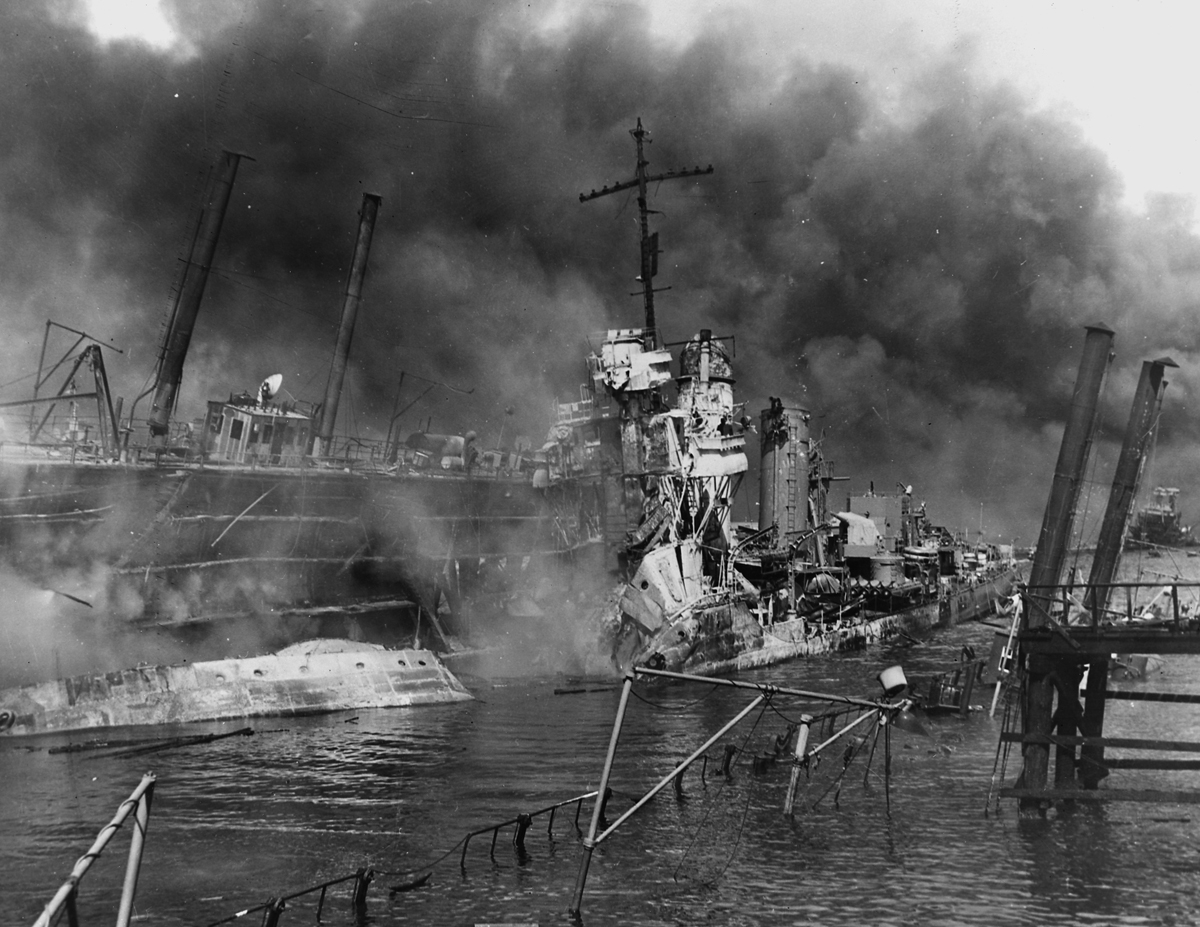
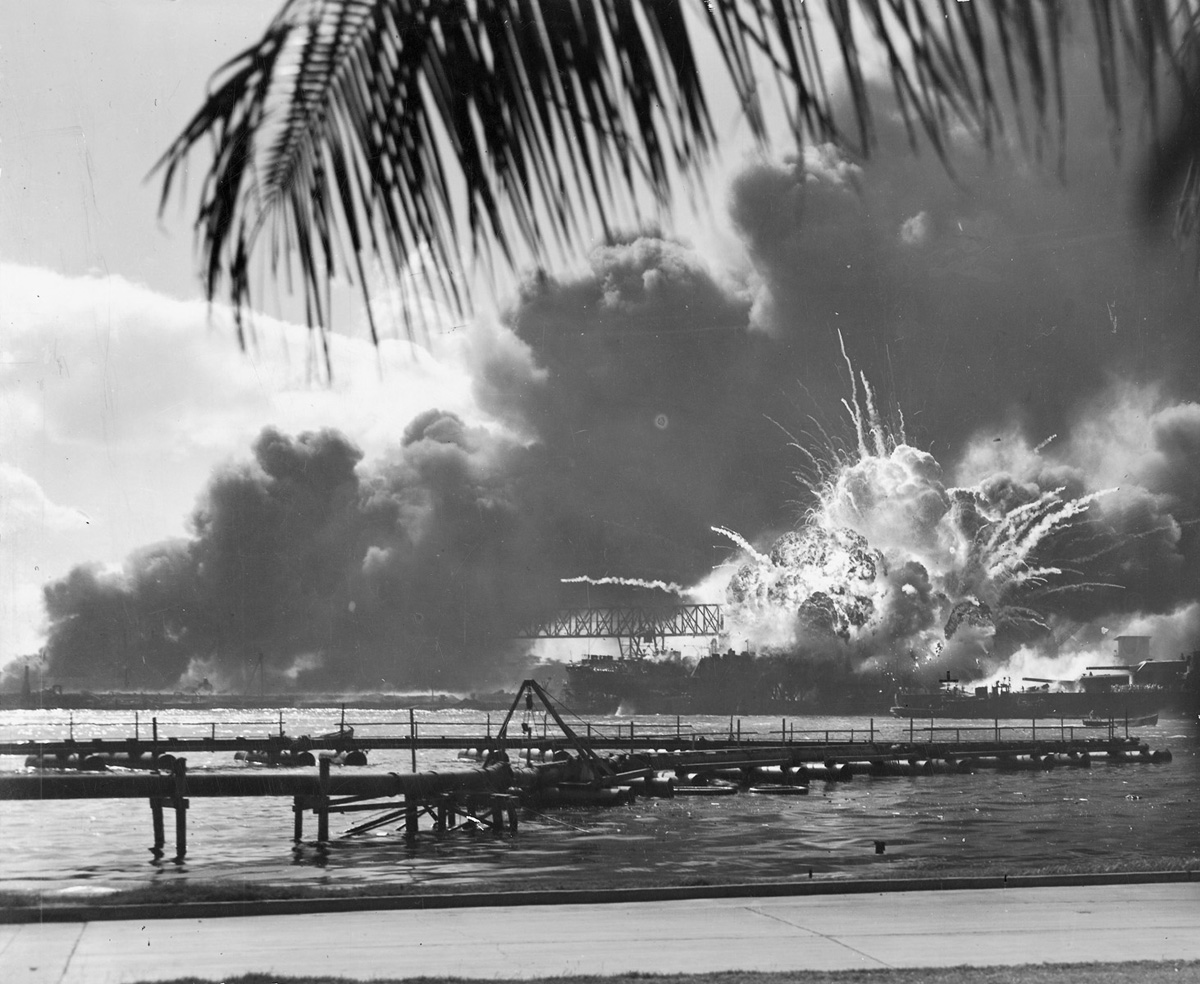 The USS Shaw explodes under Japanese attack the morning of December 7, 1941, in the waters of Pearl Harbor, Oahu, Hawaii.
 Wreckage at Pearl Harbor after the Japanese attack, with destroyers USS Downs and USS Cassin in the foreground, December 7, 1941. Japan’s aim was to cripple American naval power in the Pacific so it could continue its territorial expansion to the south and east. FDRL
 Franklin D. Roosevelt addresses Congress on December 8, 1941, the day after the Japanese attacked a U.S. naval base in Pearl Harbor, Hawaii, killing some 2,400 Americans. “I believe that I interpret the will of the Congress and of the people when I assert that we will not only defend ourselves to the uttermost but will make it very certain that this form of treachery shall never again endanger us,” FDR said. Congress approved a declaration of war against Japan with only a single dissenting vote. FDRL
2. War in Europe: 1939 to 1945
Adolf Hitler became dictator of Germany in 1933 with the dream of creating an indomitable Nazi state that would seize the resource-rich territory of its neighbors to provide additional lebensraum (“living space”) for people of superior Germanic blood. At the height of Nazi success in 1942, the Germans and their allies and collaborators claimed a new dominion stretching from Finland and Norway in the Arctic Circle down through the boot of Italy and across the Mediterranean to North Africa, and from the Atlantic coast of France all the way to Russia’s Stalingrad on the banks of the Volga River. On the Eastern Front, the Soviet Red Army in 1943 and 1944 arduously pushed the battlefront west. The Western Allies, led by the United States and Britain, drove into Axis-occupied North Africa in late 1942, then took on Italy in the fall of 1943, finally landing a massive amphibious invasion force on the French coast in June 1944 for the final push eastward into Germany. By the time Soviet and American forces met at the Elbe River just south of Berlin in April 1945, the Nazis were undone. Their final surrender, a cause for the most joyous celebrations around the world, came on May 8, 1945.
 German soldiers smash their way into a Russian home in the Nazi invasion of the Soviet Union, 1941. This operation opened the Eastern Front, a massive battle zone of unprecedented ferocity, claiming more lives, military and civilian, than any other theater of the war—some thirty million in all. The Eastern Front was the site of a network of concentration camps where the Nazis exterminated those they considered subhuman, including Jews and Slavs. It took four years for the Red Army to push the German line back to Berlin. © IWMHU 111383
 Recovering the dead at Omaha Beach, Normandy, France, after the D-day invasion of June 6, 1944. On the initial day of the operation, more than four thousand Allied personnel lost their lives. That evening, Franklin D. Roosevelt broadcast his stirring prayer for the men, “our sons,” carrying out the invasion. “They fight to liberate,” he said. “They fight to let justice arise, and tolerance and good will among all Thy people. They yearn but for the end of battle, for their return to the haven of home.” LOC
 Soviet and American soldiers relax by the Elbe River, following their forces’ historic linkup at the small town of Torgau, sixty miles south of Berlin. The meeting in April 1945 signaled that the Allies had effectively divided German forces. The war was nearly over. © IWM OWIL 64545
3. War in the Pacific:1937 to 1945
In the 1930s, Japan’s leaders became committed to driving Western colonial powers from Asia and the Pacific and uniting these resource-rich lands and their peoples in a self-sufficient, Japanese-dominated “new order.” Having already advanced into China and Southeast Asia, in December 1941 the Japanese launched the Pacific War by striking America at Pearl Harbor, Hawaii, among other targets. By late summer 1942, their domain stretched from the British colony of Burma to the Gilbert Islands more than five thousand miles to the east, and from Alaska’s Aleutian Islands in the north all the way south to the Dutch East Indies and New Guinea.
The Allies, led by the Americans, began to turn the tide against the Japanese on the Pacific islands of Midway and Guadalcanal in 1942, then launched a two-pronged advance along the coast of New Guinea toward the Philippines and up through the central Pacific toward Japan. As Allied troops approached the Japanese mainland in 1944 and 1945, the Japanese fought with a desperate intensity for the Philippines and the islands of Iwo Jima and Okinawa, incurring and inflicting steep losses. An American bombing campaign laid waste to Japanese cities in the final months of the war, culminating, on August 6 and 9, 1945, in the dropping of atomic bombs—a new weapon tested for the first time in the New Mexico desert on July 16— on Hiroshima and Nagasaki. On August 15, Japan’s imperial government announced its surrender, bringing World War II to an end.
 A map of Imperial Japan at the height of its success in conquest, the result of a swift offensive campaign in the Pacific that began with the December 7, 1941, attacks on Pearl Harbor, Malaya, Hong Kong, Guam, Wake Island, and the Philippines. In the lower right of the Japanese territory is Guadalcanal in the Solomon Islands, whose recapture by the Americans in February 1943 would be a first step in their struggle toward the Japanese mainland.
 A casualty from the front line in the battle for Guadalcanal (August 1942 to February 1943) being transferred from a makeshift stretcher for transport through the jungle and downriver to a military hospital. In this first major Allied offensive in the Pacific, more than seven thousand servicemen died. LOC
 Tokyo burns under a firebombing assault by American B-29s, 1945. In the last months of the war, incendiary raids against Japanese targets were so relentless that they paralyzed the Japanese economy, disabling communications and industrial production and displacing more than eight million civilians. LOC
4. “We Are All in It”: Franklin D. Roosevelt and the American Home Front
When World War II began, America had an army smaller than Portugal’s and an economy still weak from the shocks of the Great Depression. Victory over the Axis powers was by no means assured. “We must pour into this war,” Franklin D. Roosevelt told the country in 1943, “the entire strength and intelligence and willpower of the United States.”
The way FDR organized and inspired the American people in this unwelcome task stands as one of the greatest achievements of his presidency. Americans worked hard in America’s factories to arm their nation and its Allies. They bought less, recycled, invested in U.S. war bonds, and paid higher taxes. By the millions, they gathered around radios to hear their president’s warm, confident words. “We are all in it,” he said, “and our spirit is good.”
 Two women operate a centerless grinder at Chicago’s Republic Drill and Tool Company, August 1942. The plant, according to the Office of War Information, was manned almost exclusively by women, and production “continued to soar.” So did the country’s female labor force, rising by 6.5 million workers between 1940 and 1945. LOC
 Chicago schoolchildren celebrate the end of a successful war bond campaign with a rally and check presentation. The children had bought $263,148.83 in war bonds and stamps—enough, according to a government release, to supply the military with 125 jeeps, two pursuit planes, and a motorcycle. LOC
 Professor Harry Nelson of San Francisco’s junior college works in a Victory Garden with his ten-year-old daughter, Pat (left), and her Girl Scout friends. The Victory Gardens supplied locals with good fresh vegetables and conserved transportation-related resources such as gas and rubber. LOC
5. Evicted and Detained: The Internment of Japanese Americans
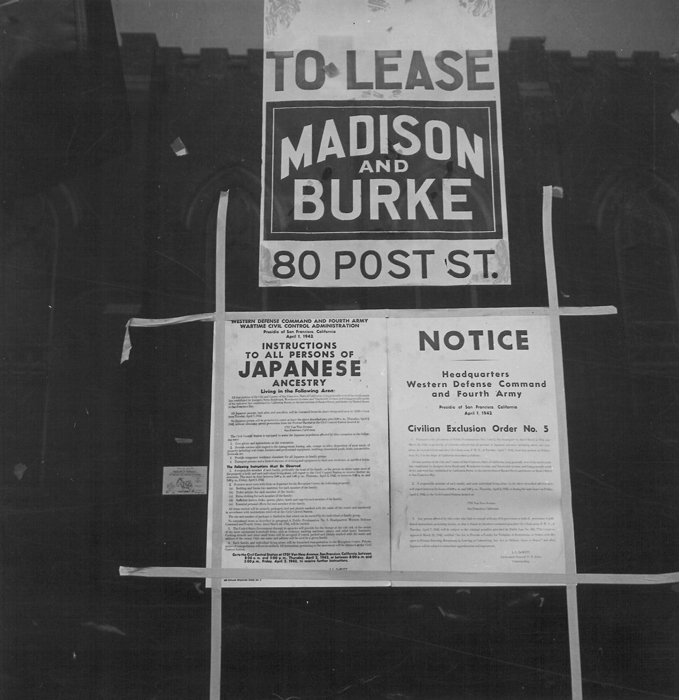
In February 1941, amid the fear and rage that followed Japan’s attack on Pearl Harbor, Franklin D. Roosevelt authorized military leaders to remove people of Japanese heritage, including American citizens, from their homes on the West Coast, then considered vulnerable to a follow-up assault from across the Pacific. Though there was no evidence to support the suspicion that ethnic Japanese communities in America would collude with the enemy, it was on that basis that the federal government evicted more than 110,000 people from zones including California and parts of Oregon, Washington, and Arizona, sending them first to temporary “assembly centers,” and then on to the remote military-style camps where many were confined until January 1945. The Supreme Court upheld the internment program in 1944, accepting national security concerns as a justification for depriving Japanese Americans of personal liberty. In 1988, however, Congress issued an apology, along with reparations, to former detainees, calling the program a “grave injustice.”
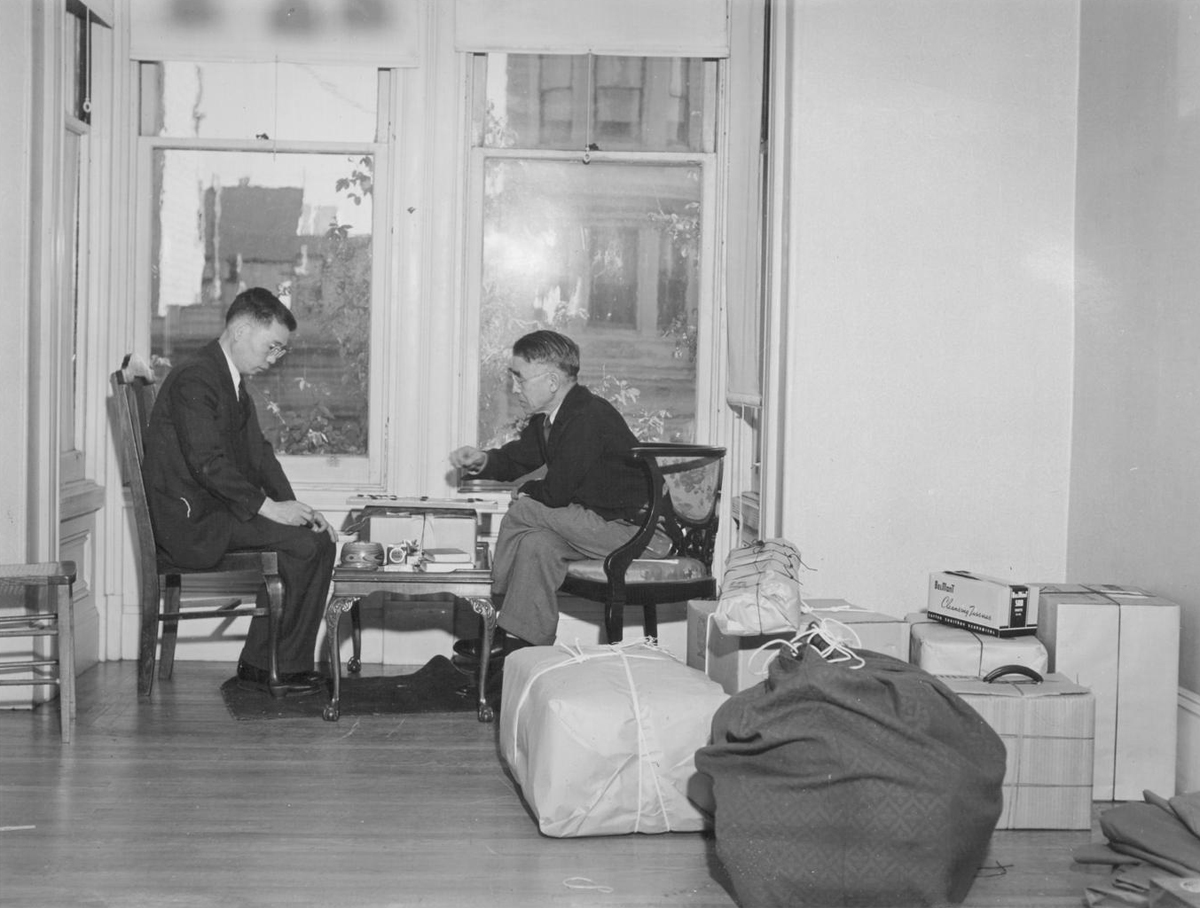 In April 1942, two friends play a last game of chess in San Francisco before being evacuated by the War Relocation Authority. Two-thirds of those removed from their homes were American citizens. UC Berkeley Library
 A view of central California’s Manzanar War Relocation Center from the guard tower. After the federal government ordered people of Japanese ethnicity from their homes on the West Coast in 1942, it hastily constructed ten camps for the forced migrants in remote areas of the West, Southwest, and Arkansas. LOC
 Farmer Richard Kobayashi, with cabbages, at the Manzanar War Relocation Center in central California east of Fresno, 1940s. In 1992, Congress made Manzanar a National Historic Site to commemorate the experience of some ten thousand ethnic Japanese confined there during World War II and to “serve as a reminder to this and future generations of the fragility of American civil liberties,” according to the National Park Service. LOC
6. Bundles for Britain: Sending Warmth (and Woolens) to a Nation at War
By mid-1940, Britain stood alone against the Nazi onslaught in Europe, its people starved for supplies and shivering in bomb shelters. Though reluctant to take up arms in the fight, Americans felt for their friends across the sea. As an expression of their concern, the women of America soon fell to knitting warm woolen garments for British soldiers and civilians. Under the auspices of a relief organization called Bundles for Britain, this became an undertaking of great scope and coordination; the aid group shipped hundreds of thousands of garments by war’s end. Socks, sweaters, hats, gloves, and other woolens—handmade with care in every hamlet of America—helped knit together the British and American peoples in an alliance that would endure long after the war was won.
 Civilians navigate the streets of a bomb-scarred London. For Londoners, World War II was an everyday reality that brought deprivations and danger. National Archives
 A “V for Victory” Bundles for Britain pin. Donors wore the pins proudly to signal their participation in a popular humanitarian cause.
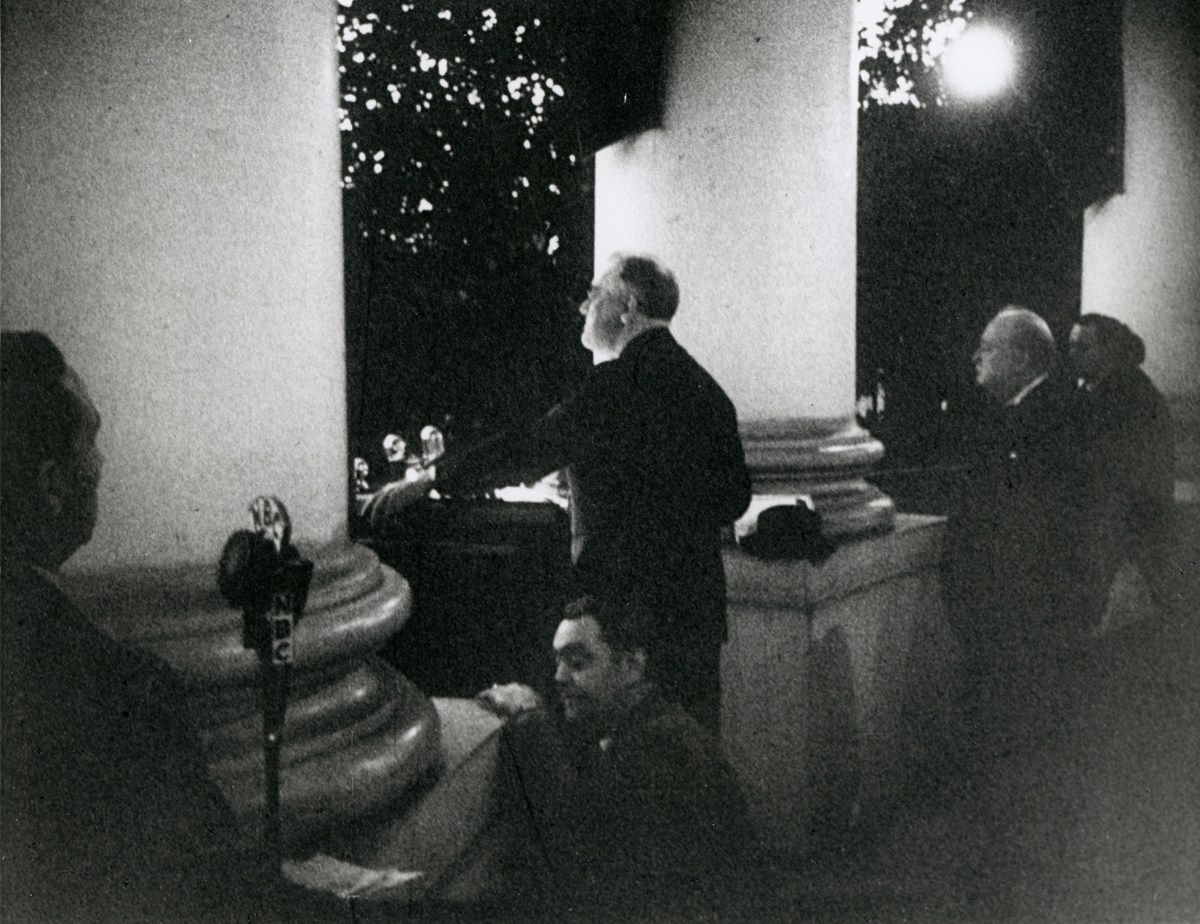 Franklin D. Roosevelt and Winston Churchill during the National Christmas Tree Lighting, December 24, 1941. The British prime minister had traveled to Washington just weeks after America officially entered World War II. While there, Churchill praised the “splendid volunteers” of Bundles for Britain. In January, a new organization would be born to send comforting “bundles” to American service personnel. FDRL
7. Bundles from Britain: Child Evacuations from Wartime Britain
By the late 1930s, the British people had seen the Germans bomb civilians in the Basque town of Guernica during the Spanish Civil War and the Japanese drop bombs on Chinese cities. They feared that if war came to their island nation, it would come in the form of a pulverizing bombardment that would kill civilians in their homes and streets. So they laid plans to evacuate their children to safety, at first by the hundreds of thousands from English cities to safe zones in the countryside and later overseas to far-flung dominions of the Crown and to America. Parents stayed behind to do their part in the war effort, sending their children—“Bundles from Britain”—to be cared for by strangers for as long as might prove necessary. The image of a small child waving good-bye, her name pinned to her coat, became a symbol of the extremity of war and of the human response to it—anguish and terror on the one hand, on the other, courage and unity.
 A Saturday Evening Post cover by illustrator J. C. Leyendecker, December 30, 1939. The image depicts Britain’s Operation Pied Piper, under which the country had swiftly evacuated some 1.5 million people, mainly children, from urban areas to parts of the countryside deemed unlikely to be targeted in a German air assault. The evacuation began on September 1, 1939, the day the Nazis sparked World War II by invading Poland. Each evacuated child was given a gas mask and allowed one small suitcase.
 Children from Rotherhithe, a section of southeast London, take a walk in Reading, the Berkshire town where they are staying for safety, 1940. The square cases in their hands are gas-mask boxes. © IWM (D 824)
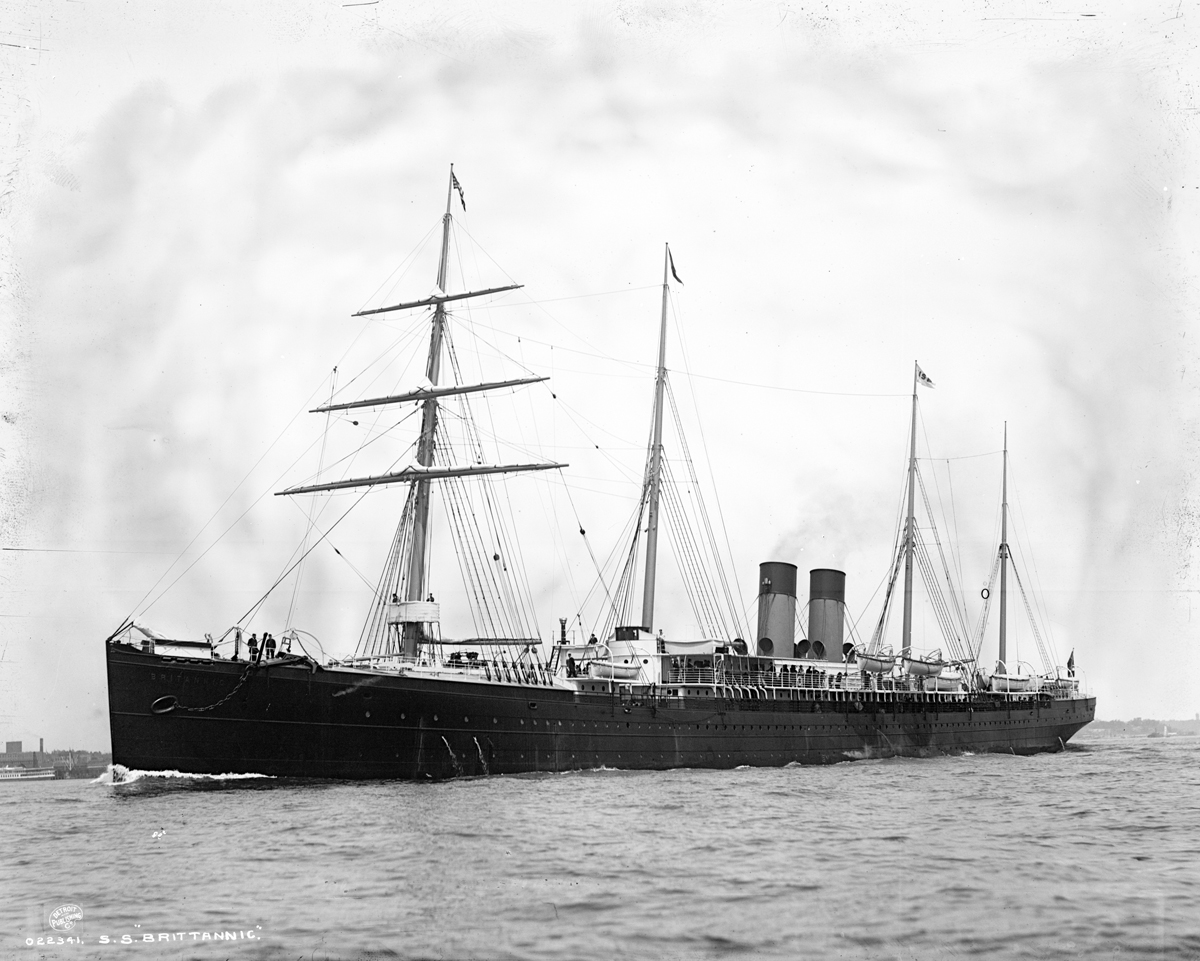
 Child evacuees from wartime Britain wave at the Statue of Liberty aboard an ocean liner as it steams into New York Harbor. Though most of these “bundles from Britain” went to dominions of the British Crown, some five thousand found their way to America. © HU 68972
8. The Special Relationship: Franklin D. Roosevelt and Winston Churchill
Though at sixty-five Winston Churchill was a seasoned politician and navy man when he became prime minister of Britain in May 1940, he had spent most of the 1930s out of office. Franklin D. Roosevelt, on the other hand, had been president of the United States for seven years. Churchill’s job was to helm a global Old World empire, whereas FDR led a young nation inclined to isolate itself from a troubled world. What the two men shared was an early and outspoken conviction that Nazi Germany and Imperial Japan posed a threat to democracies that they dare not ignore or appease.
In their first meeting, a shipboard rendezvous off the coast of Newfoundland, Canada, in August 1941, FDR and Churchill developed a personal rapport and created a document, the Atlantic Charter, that laid out their urgent common purpose: to defend the ideal of freedom against dictators whose fanatical philosophies gave them the right to enslave their neighbors. This Anglo-American bond formed the linchpin of a multinational alliance that would rise up to resist and ultimately defeat the Axis powers.
 Franklin D. Roosevelt fishes with Winston Churchill at the presidential retreat Shangri-La (later called Camp David) outside Washington in May 1943. Here, as was often the case when the two enjoyed recreational diversions together, they were engaged in a task of utmost seriousness. As part of the conference code-named Trident, the two were planning the Italian campaign that would knock Benito Mussolini out of the war and keep American forces on the ground in Europe pending a large-scale invasion of France. FDRL
 Soviet leader Joseph Stalin, Franklin D. Roosevelt, and British prime minister Winston Churchill—the Big Three—sit on a porch in Tehran, Iran, November 29, 1943. At the Tehran Conference, Churchill wanted to extend Allied action in the Mediterranean and Italy, but FDR insisted the time had come to commit to a major operation in France. FDRL
 At the Quebec Conference in September 1944, Franklin D. Roosevelt has a word with Winston Churchill. The two leaders are flanked by the conference’s Canadian hosts: at left is the governor general of Canada, the Earl of Athlone; at right is Canadian prime minister William Lyon Mackenzie King. The Anglo-American conference addressed such issues as how the Allies would occupy Germany after its defeat, which now seemed imminent. FDRL
9. The Dictator and the Democrat: Adolf Hitler and Franklin D. Roosevelt
Franklin D. Roosevelt became president in 1933, the same year Adolf Hitler assumed sweeping dictatorial powers in Germany. FDR would go on to play a very significant part in destroying Hitler and his Nazi state. From early in his presidency, FDR saw Hitler as “a madman.” In the next few years, as the Führer oppressed populations and launched his expansionist war, FDR became convinced—and worked hard to persuade other Americans—that the Nazi leader posed a dire threat to American security and democracy everywhere. Though it was Imperial Japan that brought the United States into World War II by bombing Pearl Harbor in December 1941, FDR embraced a “Germany First” policy that made defeating the Nazis the top priority of U.S. forces.
 Adolf Hitler at the annual rally of the Nazi Party in Nuremberg, September 10–16, 1935. It was at this rally that the Nazis introduced their infamous Nuremberg Laws, which stripped Jews of the rights of German citizenship. Germany was also busy rearming in violation of the Treaty of Versailles. Though alert to the threat, Franklin D. Roosevelt was much occupied with domestic issues. A month before the rally pictured here, FDR had signed the Social Security Act, which established old-age pensions and unemployment insurance for American workers. Norway National Archives
 Hitler receives an ovation, complete with Nazi salute, from members of the German parliament (Reichstag) after announcing Germany’s “peaceful” annexation of Austria, Berlin, March 1938. A major first step in the Nazis’ territorial expansion, the Anschluss (“union”), along with the persecution of Austrian Jews and dissidents that swiftly followed, occasioned concern around the world, but little concrete action. National Archives
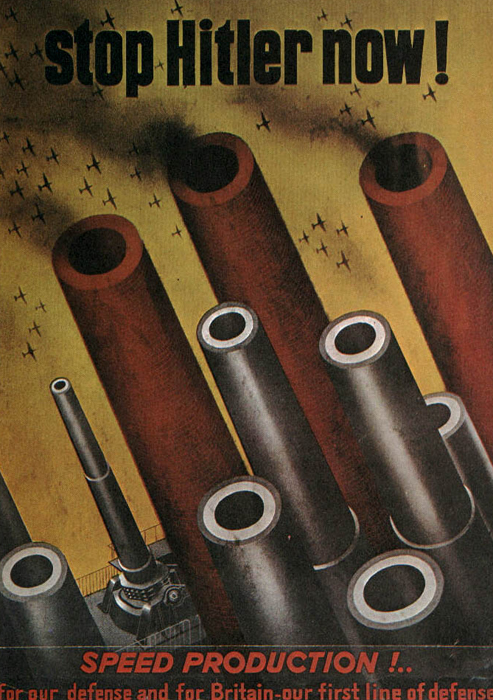
 A poster caricaturing Hitler, issued by the federal government in 1942. Though Hitler was a master propagandist, sowing fear and hatred, Franklin D. Roosevelt kept telling Americans they would win the war and see a better day. LOC
10. A Wartime Alliance: Franklin D. Roosevelt and Joseph Stalin
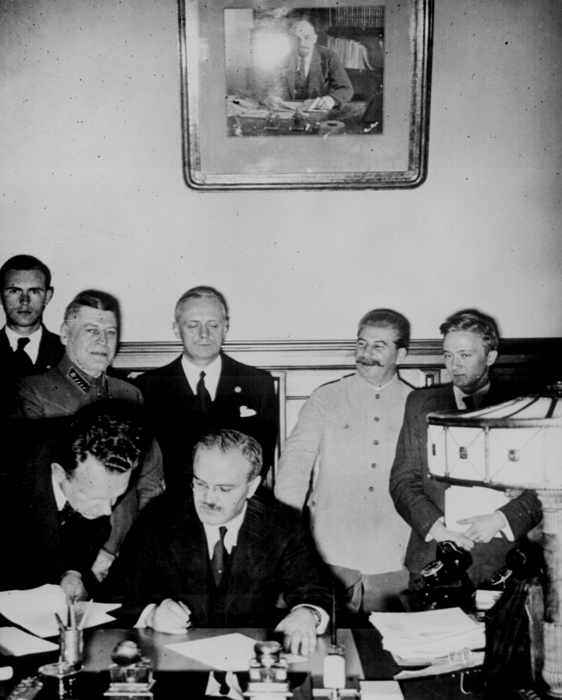
Franklin D. Roosevelt made a concerted effort to establish diplomatic ties with the Soviet Union and cultivate a direct relationship with its autocratic ruler, Joseph Stalin. Though FDR understood Stalin was a brutal despot, he thought it better to make alliances with the powerful Soviets than to see them side with forces he considered more dangerous—Nazi Germany and Imperial Japan. Once Germany made an enemy of its former Soviet collaborator by invading Russia in 1941, FDR endeavored to bind the Soviet Union to the Allied coalition by sending American aid to the Russians and, later, by pressing the case for opening a western front against the Germans to support the Red Army fighting in the east.
The Soviets did prove a critical part of the alliance that won World War II, drawing off and ultimately destroying vast quantities of German firepower on the Eastern Front. FDR knew the Soviet Union would emerge from the war a world power. As the conflict wound down and FDR neared the end of his own life, the president hoped the newly created United Nations would help channel this power in a peaceful direction.
 Russian (front) and German planes destroyed during Operation Barbarossa. Truly a shocking blitzkrieg (“lightning war”), this Nazi attack on Russia in the summer of 1941 was the largest invasion in European history. Polish Archive
 A U.S. Army truck convoy prepares to carry goods to Russia along a supply route through Iran, March 1943. In 1941, Franklin D. Roosevelt made the controversial decision to extend American military and other aid to the Russians, who proved critical Allies in the war, sacrificing more men in the fight than any other combatant nation. LOC
 British prime minister Winston Churchill, a tired-looking Franklin D. Roosevelt, and Joseph Stalin at the Yalta Conference of February 1945, the three leaders’ last meeting. Critics have argued that FDR and Churchill failed to press Stalin hard enough about the political future of Eastern Europe. Soviet occupation of this territory in 1945—the result of bloody fighting by the Red Army—set the stage for Stalin to establish a “buffer zone” of communist-dominated states along Russia’s western flank. LOC
11. Commander in Chief: FDR as Leader of the Nation’s Armed Forces
In 1940, even as critics of Franklin D. Roosevelt’s New Deal gained momentum, Americans chose FDR to lead the country through the terrifying world war they had for years hoped to avoid. To meet the crisis, FDR directed a historic expansion of the American military—the development of a navy capable of major deployments on two vast oceans, the growth of the U.S. Army from fewer than two hundred thousand personnel to more than eight million by war’s end, and the establishment of an air force equal in status to the other two service branches. FDR handpicked his war commanders and organized top brass into a unified high command with a direct link to the president—the first Joint Chiefs of Staff.
As perhaps the most important figure tying together the multinational Allied coalition, FDR was also a key director of war strategy. He believed fervently in the need to confront Nazi Germany before committing major resources to fighting Imperial Japan, advocated consistently for opening a western front against the Nazis to relieve Russian Allies fighting in the east, and in 1943 announced a policy to accept no end to the war short of the Axis powers’ “unconditional surrender.” FDR died a few months before that outcome was achieved in August 1945. But around the globe, he is remembered as a person who marshaled both reason and unyielding force against violent, fanatical movements that might have darkened the world for generations to come.
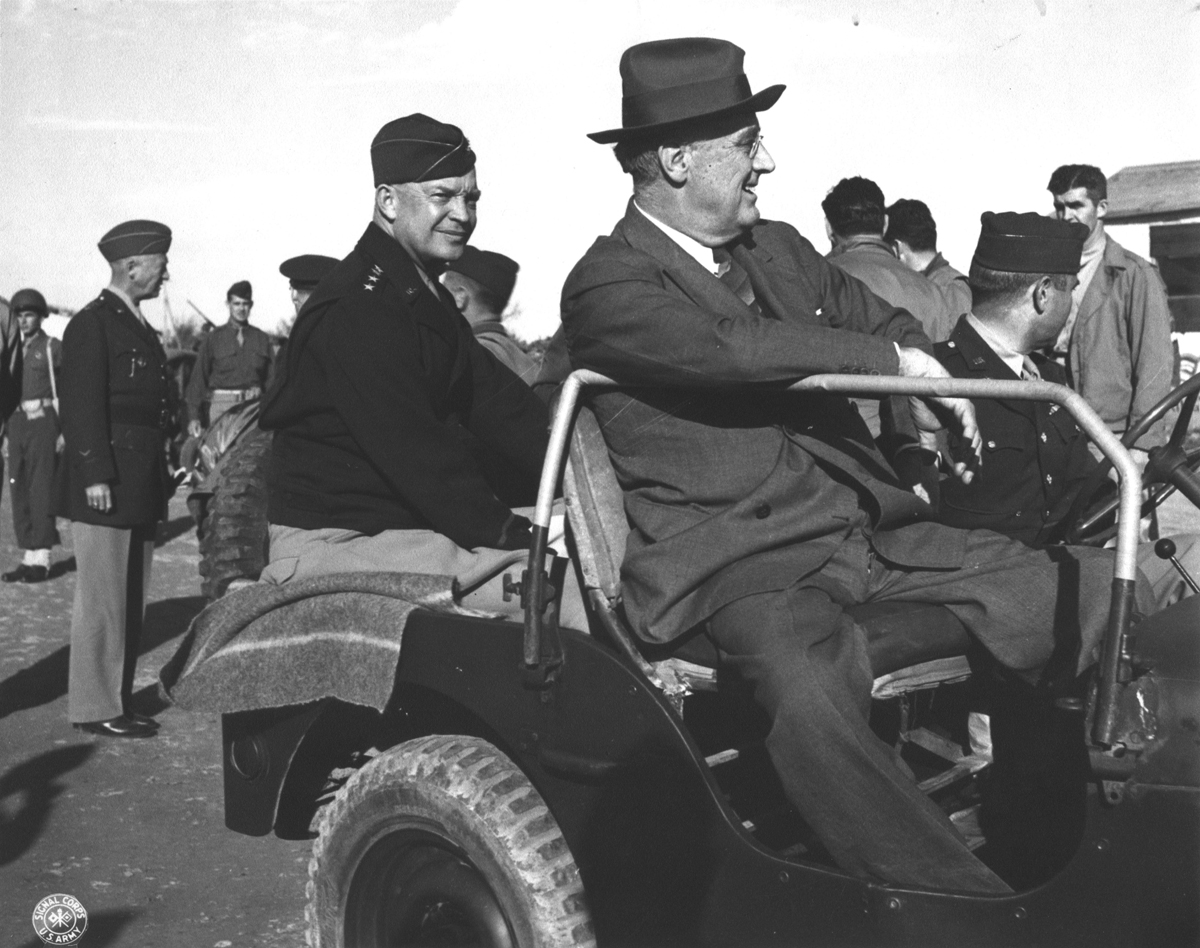 Franklin D. Roosevelt rides with General Dwight D. Eisenhower in Sicily, December 1943. Eisenhower had led Allied forces in successful operations in North Africa in 1942, Sicily and Italy in 1943. In 1944, he would lead American, British, and Canadian forces in their historic drive across Nazi-occupied France to the heart of Germany. LOC
 At a September 1944 conference in Hawaii to plan military strategy in the Pacific, Franklin D. Roosevelt confers with, from left to right, General Douglas MacArthur, Admiral William D. Leahy, and Admiral Chester W. Nimitz. MacArthur and Nimitz each commanded a large section of the Pacific Theater and would join the next month in a major drive to retake the Philippines from the Japanese. Leahy, as chief of staff to the president, advised FDR on war strategy and liaised with the service chiefs. FDRL
 American troops land on the beaches of Normandy, France, in the largest seaborne invasion in history, June 6, 1944. A hands-on commander in chief, Franklin D. Roosevelt had taken a lead role in laying the diplomatic and strategic groundwork for the offensive, which opened a second front against the Germans already fighting the Red Army in the east. FDRL
12. Grand Strategy: Franklin D. Roosevelt and the Wartime Conferences
World War II was a sprawling system of interconnected battles fought on land, in the air, and at sea, involving eight major combatant nations but eventually dividing much of the world. It was essential that the Allies, despite sometimes obscure or even conflicting motivations, apply their energies against the Axis in a coordinated fashion. To that end, the Allies met in a series of wartime conferences bringing together heads of state, top diplomats, and military chiefs.
At the Arcadia Conference in Washington, DC, just weeks after Japan bombed Pearl Harbor in December 1941, Franklin D. Roosevelt and British prime minister Winston Churchill officially launched the Allied coalition, issuing a United Nations Declaration signed by twenty-six nations. Within the year, Anglo-American forces invaded Axis-occupied North Africa. At the Casablanca Conference in January 1943, the Allies laid plans to attack Sicily and Italy, and at Tehran in late 1943, the first conference attended by both FDR and Soviet leader Joseph Stalin, they committed to an invasion of Nazi-occupied France in the spring of 1944. In February 1945, at Yalta on the Crimean peninsula, the “Big Three”—FDR, Churchill, and Stalin—met for the last time. Stalin promised to join the war against Japan, participate in the postwar United Nations peace organization, and support free elections in liberated Europe. He would keep the first two pledges, but renege on the last.
 Franklin D. Roosevelt and Winston Churchill at a press conference on the last day of the Casablanca Conference in the Moroccan city of the same name, January 24, 1943. At the press briefing, FDR announced that the Allies would accept no outcome in the war except the Axis powers’ “unconditional surrender.” This was a way to reassure the Soviets of the Anglo-American commitment and also to ensure that an Allied victory would end Axis militarism once and for all. FDRL
 Joseph Stalin, Franklin D. Roosevelt, and Winston Churchill with diplomats and advisers in the Iranian capital of Tehran, November 29, 1943. Perhaps the most critical resolution to come out of the Tehran Conference was the decision to launch an Anglo-American invasion of France in the spring of 1944. In this decision, FDR sided with Stalin over Churchill’s reservations. National Archives
The “Big Three”—Winston Churchill, Franklin D. Roosevelt, and Joseph Stalin—at their last meeting in the Crimean resort of Yalta, February 1945. The most controversial of the wartime conferences, Yalta addressed the fate of postwar Europe. Though Stalin agreed to support free elections there, in reality, the Soviets would establish communist “buffer states” between Russia and the historically bellicose Germany, at times violently suppressing rebellions in those states. An ideological “Iron Curtain”—Churchill’s coinage—would divide Europe for generations. LOC
Joseph Stalin, Franklin D. Roosevelt, and Winston Churchill with diplomats and advisers in the Iranian capital of Tehran, November 29, 1943. Perhaps the most critical resolution to come out of the Tehran Conference was the decision to launch an Anglo-American invasion of France in the spring of 1944. In this decision, FDR sided with Stalin over Churchill’s reservations. National Archives
The “Big Three”—Winston Churchill, Franklin D. Roosevelt, and Joseph Stalin—at their last meeting in the Crimean resort of Yalta, February 1945. The most controversial of the wartime conferences, Yalta addressed the fate of postwar Europe. Though Stalin agreed to support free elections there, in reality, the Soviets would establish communist “buffer states” between Russia and the historically bellicose Germany, at times violently suppressing rebellions in those states. An ideological “Iron Curtain”—Churchill’s coinage—would divide Europe for generations. LOC
13. Destruction from the Air: Strategic Bombing in World War II
World War II took place far from American shores. So Americans were spared the terror and destruction of the bombing campaigns that hammered cities and towns of other combatant nations on both sides of the conflict, from China’s Chungking (Chongqing) to Warsaw, Poland, to London and Coventry in England; from Rome, Italy, to Dresden, Germany, to Japan’s Tokyo, Hiroshima, and Nagasaki.
The bombardment of population centers was a relatively new feature of warfare that reflected evolving airpower technologies and ideas about how to apply them not just against active military forces but also in more wide-ranging efforts to soften enemy defenses and morale. Although in general the stated goal of these bombing raids was not to kill civilians, this outcome was hardly unexpected, especially as experience proved that so-called pinpoint targeting was not effective in real-world conditions. The bombing campaigns killed many hundreds of thousands of civilians and made millions homeless, their neighborhoods reduced to rubble.
United States participation came most prominently in joint bombing missions with Britain’s Royal Air Force over Germany and in devastating aerial attacks on Japanese cities in the final months of the war. Whether such extensive, deadly destruction was necessary or justifiable is a question sharply debated, but it is clear that achieving control of the skies was an important prelude to Allied victory in both Europe and the Pacific.
 The seaport city of Rotterdam, Holland, after German bombers attacked on May 14, 1940, during the Nazi invasion of the Low Countries and France. The Rotterdam bombing killed more than eight hundred civilians and destroyed much of the historic city center. The Dutch, defenseless against aerial assault and fearful that the Germans would make good on their threat to bomb other cities, surrendered on May 15. National Archives
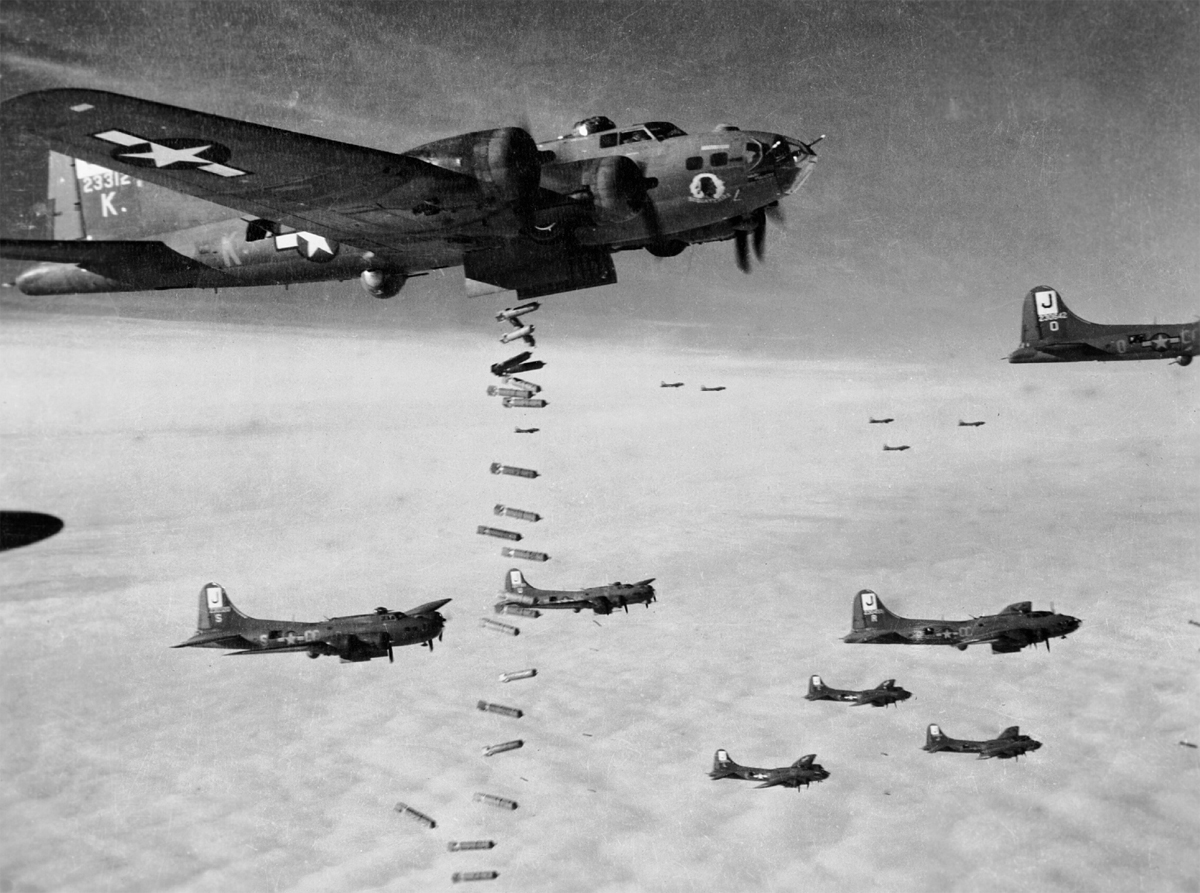
 Bombs fall away from a formation of American B-17s of the Eighth U.S. Army Air Force in a daylight raid over occupied Europe, sometime between 1942 and 1945. Despite the American intention to conduct “precision” attacks on identified targets, factors such as cloud cover (as shown here) and the need to fly in defensive formation meant that sometimes pilots simply released their bombs on a signal from the formation leader. © IWM HU 4052
 The rollout of the first B-29 Superfortress from a bomber plant at Offutt Air Force Base near Bellevue in eastern Nebraska, May 24, 1944. This new very-long-range heavy bomber allowed the United States to conduct bombing raids against Japanese home islands, including the missions in August 1945 that dropped nuclear bombs on Hiroshima and Nagasaki. LOC
14. Building the Atomic Bomb: The Manhattan Project
In 1939, world-famous physicist Albert Einstein sent a letter to Franklin D. Roosevelt alerting the president that science might soon yield a new and extremely powerful bomb—and that the Nazis might already be working to develop this weapon. FDR quickly ordered an advisory panel to examine the issue. In 1942, the United States now at war with Germany and Japan, FDR threw the full weight of the federal government behind a top-secret program to build the first atomic bombs, known as the Manhattan Project. Employing some 130,000 people at multiple sites—including sprawling federal facilities that sprung up almost overnight—the effort was an awesome display of what science, government, and industry can accomplish together. Its consequences were profound and manifold. After FDR’s death and the German defeat, the secrets unlocked in the Manhattan Project would rain death on the residents of two Japanese cities, finish World War II, change the course of postwar geopolitics, and open fertile new fields for science.
 A letter signed by Albert Einstein alerting Franklin D. Roosevelt that “extremely powerful bombs” might result from research in progress, August 2, 1939. The world-famous German Jewish physicist moved to America in 1933 when Hitler came to power, and became a U.S. citizen in 1940. The letters drafter, Einstein’s colleague Léo Szilárd, was a Hungarian-born Jew who also fled Hitler’s Germany in 1933; he would go on to work on the Manhattan Project in Chicago. FDRL
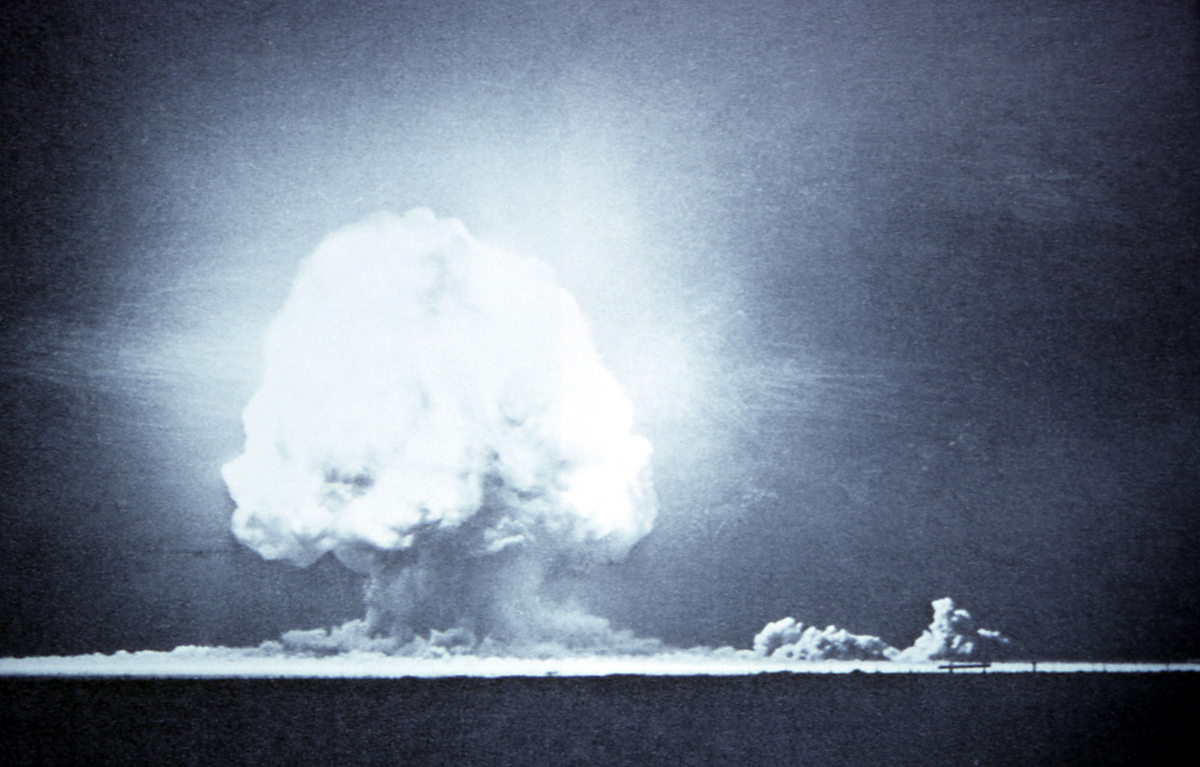 The first atomic explosion, New Mexico, July 16, 1945. Franklin D. Roosevelt, who had assigned the secret weapons project top priority in 1942, did not live to see the bomb tested. He died in April 1945. National Park Service
 A U.S. Army photo showing a devastated Hiroshima after the B-29 Enola Gay dropped an atomic bomb on the city at 8:15 a.m. local time, August 6, 1945. LOC
15. The Holocaust: The Nazi Slaughter of European Jews
As Allied forces pushed into German-occupied Europe in 1944 and 1945, they uncovered a vast network of concentration camps where the Nazis had carried out their plan to massacre the Jews along with others they deemed subhuman or enemies of the state. Reports of such atrocities had been coming out of Nazi-controlled territory for years; in December 1942, Allied governments had confirmed that a Nazi campaign “to exterminate the Jewish people in Europe” was under way. Yet even battle-tried commanders were deeply shocked by the depravity they discovered behind the camps’ barbed-wire perimeters.
In the late 1930s, the United States had received more Jewish refugees from Nazi Germany than did any other country, but rigid immigration quotas and State Department policies meant that many more who needed sanctuary could not get a visa to enter the United States. Franklin D. Roosevelt spoke out against Nazi atrocities, promised retribution for these crimes, and in early 1944, created a rescue agency to pluck Hitler’s intended victims from harm’s way. The director of this agency, the War Refugee Board, would call its efforts “little and late.”
FDR’s answer to the Nazi assault on humanity focused on articulating an opposing set of values—the Four Freedoms—and, crucially, on confronting the Nazis with unsparing military force. The Allies drove the Nazis from the face of the earth—but not before these committed killers had extinguished the lives of eleven million civilians, including six million Jewish men, women, and children.
 Two Germans walk past a Jewish business in Berlin vandalized during Kristallnacht (“Night of Broken Glass”), November 10, 1938. Although this spasm of anti-Jewish rioting across Greater Germany (it now included Austria) provoked disgust and concern in America, most Americans still did not want to admit more refugees to the United States. National Archives
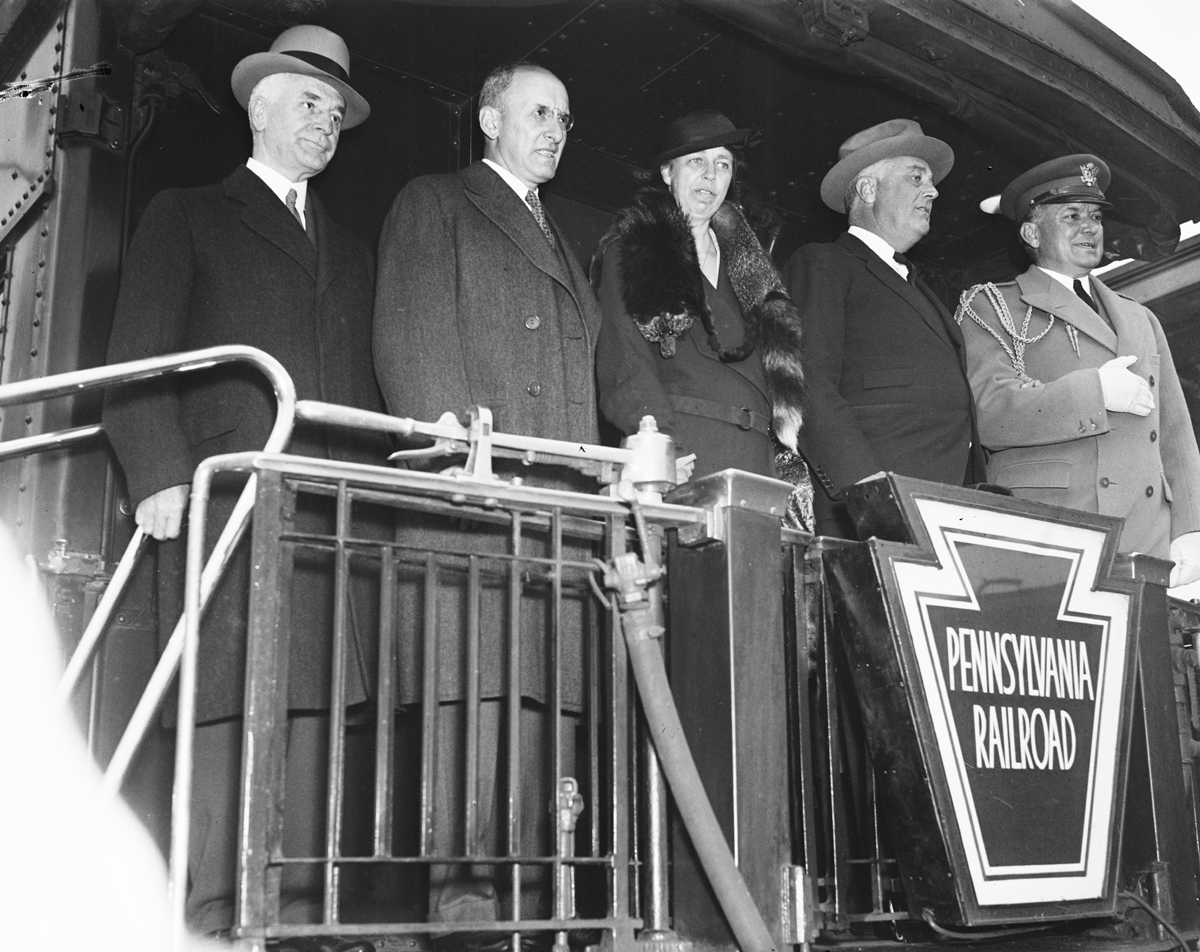 From left to right: Secretary of State Cordell Hull, Secretary of the Treasury Henry Morgenthau Jr., First Lady Eleanor Roosevelt, and Franklin D. Roosevelt, 1935. The top-ranking Jewish member of FDR’s administration, Morgenthau would be instrumental in pushing the president to form a United States rescue agency for Hitler’s intended victims—the War Refugee Board—in January 1944. He would run the board in concert with Hull and Secretary of War Henry Stimson. LOC
 Survivors at Buchenwald, a Nazi concentration camp in east-central Germany, days after its liberation by the U.S. Army, April 16, 1945. Some of its prisoners had been driven there by the Nazis from Auschwitz in Poland, which the Soviets had liberated on January 27, 1945. Although Americans had understood the Nazis were targeting Jews and other civilians for slaughter, they were deeply shocked by what they first encountered at Buchenwald and its subcamps—including corpses stacked like cord wood, crematory ovens for disposing of the dead, and survivors starved and tortured to within an inch of their lives. SDASM Archives
16. The Nuremberg Trials: Nazi Criminals Face Justice
Initially there was deeply felt disagreement in Franklin D. Roosevelt’s cabinet and among the major Allies about how best to deal with defeated Nazis. Some, including British prime minister Winston Churchill, believed the Allies should execute top Nazis as soon as they laid hands on these “arch-criminals.” Others proposed an international legal process that would meet the Nazis’ iniquity with reason and moral force and, not incidentally, leave a detailed document of their astonishing crimes for future generations. FDR himself was of two minds on the subject, but by early 1945 had come out strongly in favor of trials.
The result: From November 1945 through August 1946, twenty-three high-level Nazis faced justice before an international tribunal at Nuremberg, Germany; nineteen were convicted. Between 1946 and 1949, U.S. military tribunals in Nuremberg tried scores more perpetrators, from Nazi doctors who performed wicked human experiments to industrialists who exploited the slave labor of prisoners. “What these men stand for we will patiently and temperately disclose,” chief U.S. prosecutor Robert H. Jackson said in his opening statement in the primary trial. “We will give you undeniable proofs of incredible events.”
 General Dwight D. Eisenhower (center-right in military cap) and other U.S. Army officials view the bodies of slain prisoners at Ohrdruf, a satellite camp of Buchenwald, shortly after the camp’s liberation, August 12, 1945. On the same day, Franklin D. Roosevelt died in Warm Springs, Georgia. Though he had advocated international trials to hold Nazis accountable, the major Allies were not yet agreed on this approach. National Archives
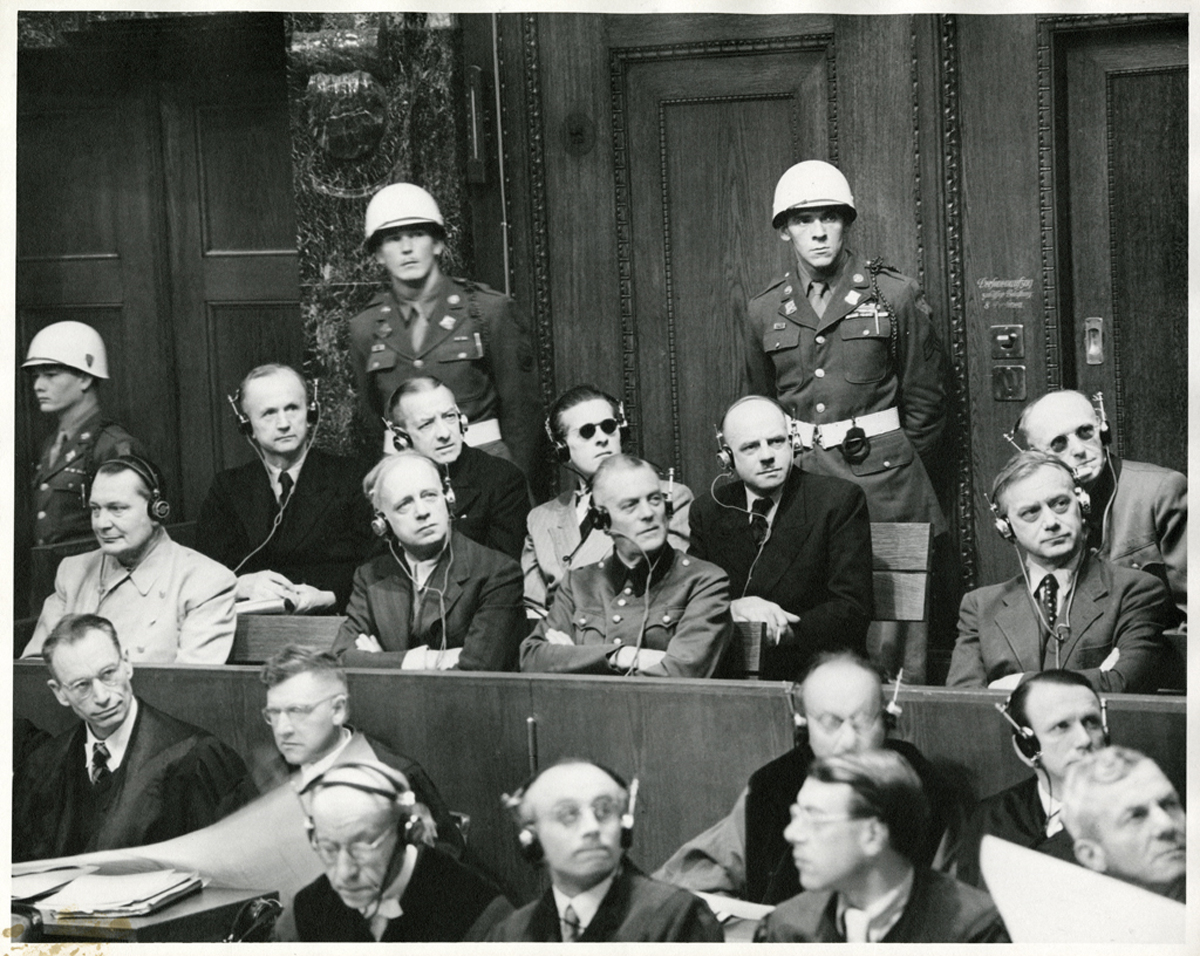
 The prisoners’ dock at the Nuremberg trial of major war criminals, 1945. The individual fates of the “twenty-odd broken men” who sat in the dock were of little consequence to the world, said top American prosecutor Robert H. Jackson. But to expose and indict what they stood for was of utmost importance. Said Jackson: “We will show them to be living symbols of racial hatreds, of terrorism and violence, and of the arrogance and cruelty of power.” Truman Library
 Karl Brandt, personal physician to Adolf Hitler, receives his sentence—death by hanging—in the so-called Doctors’ Trial, August 20, 1947. Brandt took part in human experimentation on concentration camp prisoners and helped run the Nazi “euthanasia” program to eliminate people with physical or mental disabilities. He was executed on June 2, 1948.
17. The United Nations: FDR and the Creation of the Postwar World
Franklin D. Roosevelt and others of his generation observed the aftermath of World War I with profound dismay. As the world economy slumped into depression, a failure to “wage peace,” as FDR put it—the United States had refused even to join the new League of Nations in 1920—led to the rise of strident nationalisms and renewed bloodshed in the 1930s. FDR was determined to ensure that an Allied victory in World War II, with all the sacrifice that implied, left the world with structures to prevent lawless violence among nations and instead settle disputes through dialogue and cooperation.
Even before the United States entered World War II in December 1941, he began articulating these values and setting in motion the international collaboration that would lead to the founding of the United Nations, with America as a leading member, just a few months after his death in April 1945. “In our disillusionment after the last war,” FDR said in his final State of the Union address in January 1945, “we preferred international anarchy to international cooperation with Nations which did not see and think exactly as we did. We gave up the hope of gradually achieving a better peace because we had not the courage to fulfill our responsibilities in an admittedly imperfect world. We must not let that happen again, or we shall follow the same tragic road again—the road to a third world war.”
 The United Nations Declaration pledging to resist and battle the Axis powers, January 1, 1942. Issued just weeks after America entered World War II in the wake of Pearl Harbor, the document was originally signed by representatives of twenty-six supporting nations, “being convinced that complete victory over their enemies is essential to defend life, liberty, independence and religious freedom, and to preserve human rights and justice in their own lands as well as in other lands.” UN Photo/VH
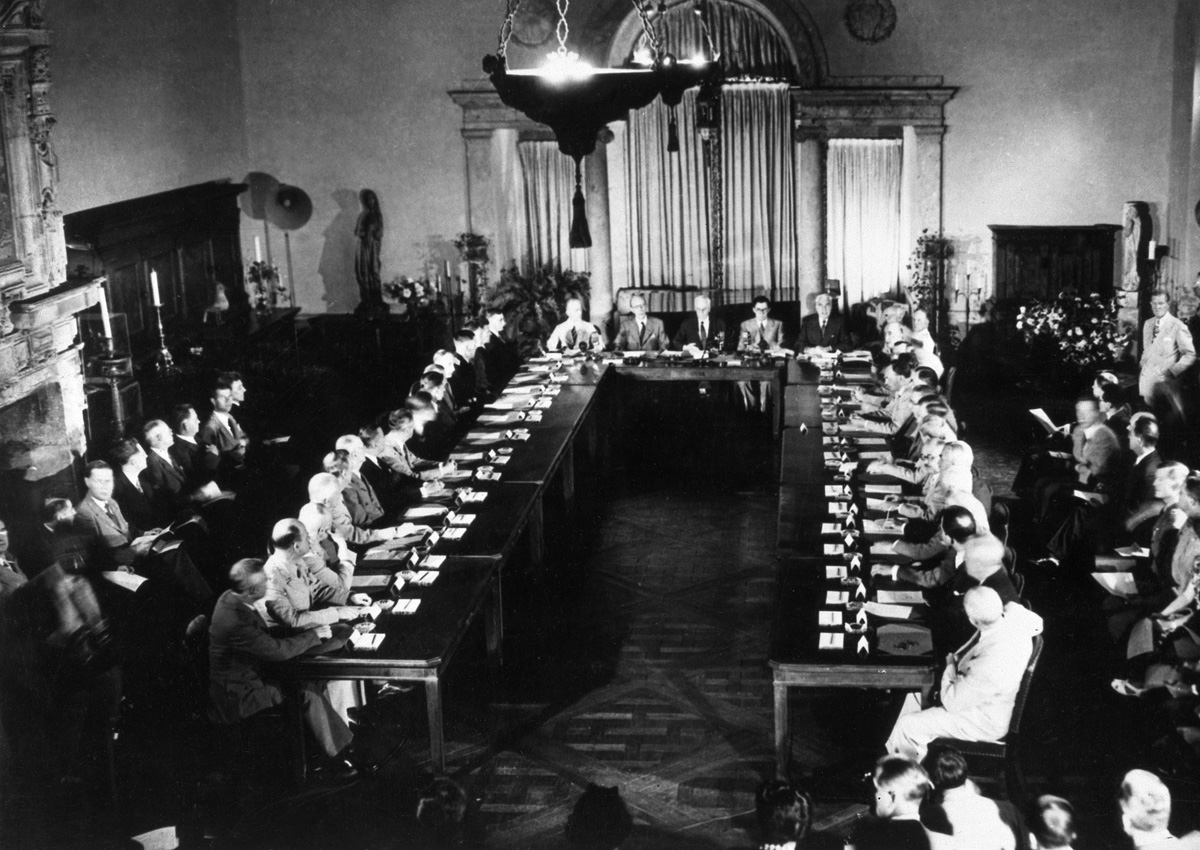
 Conferees at Dumbarton Oaks in Washington, DC, in a meeting formally titled Washington Conversations on International Peace and Security Organization, August 1944. In the meetings, American, British, Soviet, and Chinese officials hammered out proposals for how the United Nations would be organized, shaping plans for a General Assembly and Security Council. LOC
 Pedro Leão Velloso, Brazil’s foreign minister and chairman of its United Nations delegation, signs the UN Charter at a ceremony held in San Francisco’s Veterans Building on June 26, 1945. On the same day, U.S. Secretary of State Edward Stettinius Jr. signed the newly approved founding document of the UN. “This charter is a compact born of suffering and of war,” he said. “With it now rests our hope for good and a lasting peace.” The charter would be ratified in October, and on December 4, 1945, the U.S. Senate would vote to approve U.S. membership in the new organization. UN Photo/McLain
18. Defining a Humane World: Eleanor Roosevelt and the Universal Declaration of Human Rights
In December 1945, President Harry Truman courted Eleanor Roosevelt, the widow of his beloved predecessor, by asking her to serve as a delegate to the newly formed United Nations. ER’s fellow UN delegates expected little from her. But as representative to the new organization that embodied her husband’s long-cherished dream of international cooperation, ER would go on to lead the drafting of one of the twentieth century’s most important documents—the Universal Declaration of Human Rights. It was no simple task to achieve agreement among the diverse nations of the UN on a first-ever statement laying out the basic rights—political, civil, social, and economic—of every person on earth. But the General Assembly adopted the groundbreaking declaration without dissent on December 10, 1948, thanks in no small part to ER’s leadership.
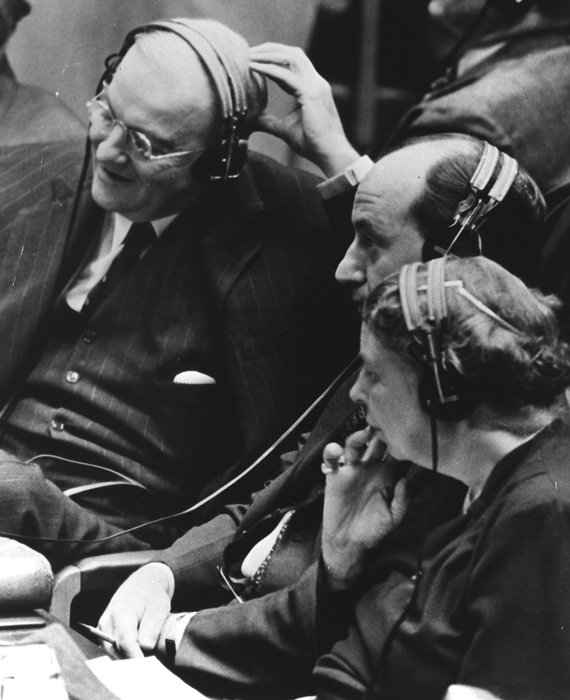
 Eleanor Roosevelt addresses the United Nations General Assembly at its first meeting in January 1946, at Central Hall, Westminster, London. Her husband, Franklin D. Roosevelt, had died in April, just weeks before the UN’s formal founding in San Francisco. ER, like FDR, believed deeply in the organization’s goals. FDRL
 The drafting committee of the Universal Declaration of Human Rights at work on June 9, 1947. Composing a list of universally affirmed human rights was a task fraught with political controversy. Westerners were wary of guaranteeing “socialist” economic rights, for example, while the Soviets were not keen to support a right to political dissent. UN Photo
 Eleanor Roosevelt holding a copy of the Universal Declaration of Human Rights shortly after its adoption by the United Nations General Assembly in December 1948. After voting on the declaration, the delegates rose to honor ER with the first standing ovation in the organization’s history. National Archives
Download PDFs
Download the in-depth history as a pdf to print, save, and share.
1.Day of Infamy: Japanese Expansionism and the Attack on Pearl Harbor
2.War in Europe: 1939 to 1945
3.War in the Pacific: 1937 to 1945
4.“We Are All in It”: Franklin D. Roosevelt and the American Home Front
5.Evicted and Detained: The Internment of Japanese Americans
6.Bundles for Britain: Sending Warmth (and Woolens) to a Nation at War
7.Bundles from Britain: Child Evacuations from Wartime Britain
8.The Special Relationship: Franklin D. Roosevelt and Winston Churchill
9.The Dictator and the Democrat: Adolf Hitler and Franklin D. Roosevelt
10.A Wartime Alliance: Franklin D. Roosevelt and Joseph Stalin
11.Commander in Chief: FDR as Leader of the Nation’s Armed Forces
12.Grand Strategy: Franklin D. Roosevelt and the Wartime Conferences
13.Destruction from the Air: Strategic Bombing in World War II
14.Building the Atomic Bomb: The Manhattan Project
15.The Holocaust: The Nazi Slaughter of European Jews
16.The Nuremberg Trials: Nazi Criminals Face Justice
17.The United Nations: FDR and the Creation of the Postwar World
18.Defining a Humane World: Eleanor Roosevelt and the Universal Declaration of Human Rights
IV. Statesman & Commander
in Chief: FDR in WWII
1941 – 1945
Statesman & Commander in Chief includes eighteen chapters,
on subjects from the American home front in World War II
to the post-war Nuremberg trials of Nazi officials.
click the “In Brief” button at upper right.
click the chapter arrow at lower left.
1. Day of Infamy:
Japanese Expansionism and
the Attack on Pearl Harbor
In May 1940, British prime minister Winston Churchill sent Franklin D. Roosevelt a lengthy telegram analyzing the war in Europe and detailing the supplies Britain needed to fight off the Nazis.
"I am looking to you," Churchill added, "to keep that Japanese dog quiet in the Pacific."
The island nation of Japan, though ruled by an emperor considered semidivine, was increasingly controlled by its military. By the time of Churchill's cable, Japan already had invaded the Chinese province of Manchuria, set up a puppet regime there, then driven relentlessly into China proper, committing, along the way, shockingly sadistic atrocities that Americans could read about in publications like Reader's Digest.
FDR had done little to check or penalize Japan's aggression. He and Churchill both were far more concerned about Nazi Germany. And the American public, with its broad and influential isolationist streak, was reluctant to go to war even against Hitler, whose expansionist plundering in Europe was already well advanced and seemed to strike closer to home.
In fact, Japan and Germany were driven by similar passions. Just as Germany sought additional lebensraum (living space) in the east, Japan, heavily populated and poor in natural resources, wanted space, markets for its industrial products, and raw materials like rubber, oil, and metals. It sought to corral these resources by uniting and dominating Asia, first in a "New Order" including Manchuria and China, and then, by June 1940, in a "Greater East Asia Co-prosperity Sphere" that would take in Southeast Asia—including colonies held by the British, French, and Dutch, as well as the U.S.–controlled Philippines.
Japan's bellicose ideology, like Germany's, contained a strong racial element. Japanese leaders believed their country's ascent to the status of world power depended on driving from its backyard Western nations that had helped themselves to Asian territories while promulgating racist theories of Asian inferiority. Japan deeply resented the West's rejection of a racial-equality clause it had proposed for the peace treaty that closed World War I, as well as America's policy of rigidly and specifically barring Japanese and other Asian immigrants from its shores. When the United States refused to acknowledge Japan's takeover of Manchuria, a Japanese diplomat bitterly observed, "The Western powers taught Japan the game of poker, but after it acquired most of the chips they pronounced the game immoral and took up contract bridge."
Of course, other Asian peoples soon learned that Japan did not mean to share power with them—in fact, it regarded them as inferior.
Already feverishly building its navy against the threat of war in two vast oceans, America first took forceful action against Japanese aggression with economic sanctions. After the fall of France in the summer of 1940, Japan signed the Tripartite Pact pledging cooperation with Italy and Germany, and moved into northern French Indochina, prompting the United States to ban the sale of aviation fuel, iron, and steel scrap to Japan. After Hitler invaded Russia in 1941, Japan, relieved of the Soviet threat that had long troubled its northern frontier, invaded southern Indochina. Now the United States froze Japanese assets in America, effectively banning the sale of American oil to Japan. And so the dominoes fell.
FDR had been reluctant to test Japan with an oil embargo. Japan was highly dependent on the United States for iron, scrap steel, and especially oil, all vital to military operations. Deprived of these resources, Japanese leaders might be forced to abandon their deeply held expansionist aspirations.
As many had feared, Japan instead resolved to seek its raw materials by advancing further south in East Asia. But first, it had to cripple American naval power in the Pacific. On December 7, 1941, a few minutes before eight in the morning Hawaiian time, the attack began.
AThe “China Incident”
BUSS Panay
C“Preparations for War”
D“A Date Which Will Live in Infamy”

 1. Day of Infamy: Japanese Expansionism and the Attack on Pearl Harbor
CLICK titles for text and images for captions
1. Day of Infamy: Japanese Expansionism and the Attack on Pearl Harbor
CLICK titles for text and images for captions
2. War in Europe:
1939 to 1945
Although the Germans took over Austria and Czechoslovakia in 1938, it was the Nazi invasion of Poland in September 1939 that triggered England and France to declare war on the Nazis, launching World War II in Europe. America's decisive entry into World War II after Japan's bombing of Pearl Harbor in December 1941 brought great relief and rejoicing in London and Moscow, where leaders had watched nation after nation topple before the Nazi onslaught and feared that without major reinforcements from abroad, theirs would be the next to fall. But it was by no means certain that even this newly formed "Grand Alliance" would achieve victory in what was now a truly global war. Indeed, over the course of the first six to eight months of 1942, the Allies suffered a string of defeats so devastating it seemed their coalition might come undone. The Axis powers—Germany, Italy, and Japan—were handily redrawing the map of the world.
In the Pacific, Japanese forces overran Hong Kong, the Dutch East Indies, Malaya, Singapore, the Philippines, and Burma. It looked as if the Japanese might also capture India, Australia, and New Zealand—and finally prostrate China, driving it from the war.
Meanwhile, in North Africa, Axis forces under the command of General Erwin Rommel advanced to within sixty miles of the Suez Canal, where, by June 1942, they were in a position to cut off this vital link between Great Britain and her empire. In the North Atlantic, German submarine attacks on Allied merchant shipping intensified to a harrowing peak.
Most worrying was the situation in Russia. German forces had recovered from the Soviets' heroic defense of Moscow in December 1941 and had launched a new offensive in the south of the country, designed to seize the Caucasus oil fields and cut off the Volga River at Stalingrad. If the Soviet Union were to fall to this new German offensive, the consequences for the West would be catastrophic.
In the years ahead, the leadership of President Franklin D. Roosevelt would be critical to the war effort. He already had pushed a major military buildup in the United States and a generous program of supplying arms to the British and Russians. Now FDR's ability to work closely with British prime minister Winston Churchill and Soviet leader Joseph Stalin despite their differing hopes for a postwar world—and his unflagging nerve in the direst circumstances—would help steer America and its allies to victory.
FDR did not live to see the end of World War II. He died suddenly of a brain hemorrhage in Warm Springs, Georgia, on April 12, 1945. The people of America grieved deeply for the president they'd elected four times.
But nothing could restrain their joy when just a few weeks later, on May 8, the war in Europe ended with Germany's unconditional surrender—just as FDR and his fellow Allied leaders had insisted it would. The nation's flags still at half-staff to mark FDR's passing, Americans poured into streets and public squares all over the country, cheering and embracing in a spontaneous outpouring of emotion. Against great odds and at great sacrifice, the Allies had consigned the Nazi juggernaut to history.
AA First Move: Franklin D. Roosevelt and the Decision for North Africa, 1942
BOperation Torch and
the Birth of the Mediterranean
Strategy, 1942–43
CD-day and the Second Front, Summer and Fall 1944
DAdolf Hitler’s Bold Move:
The Battle of the Bulge,
December 1944–January 1945
EThe Fall of Berlin and the End of the Third Reich, Spring 1945
2. War in Europe: 1939 to 1945
CLICK titles for text and images for captions
3. War in the Pacific:
1937 to 1945
All during the late 1930s, President Franklin D. Roosevelt watched with intense concern as fascists marched across Europe. But the provocation that finally brought America into World War II came not from a German submarine trawling the Atlantic, but from Japanese bombers winging across the Pacific to bomb Pearl Harbor. And the bloodiest war in history would finally end not with the surrender of Nazi Germany in May 1945, but three months later, after the United States dropped nuclear bombs on Japanese cities.
The Axis Pact of September 1940, in which Imperial Japan had pledged alliance with Adolf Hitler and Benito Mussolini, was a matter of expediency as much as shared values. But the aggressor nations had this in common: they wanted to acquire territory and the resources that came with it.
The Japanese strike on Pearl Harbor was only the most destructive of several simultaneous attacks that took place on December 7, 1941. As FDR noted the next day in his famous "date of infamy" speech, the Japanese also attacked Malaya, Hong Kong, Guam, Wake Island, and the Philippines. Their goal was to advance from these initial assaults over a wide area of the Pacific, from Burma and the Aleutian Islands in the north to Fiji and New Caledonia in the south, seizing the resource-rich Dutch East Indies in the process. The Japanese hoped this stunning blow delivered to the U.S. fleet at Pearl Harbor, combined with the rapid seizure of a vast territory, would so debilitate the American military and demoralize the American public that the United States would sue for peace, leaving the Japanese empire to enjoy the spoils of a sweeping domain its leaders called "the Greater East Asia Co-Prosperity Sphere."
Japanese forces swiftly achieved nearly all of their initial goals. By the end of January, Malaya was in their hands; by the end of February, they held the Dutch East Indies. In the Philippines, American forces under the initial command of General Douglas MacArthur managed to hold out on the Bataan Peninsula and the Island of Corregidor for some months, but in early May, after FDR ordered MacArthur to leave, they, too, succumbed to the Japanese advance. Perhaps the most humiliating defeat of all, however, took place at the British island base of Singapore, where more than seventy thousand British and Commonwealth troops fell to a Japanese force of roughly half that number in mid-February 1942.
Having secured most of Burma and the northern coast of New Guinea by the end of May, the Japanese were now in a position to threaten India, Australia, and New Zealand, and, thanks to the closure of the Burma Road by which China received needed supplies, possibly even to neutralize that longtime foe.
The massive Japanese offensive that followed Pearl Harbor put the United States on the defensive in the Pacific War. But the vigorous military buildup FDR had initiated in 1939 ensured that the balance of naval power would soon turn in America's favor. Though FDR continued to insist on a strategy of defeating "Germany First," the United States would prove capable of sending reinforcements to the Pacific—and launching offensive operations in that theater much earlier than expected.
AAmerica Strikes Back:
The Doolittle Raid
BTurning Point: The Battle of Midway
CThe Fight for Guadalcanal
DPacific Island Advance:
Campaign for the Gilbert,
Marshall, and Mariana Islands
EReturn to the Philippines and the Battle of Leyte Gulf
FClosing In: Iwo Jima and Okinawa
G“Utter Destruction” from the Air
3. War in the Pacific: 1937 to 1945
CLICK titles for text and images for captions
4. “We Are All in It”:
Franklin D. Roosevelt and
the American Home Front
On the eve of World War II, America was depleted by years of economic depression and disillusioned by the bitter aftermath of the First World War, once billed as "the war to end all wars." Much of American industry lay idle, its armed forces vastly underdeveloped. Whether measured in logistical terms or by morale, Americans were not ready to face the combined might of the Axis powers.
But Franklin D. Roosevelt understood that face it they must or surrender everything they held dear. He knew that in order to prevail, Americans must confront this tremendous threat as one people, with a unity of purpose perhaps not seen since the Revolution. In the annals of history, one of FDR's greatest achievements was the way he summoned the American people to this mission.
After a tour around the country inspecting defense plants and other war-readiness programs in October 1942, FDR spoke to the country in a fireside chat. "This whole nation of one hundred and thirty million free men, women and children," he said, "is becoming one great fighting force. . . . A few of us are decorated with medals for heroic achievement, but all of us can have that deep and permanent inner satisfaction that comes from doing the best we know how—each of us playing an honorable part in the great struggle to save our democratic civilization."
The American home front was indeed critical to Allied victory. Ultimately more than sixteen million Americans would serve in the armed forces during the conflict—far more than in any war before or since. But well before the country sent large numbers of soldiers overseas in 1943 and especially 1944, its home industries were beating the Axis in the vital area of armaments production. The United States outproduced all the Axis countries as well as the other Allies by a large margin, and many have argued this "crushing superiority of equipment," as FDR put it shortly after Pearl Harbor, was a deciding factor in the war. In an extraordinary burst of effort, Americans converted industrial plants and ramped up output to arm both the Allies and themselves, nearly doubling the country's gross domestic product in the process.
This undertaking required a very high level of cooperation and coordination. Labor and management had to lay aside their differences to keep plants running 24–7. Both had to relinquish prejudices against women and minority workers. Meanwhile, everyone accepted federal controls on prices and wages to prevent war spending from boosting the cost of living to untenable heights. They accepted bans on the manufacture of certain consumer products so that materials could be diverted to war production, and rationing of food and other commodities to make sure that everyone got the essentials despite inevitable shortages. People saved the earnings from their long hours on the job, conserved resources in their homes and neighborhoods, and invested in war bonds to support their country. They grew and canned their own food.
Throughout the war, FDR reminded Americans at home that every one of these choices mattered in the great contest that would decide whether their way of life stood or fell. Now more than ever, his fireside chats riveted listeners. In the summer of 1943, for example, FDR used a radio broadcast to admonish his countrymen, "The next time anyone says to you that this war is 'in the bag,' or says 'it's all over but the shouting,' you should ask him these questions: 'Are you working full time on your job? Are you growing all the food you can? Are you buying your limit of war bonds? Are you loyally and cheerfully cooperating with your Government in preventing inflation and profiteering, and in making rationing work with fairness to all?' . . . It is not too much to say that we must pour into this war the entire strength and intelligence and will power of the United States."
The challenge was formidable and even terrifying, but FDR's sure-footedness and seemingly eternal optimism helped sustain Americans in the cause to which he had rallied them. He always believed that their strength and intelligence and willpower would carry them to victory. "Whatever our individual circumstances or opportunities," he told them in 1942, "we are all in it, and our spirit is good, and we Americans and our allies are going to win—and do not let anyone tell you anything different."
AArming America and Its Allies
BBack to Work
CManaging a Wartime Economy
“All excess income should go to win the war.”
Franklin D. Roosevelt, 1942
D“Make It Do”: Saving and Rationing
EA Nation of Volunteers
FR & R on the Home Front
GHome Again: The G.I. Bil
4. “We Are All in It”: Franklin D. Roosevelt and the American Home Front
CLICK titles for text and images for captions
5. Evicted and Detained:
The Internment of
Japanese Americans
In the months after the Japanese bombed Pearl Harbor, under Franklin D. Roosevelt's leadership and by the authority of his executive orders, the United States orchestrated what an official report would call "the massive eviction of an entire ethnic group"—people of Japanese ancestry—from America's West Coast. After expelling these families from their homes in California, Oregon, Washington, and Arizona, the government held them under armed guard in isolated, hastily constructed camps scattered across the West for more than two years. More than 110,000 people—men, women, and children whose only crime was their Japanese ethnicity—experienced this forced migration and internment. Two-thirds were American citizens and more than half were minors.
The government's rationale for this action: "military necessity." Shocked that Imperial Japan had come as far as Hawaii in its opening salvo against the United States, Americans, including top military brass, feared the enemy's next move might be to launch a lethal strike on the U.S. mainland. Military leaders—particularly Lieutenant General John DeWitt, who headed the command responsible for protecting America's Pacific coast—argued that Japanese Americans living in the region might maintain a strident loyalty to Japan's militarist regime and collude in an attack on the vulnerable U.S. coast.
At the "exclusion" policy's inception in February 1942, there was no evidence of disloyalty, much less of treason, among ethnic Japanese communities. Nor did any emerge later. In any event, the program made no attempt to base evacuation and confinement on individual culpability. "It was unfortunate," Secretary of War Henry Stimson wrote in a 1943 report on the evacuation, "that the exigencies of the military situation were such as to require the same treatment for all persons of Japanese ancestry, regardless of their individual loyalty to the United States. But in emergencies, where the safety of the Nation is involved, consideration of the rights of individuals must be subordinated to the common security."
Western members of Congress strongly advocated the internment program. At the time, California Attorney General Earl Warren, who as chief justice of the U.S. Supreme Court in the 1950s and '60s would go on to play a key role in dismantling racial segregation in America, supported Japanese internment. In 1944 the U.S. Supreme Court upheld the exclusion orders as constitutional.
But some forty years later, a bipartisan federal commission would hear testimony from former internees—testimony about disrupted lives, lost homes and businesses, and deep emotional injury—and conclude that they had suffered a "grave personal injustice" at the hands of the federal government. "The broad historical causes that shaped [the policy] were race prejudice, war hysteria and a failure of political leadership," the report said. "Widespread ignorance about Americans of Japanese descent contributed to a policy conceived in haste and executed in an atmosphere of fear and anger at Japan." Issued in 1983, the report led to bipartisan passage of the Civil Liberties Act of 1988, which extended an official American apology to Japanese internees, giving each $20,000 in reparations.
APrewar Anti-Asian Sentiment
B“Exclusion” Gets Underway
CLife in Camp
DKorematsu’s Challenge
EJapanese Americans in Uniforms
FPeople of Japanese Ancestry in Hawaii
GLoyalty Questionnaires
5. Evicted and Detained: The Internment of Japanese Americans
CLICK titles for text and images for captions
6. Bundles for Britain:
Sending Warmth (and Woolens)
to a Nation at War
On September 1, 1939, the American people awoke to the news that Germany had launched a massive attack on Poland. The Second World War had begun.
As news reports poured in detailing the horrors of modern war—the fear and destruction of aerial bombing; the plight of an ever-increasing flood of war refugees; and the intensifying struggle to keep the Atlantic lifeline to Europe open—ordinary Americans were eager to find ways to aid and comfort their besieged friends across the ocean.
President Franklin D. Roosevelt endorsed this humanitarian impulse within weeks of the outbreak of war in Europe. "While we, as a Nation, are neutral in the present tragic war in Europe," he said, "I am sure we cannot be indifferent to the suffering inflicted upon the helpless women and children. It is traditional the American people should wish . . . to extend material aid to the helpless victims of war abroad."
By December 1939, hundreds of small relief organizations began to spring up in various parts of the country. Natalie Wales Latham, a glamorous fixture of New York City society, launched one of these groups. Latham believed that Great Britain was "suffering more than is generally realized" and that the island nation, as defender of "the ideals of liberty, democracy, human decency and freedom of spirit," deserved all the help Americans could offer.
The British Red Cross had recently issued an urgent appeal for "sweaters, knitted helmets, gloves, and socks." So on January 14, 1940, in a small abandoned office on Park Avenue, she and a small group of like-minded friends began to knit the first of thousands of woolen garments to be bundled together and shipped to the British Isles. Thus was born one of the most popular—and most important—nonprofit wartime relief organizations: Bundles for Britain.
Latham, a divorced mother of two young children, hoped she could inspire others to join her. But she had no idea on that cold January morning when she and her friends took up their needles that Bundles for Britain would eventually include an astonishing 1.5 million volunteers in every city and hamlet of the country—or that they'd produce hundreds of thousands of knitted garments in which the men, women, and children of wartime Britain could wrap themselves for warmth. Within a year's time the program became so popular in America that the dean of a women's college in Illinois complained that knitting the bundles "interferes . . . with a college girl's education now more than any other distraction." The dean continued, "If a student starts talking about a number 5, 6, or 7 these days, she doesn't mean shoes or stockings. All she wants is a pair of new knitting needles."
This was a way for Americans to engage emotionally and practically in the war effort, a potent counterweight to the antiwar, isolationist mood that dominated in the years before the attack on Pearl Harbor brought the country fully into the conflict. Meanwhile, Britons took to looking up the American communities indicated on the labels of the knitwear they received, curious about the people who made it. Bundles for Britain became a way to knit together the people of Britain and America, nurturing an affinity that foreshadowed the grand political and military alliance that would win the war. Britons writing letters of thanks for the packages would often begin simply, "Dear Bundles."
AA Growing Concern
BFriends in High Places
CBundles for America
DA Cause Completed
6. Bundles for Britain: Sending Warmth (and Woolens) to a Nation at War
CLICK titles for text and images for captions
7. Bundles from Britain:
Child Evacuations from
Wartime Britain
“I think it is well also for the man in the street to realize that there is no power on earth that can protect him from being bombed. Whatever people may tell him, the bomber will always get through.”
—British prime minister Stanley Baldwin to the House of Commons, November 10, 1932
On July 29, 1940, the British passenger liner SS Britannic docked in New York Harbor carrying a special cargo—272 children evacuated from a Great Britain gripped by war. These young people made up a small portion of the estimated fifteen to twenty thousand British children spirited to safety overseas during the course of World War II. Among the passengers arriving in New York that day was fourteen-year-old Alistair Horne, who later became a well-known author and historian. His memoir, A Bundle from Britain, recounts his heartfelt experience as a child evacuee.
Horne coined the term as a play on the name of a popular wartime program, Bundles for Britain, in which American volunteers bundled together huge quantities of hand-knitted garments and other materials for shipment to the war-ravaged British Isles. These gifts Americans sent to besieged Britons and the cherished children they in turn entrusted to American shores helped weave the two peoples together in what British prime minister Winston Churchill would later call the "special relationship."
AOrigins of the Evacuation Program
BOperation Pied Piper
CThe Fall of France
and the “Mercy Ship”
Campaign
DBundles from Britain
The National Archives UK
The National Archives UK
EAn Enduring Legacy
7. Bundles from Britain: Child Evacuations from Wartime Britain
CLICK titles for text and images for captions
8. The Special Relationship:
Franklin D. Roosevelt and
Winston Churchill
As the world came unwound, Winston Churchill and Franklin D. Roosevelt built the most celebrated political relationship in modern history. Between September 1939, when Britain declared war on Germany, and Franklin D. Roosevelt's untimely death in April 1945, the two men exchanged nearly two thousand letters and cables. They met eleven times.
During these years, both understood that their relationship—their ability to understand each other and work together—was of utmost consequence to their own nations and to the world. To reach the location of their first meeting, a shipboard rendezvous in the waters off Newfoundland in the summer of 1941, Churchill crossed an Atlantic infested with German submarines, and FDR constructed an elaborate ruse to make the press believe he was fishing off Cape Cod. Emissaries and transatlantic cables would no longer suffice. At this moment when Britain desperately required America's help in the struggle against the Nazis, the two leaders knew they had to meet face-to-face.
What developed between FDR and Churchill was a give-and-take of extraordinary candor, leavened by great mutual admiration. Churchill had begun his career as a war hero and writer, FDR as a New York lawyer and politician, and both men had a deep interest in history and a gift for language. Churchill was emotional and at times blunt, while FDR was more apt to exude a charming cordiality even in the face of ideas he was determined to oppose. Yet both men possessed an intense, magnetic personality that inspired and attracted others. In the early 1940s, history contrived to concentrate in these two leaders an uncommon share of responsibility for the future of civilization—and that was something else they had in common.
FDR and Churchill became friends, their exchanges largely unconstrained by the formalities of high office. They talked, dined, and drank together, and they stayed up late following Churchill's habit. The British prime minister lodged for weeks at a time in the Queens' Bedroom on the second floor of the White House. "I was solicitous for his comfort," Eleanor Roosevelt would later write, "but I was always glad when he departed, for I knew that my husband would need a rest, since he had carried his usual hours of work in addition to the unusual ones Mr. Churchill preferred."
After Churchill returned home from his first stay at the White House over Christmas of 1941, FDR wrote him a long missive on war matters, closing it with the warm remark, "It is fun to be in the same decade with you." Not long after FDR's death, Churchill would say that meeting him had been "like uncorking your first bottle of champagne."
The president and prime minister enjoyed each other. But while their relationship was marked by a lack of ceremony, it was hardly casual. In fact, it was FDR's style to draw his associates close, making little distinction between work and personal life. Advisors Louis Howe and later Harry Hopkins lived with the Roosevelt family for years. Secretary Marguerite LeHand was both a colleague and a constant companion. And ER, his wife and mother of his children, was every bit as much his political partner. It might be said that he mixed work with pleasure—or indeed that both were part of the mission to which he devoted himself completely.
So it was with Churchill. The two men cultivated each other's friendship, not insincerely but as the ultimate act of diplomacy. Each leader remained ever alert to his own nation's separate interests. FDR did not hesitate to oppose and disappoint Churchill, especially as the balance of world influence shifted in FDR's favor. But FDR and Churchill also recognized that, to a great extent, the interests of their two peoples were not just overlapping but inextricably joined. So much was at stake.
AAn Early Encounter, 1918
BThe President and the “Naval Person,” Fall 1939
CThe Fall of France, Spring 1940
“You ask, what is our policy? I can say: It is to wage war, by sea, land and air, with all our might and with all the strength that God can give us; to wage war against a monstrous tyranny, never surpassed in the dark, lamentable catalogue of human crime.”
Winston Churchill in the House of Commons, May 13, 1940
DThe Battle of Britain and
the “Destroyers for Bases” Deal,Summer and Fall 1940
EThe Great Arsenal of Democracy,
Early 1941
FThe Atlantic Charter
and American Entry into the War,
June–December 1941
“Well, we are all in the same boat now.”
Franklin D. Roosevelt to Winston Churchill, by telephone on the day of Pearl Harbor, December 7, 1941
GChristmas in the White House, December 1941
“I spend this anniversary and festival far from my country, far from my family, yet I cannot truthfully say that I feel far from home. Whether it be the ties of blood on my mother’s side, or the friendships I have developed over here over many years of active life, or the commanding sentiment of comradeship in the common cause of great peoples who speak the same language, who kneel at the same altars, and to a very large extent, pursue the same ideals, I cannot feel myself a stranger here.”
Winston Churchill at the White House, Christmas 1941
HCrafting the Grand Alliance
ID-day
JThe Yalta Conference
KWinston Churchill and the Death of Franklin D. Roosevelt
8. The Special Relationship: Franklin D. Roosevelt and Winston Churchill
CLICK titles for text and images for captions
9. The Dictator and
the Democrat: Adolf Hitler
and Franklin D. Roosevelt
CAPTION
AConfronting a Dangerous Man
9. The Dictator and the Democrat: Adolf Hitler and Franklin D. Roosevelt
CLICK titles for text and images for captions
10. A Wartime Alliance:
Franklin D. Roosevelt and
Joseph Stalin
Never one to accord ideology much weight, Franklin D. Roosevelt tended to regard the Union of Soviet Socialist Republics (USSR), a federation of communist republics dominated by Russia and formed in 1922 after a three-year Russian civil war, the same way he viewed Russia itself—as a continental power largely devoid of colonial ambitions that was driven by the same fears and ambitions as Europe's other leading states. Though concerned about the zealous rhetoric found in Soviet communism, FDR regarded the adherents of Nazism and Japanese militarism as far more dangerous. These ideologues were bent on world conquest by any means, whereas FDR remained convinced that the American people would never wholeheartedly embrace communism, a philosophy advocating class war and collective ownership of property that he considered alien to American culture and experience.
This is not to say that FDR had any illusions about Joseph Stalin or the nature of the Soviet regime. FDR understood that Stalin was an oppressive and even violent ruler, asserting in 1940 that the USSR was run by "a dictatorship as absolute as any other dictatorship in the world." But Stalinist Russia, focused inward and more concerned about protecting itself from external threats than with spreading communist ideology, could also serve as a counterweight to both German and Japanese expansionism.
It is for this reason that FDR made the decision to recognize the Soviet Union in 1933, and, in the aftermath of Russia's entry into World War II, to offer Stalin substantial American military and economic aid. Moreover, once it became clear that the Soviet Union would not only survive the German onslaught, but would emerge from the war—like the United States—as a superpower, FDR remained determined to try to extend U.S.–Soviet wartime cooperation as the basis for the peace that would follow.
Above all else, this would require developing a working relationship with Stalin—a working relationship that would allow FDR to overcome Soviet suspicions of the outside world and draw it into the postwar system of peace and security FDR hoped to establish in the United Nations. The president believed the future of the world depended to a large extent on the cooperation of what he called "the Four Policemen"—the United States, the United Kingdom, China, and the USSR. Given his faith in personal diplomacy—"I think I can personally handle Stalin better than your Foreign Office or my State Department," he wrote British prime minister Winston Churchill in 1942—FDR was most anxious to meet directly with Stalin. He would do so twice during the war, at the Tehran Conference in November–December 1943 and again at the Yalta Conference in February 1945.
AFranklin D. Roosevelt and the Recognition of the USSR, 1933
BFranklin D. Roosevelt and the Decision to Aid Russia, 1941
CBinding Joseph Stalin
to the Alliance, 1941–44
DYalta: Making an Uneasy Peace
10. A Wartime Alliance: Franklin D. Roosevelt and Joseph Stalin
CLICK titles for text and images for captions
11. Commander in Chief:
FDR as Leader of the
Nation’s Armed Forces
No American president, with the possible exception of Abraham Lincoln, bore a graver responsibility as commander in chief of the armed forces than Franklin D. Roosevelt. And no president was more active in meeting that responsibility.
FDR led the United States through the most destructive war the world had ever seen, a struggle in which the American way of life hung in the balance. He took a direct, decisive hand in American diplomacy and strategy in that conflict, aspects of wartime leadership that were not easily separated.
In part by cultivating firsthand relationships with his counterparts, Britain's Winston Churchill and the Soviet Union's Joseph Stalin, FDR drew together and carefully managed the Allied coalition that ultimately defeated the forces of fascism in Europe and militarism in Asia. FDR transformed the way the United States would execute its foreign policy and in the process gave America a much more prominent role in world affairs.
FDR was largely reponsible for preparing a reluctant America to wage all-out war. Before the United States entered the conflict, he pushed for a massive buildup in American armed forces and weapons production, and he led the fight—over the objections of his chiefs of staff— to increase American military aid to Britain in the critical summer of 1940, when it stood alone against the Nazis. Then FDR conceived and developed the generous Lend-Lease program that would make America "the great arsenal of democracy," providing tens of billions of dollars worth of crucial war supplies to its allies.
Once the United States had entered the war, FDR was an active strategist. He selected his top commanders personally and with care, and created the institutional structures that would allow the president himself to direct wartime strategy. It was FDR who insisted that the joint Anglo-American military command body, the Combined Chiefs of Staff, be based in Washington, DC—making the American capital, and not London, the principal nerve center of the war. Determined to open a second front in the war to relieve the Russians fighting in the East, FDR was the key figure in the decision to launch an Allied invasion of North Africa in 1942.
FDR, in short, was deeply engaged in all aspects of the war. It is to a great extent thanks to his decisive and inspiring leadership that the United States, in just a few short years, went from being a largely unarmed and unprepared isolationist state—with an army that in 1939 was smaller than Portugal's and ranked seventeenth in the world—to the most powerful nation on the planet.
AThe Creation of the Joint Chiefs of Staff and the Birth of National Security Policy
BThe Germany First Strategy
CFranklin D. Roosevelt and George C. Marshall
DFranklin D. Roosevelt and Ernest J. King
EFranklin D. Roosevelt
and Dwight D. Eisenhower
FFranklin D. Roosevelt
and Henry “Hap” Arnold
GFranklin D. Roosevelt and Chester W. Nimitz
HFranklin D. Roosevelt and Douglas MacArthur
11. Commander in Chief: FDR as Leader of the Nation’s Armed Forces
CLICK titles for text and images for captions
12. Grand Strategy:
Franklin D. Roosevelt and
the Wartime Conferences
Within hours of receiving news of the Japanese attack on Pearl Harbor on December 7, 1941, British prime minister Winston Churchill resolved to travel to Washington, DC, to meet with President Franklin D. Roosevelt. On December 13, Churchill secretly boarded the British battleship HMS Duke of York. With both their countries now officially at war against Germany and Japan, the two leaders came face-to-face at the White House a few days before Christmas 1941.
These events formally inaugurated the "Grand Alliance," a phrase coined by Churchill to describe the coalition of three major powers— the United Kingdom, the United States, and the Union of Soviet Socialist Republics (USSR)—that together would battle the Axis. Born of urgent necessity, it was an alliance of nations with quite different histories and political philosophies, led by three markedly different men often referred to as the "Big Three"—FDR, Churchill, and Soviet leader Joseph Stalin.
A de facto alliance among the three Allied powers began even before Churchill's trip to the White House in the wake of Pearl Harbor. FDR had launched secret staff talks among British, American, and Canadian military chiefs in January 1941. And in March, he had established the Lend-Lease program to begin rushing war supplies to Great Britain and, before the year was out, to the Soviet Union. Finally, in August 1941 FDR and Churchill had met in a secret shipboard rendezvous on the Atlantic to hammer out preliminary war aims in a document called the Atlantic Charter.
Confident in his powers of communication, FDR engaged directly with his two fellow leaders, always careful to nurture the ties that bound the coalition together against the Axis, but also ready to disagree sharply on matters of strategy and principle alike.
In his work with Churchill and Stalin, FDR shaped how the war would be fought. Perhaps even more important, he took the lead in setting forth the principles the Allies were fighting to defend. Though the Grand Alliance shared a single, paramount near-term objective—to squelch the Axis—the USSR's communist totalitarianism and Britain's imperialism cast doubt on whether the leaders could share the same hopes for a postwar world. Even while waging the immediate life-or-death struggle for victory, FDR looked to the future. In taking the initiative to define the coalition's war aims, he played a prominent part in setting the terms of an eventual peace and the direction of postwar geopolitics.
AFranklin D. Roosevelt
and Harry Hopkins:
A Wartime Partnership
BThe Arcadia Conference:
The Planning Begins,
December 1941
CThe Casablanca Conference:
Birth of the Mediterranean Strategy,
January 1943
DTehran and the Second Front,
November–December 1943
EThe Yalta Conference, February 1945
12. Grand Strategy: Franklin D. Roosevelt and the Wartime Conferences
CLICK titles for text and images for captions
13. Destruction from
the Air: Strategic Bombing
in World War II
World War II saw the rise of airpower as a key striking force in war, and the first widespread use of strategic bombing—the dropping of bombs, not against active military units such as troops, tanks, or planes in the midst of directly engaging the enemy, but as a means of weakening the enemy's ability and will to wage war in general. This could mean destroying weapons such as ships and aircraft, disabling plants key to the production of armaments, or disrupting transportation, communication, and food production capacity.
The concept of deploying aircraft deep behind enemy lines to strike at the heart of a nation's "war machine" grew out of the experience of the First World War. This drawn-out conflict had seen mass slaughter by trench warfare and poison gas, as well as the first, limited demonstration of the power of aerial bombardment when the Germans attacked London and other British cities from gas-buoyed dirigibles and the first heavy bomber planes, called Gothas.
In the interwar years, technical advances in aviation allowed planes to fly farther, carry more weight, and maneuver more accurately, making airpower a potentially far more powerful weapon. Meanwhile, airpower theorists—most notably U.S. Brigadier General Billy Mitchell (who had led American air units in France during World War I), British air force chief Hugh Trenchard, and Italian general Guilio Douhet—strenuously argued that airpower should play a greater role in war planning. They developed the theory, deeply influential in both British and American military circles, that strategic bombing of vital economic centers could force the enemy to capitulate, shortening the conflict and actually saving lives. As Mitchell put it, "Air forces will attack centers of production of all kinds, means of transportation, agricultural areas, ports and shipping; not so much the people themselves."
Indeed, President Franklin D. Roosevelt and most American generals insisted through much of World War II that bombing civilians per se was unacceptable. In 1939, after the Soviets, still in league with the Nazis, bombed Helsinki, Finland, FDR roundly condemned this and other early bombing raids that targeted "unfortified centers of population." "If resort is had to this form of inhuman barbarism during the period of the tragic conflagration with which the world is now confronted," FDR warned, "hundreds of thousands of innocent human beings who are not even remotely participating in hostilities, will lose their lives."
FDR's words would prove prescient, but as the Allies gained control of the skies, it would be the residents of German and Japanese cities who died in huge numbers under aerial bombardment. If airpower theory blurred the line between combat and civilian zones, the practice of strategic bombing in World War II eventually erased that line.
First, the tightly targeted "precision" bombing espoused by the Americans proved far less accurate and more dangerous to pilots than expected. Then, too, the animus of warfare and Allied desperation to return the enemy's blows in kind played a role. Japanese bombing of Chinese cities in the late 1930s had provoked worldwide outrage. In their advance across Europe, the Germans likewise had bombed Warsaw in 1939, Rotterdam in 1940. They pummeled London and other English cities during the summer and fall of 1940 in preparation for a possible land invasion. "We can endure the shattering of our dwellings, and the slaughter of our civil population by indiscriminate air attacks," British prime minister Winston Churchill wrote to FDR in December 1940, "and we hope to parry these increasingly as our science develops, and to repay them upon military objectives in Germany as our Air Force more nearly approaches the strength of the enemy."
The Royal Air Force would begin with military targets but ultimately mount devastating "area bombing" attacks on German cities that left them in ruins and killed hundreds of thousands of civilians. American airplanes would participate in many of these European operations, but would not take up full-scale area bombing until late in the war in assaults on Japan, including those that immolated a large swath of Tokyo in March 1945 and, in August of that year, laid waste to Hiroshima and Nagasaki with nuclear bombs. An estimated 330,000 Japanese civilians died in these strategic bombing campaigns.
Strategic bombing, largely untested before World War II, remains one of the most controversial aspects of the war. There is heated debate on the question of how much this bombing contributed to Allied military success and, even more pointedly, about whether any such gains can justify the toll in civilian lives that accompanied the bombardment of urban neighborhoods.
The U.S. Strategic Bombing Survey, a report by an expert committee established at FDR's direction in November 1944, concluded that strategic bombing by the Allies in Europe—particularly bombing of German oil plants, rail and waterways, and truck production plants in preparation for the Allied thrust into Germany—did contribute to the enemy's collapse. In the case of Japan, the committee drew the provocative conclusion that Japan would have surrendered in 1945 even if it had not been attacked with nuclear bombs. But the Allies' dominance by that time, the report said, was largely attributable to its control of the skies. "The experience in the Pacific war," the report said, "supports the findings in Germany that no nation can long survive the free exploitation of air weapons over its homeland."
AThe Bombing Begins
BCasablanca and the Combined Bomber Offensive
COperation Argument
and the D-day Operations
DBerlin, Dresden, and
End of the War in Europe
EThe Bombing Campaign against Japan
13. Destruction from the Air: Strategic Bombing in World War II
CLICK titles for text and images for captions
14. Building the
Atomic Bomb:
The Manhattan Project
On July 16, 1945, in the darkness just before dawn, a flash lit up the New Mexico desert some 160 miles south of Santa Fe, and observers witnessed the world's first nuclear mushroom cloud boil and climb more than seven miles into the sky. The U.S.–led program to develop a massive explosive device based on cutting-edge physics had taken five years, cost nearly $2 billion, and included research and production facilities in more than two dozen locations. Dubbed the Manhattan Project for its first headquarters in New York City, this program had yielded a weapon of astonishing potential. Exceeding most expectations, the bomb had exploded with a force of twenty thousand tons of TNT.
Franklin D. Roosevelt launched the atomic bomb project in 1939, after a letter signed by Albert Einstein explained the potential for such a weapon and suggested the Nazis might already be working to develop one. The president ordered immediate action on the information. The combatant that laid hold of such an annihilating weapon first would surely win the war.
Of course, FDR did not live long enough to witness the successful test detonation, nor to make the final order that sent B-29s over the Japanese homeland to drop nuclear bombs on Hiroshima and Nagasaki in August 1945. That would fall to his successor, Harry Truman, who until FDR's death in April didn't even know of the top-secret weapons program. But FDR's secretary of war, Henry Stimson, who had supervised the bomb project and advised FDR on it, also headed a committee appointed by Truman to advise the new president on atomic policy. Even before the successful detonation, this committee recommended the bomb be used on Japan as soon as possible and without warning.
Though no one can say what FDR would have done in Truman's place, according to Stimson, FDR and his war planners were concerned, first, with how the bomb could help them bring the war to a speedy end with a minimum of casualties, and, second, with controlling the use of nuclear weapons after the war; at no time, according to Stimson, did FDR suggest the bomb shouldn't be used in war if it became available. "All of us of course understood the terrible responsibility involved in our attempt to unlock the doors to such a devastating new weapon," he wrote. "President Roosevelt particularly spoke to me many times of his own awareness of the catastrophic potentialities of our work. But we were at war, and the work must be done."
In the summer of 1945, the United States was at last in possession of deployable nuclear weaponry, and the war in the Pacific dragged on. A Japanese victory was out of the question, yet, thanks to a small cadre of fanatical militarists, a Japanese surrender seemed equally elusive. In approaching the Japanese mainland, Americans had sacrificed more than six thousand lives at Iwo Jima in February and twelve thousand in the spring at Okinawa. The Japanese had fought fiercely for both islands, losing some hundred thousand men at Okinawa, with many thousands of casualties among local civilians.
In June Truman authorized a tremendous amphibious assault on Kyushu, the third largest Japanese island, to take place that fall. Intelligence intercepts revealed the Japanese were massing their forces there. American casualty projections were astronomical. But the attack on Kyushu, code-named Operation Downfall, never took place. Instead the final assault on Japan would come from the air.
AThe Einstein Letter
BThe Manhattan Project
CHiroshima and Nagasaki
DThe Legacy of the Manhattan Project
14. Building the Atomic Bomb: The Manhattan Project
CLICK titles for text and images for captions
15. The Holocaust:
The Nazi Slaughter
of European Jews
During the course of World War II, as the Allies fought the Axis powers on multiple continents, Adolf Hitler not only waged war by land, air, and sea, but also conducted a genocide of unprecedented calculation and scope. What began as an effort to expel Jews from Nazi territory evolved, around 1941, into a plan to imprison and eliminate them. Before putting a bullet in his own head on April 30, 1945, Hitler brought about the murder of some six million Jews, destroying Jewish communities that had existed in cities and hamlets across Europe for centuries.
In the face of such facts, to make the pledge "never again" is inevitably to ask the questions: What did America and its president, Franklin D. Roosevelt, do to stop the genocide? Could they have done more?
While taken up first with the crisis of the Great Depression and then with the demands of global war, FDR did respond to the plight of Jews under Hitler's power. He worked within the rigid U.S. immigration quotas established by Congress to admit more Germans and Austrians in the late 1930s, so America received significantly more Jewish refugees from Nazi Germany than any other country. He urged nations in Latin America and elsewhere to accept refugees, and he called an international conference attempting to promote an organized response to the refugee crisis. FDR repeatedly spoke out about the Nazis' wrongs, publicly promised retribution for them, and eventually established an American agency to work on the ground in Europe rescuing Jewish lives.
There can be little doubt that FDR was sympathetic to the victims of Nazism in general, and contemporaries saw him as friendly to Jewish concerns in particular. American Jews supported him overwhelmingly in all four of his elections and were well represented among his top advisors and friends. (Indeed, anti-Semites in America and even Hitler himself claimed that Jews exerted a nefarious influence on the president.)
Yet FDR did not choose to make Jewish refugees the subject of a confrontation with a U.S. Congress and public that, especially during the Depression years of high unemployment and poverty, supported very restrictive immigration laws that made no exceptions for refugees. Even after Kristallnacht, the violent riot against Jewish people that swept Nazi Germany in late 1938, a robust majority of Americans, while condemning the Nazi mobs, did not want to relax immigration quotas to admit more German Jews to America. In speaking against a 1939 bill to waive the quotas to admit twenty thousand refugee children, the leader of a coalition of "patriotic" organizations insisted America shouldn't "play Santa Claus while our own people are starving." In 1940 and 1941, as the Nazi conquest spread across much of Europe and America edged toward war, FDR's State Department made it even harder for Jewish refugees to get U.S. visas, citing the fear that the refugees might include Nazi-sympathizing subversives and spies.
Other elements in FDR's government, along with First Lady Eleanor Roosevelt, opposed the State Department's obstructionist stance, especially after December 1942, when the Allies confirmed reports that the Nazis were carrying out a plan "to exterminate the Jewish people in Europe." It was Secretary of the Treasury Henry Morgenthau Jr., a longtime close associate of FDR and the highest-ranking Jewish member of his administration, who finally mounted a successful challenge to the policy in late 1943. In response, FDR established the War Refugee Board, whose explicit mission was to rescue civilians at imminent risk of being murdered by the Nazis.
"We shall win this war"
The January 1944 executive order creating the board pledged the U.S. government to doing all it could to rescue victims "consistent with the successful prosecution of the war." Though the rescue agency would save many thousands of people (its directors regretted that it had not been created sooner), FDR's main answer to the humanitarian disaster created by the Nazis was to engage and defeat them militarily.
In the months and years before the Japanese assault on Pearl Harbor brought America into the fight against the Axis in December 1941, FDR waged a consuming campaign to ready the nation for that war—by building up its paltry military, overcoming American neutrality laws to supply allies for combat, and coaxing Americans to see Hitler as a threat to freedom everywhere. As late as the 1940 presidential election campaign, well over half of Americans, disillusioned by the bitter aftermath of World War I, said staying out of the war in Europe should be America's first objective, and FDR was insisting he would try to satisfy them.
In July 1943, when America had been officially at war for a year and a half, a scout for the Polish government-in-exile named Jan Karski visited secretly with FDR, describing to the president the despoiled state of Nazi-occupied Poland, including the savagery he had seen unleashed against Jews in the Warsaw Ghetto and at a concentration camp in the Lublin area. Before he left, Karski recalled, the president had this to offer: "We shall win this war!" FDR believed that liberating the European continent—a massive project that would begin on D-day, June 6, 1944—was the best and perhaps the only way to save the lives of civilians suffering and dying behind enemy lines.
A bitter end
As the long-awaited Allied victory drew near, it became clear the Germans' commitment to their genocidal "solution" would die out only with the last gasp of the Nazi regime itself. In the winter of 1944–45 and into the spring of 1945, the Nazis faced inevitable defeat as the Soviets and Western Allies closed in, pincerlike, on the heart of Germany. Yet the Nazis devoted their energies to moving imprisoned Jews en masse in torturous "death marches" rather than see them freed by the Allies.
The fact that the Nazis were systematically murdering Jews in vast numbers had been widely reported in America after 1942. Yet many Americans had suspected these reports contained a measure of hyperbole, rumor, or propaganda (as was the case in some reports of German atrocities during World War I). The true scope of this industrialized genocide did not sink in until Allied soldiers entered the concentration camps in 1944 and 1945. General Dwight D. Eisenhower, commander of the Western Allies in their advance across Europe, wrote that his first visit to a "horror camp" on April 12, 1945, inspired a determination to "visit every nook and cranny" and record the details so that future generations would not be tempted to write off reports of the Nazi killing machine as propaganda. "Up to that time I had known about it only generally or through secondary sources," he wrote. "I am certain, however that I have never at any other time experienced an equal sense of shock."
ARefugees
BThe St. Louis
COn the Record: Statements about Nazi Crimes against Jews
“The news of the past few days from Germany, has deeply shocked public opinion in the United States ... I myself could scarcely believe that such things could occur in a twentieth century civilisation.”
Franklin D. Roosevelt, following the anti-Jewish violence of Kristallnacht, November 1938
DThe War Refugee Board
AN ESSAY BY WILLIAM J. VANDEN HEUVEL
America and the Holocaust
Adapted from a speech delivered at the United States Holocaust Memorial Museum, Washington, DC, on October 24, 1996, and an essay originally published in American Heritage, 1999.
15. The Holocaust: The Nazi Slaughter of European Jews
CLICK titles for text and images for captions
16. The Nuremberg Trials:
Nazi Criminals Face Justice
On a ship off the coast of Newfoundland in August 1941, four months before the United States entered World War II, Franklin D. Roosevelt and British prime minister Winston Churchill agreed to commit themselves to "the final destruction of Nazi tyranny." In mid-1944, as the Allied advance toward Germany progressed, another question arose: What to do with the defeated Nazis? FDR asked his War Department for a plan to bring Germany to justice, making it accountable for starting the terrible war and, in its execution, committing a string of ruthless atrocities.
By mid-September 1944, FDR had two plans to consider. Secretary of the Treasury Henry Morgenthau Jr. had unexpectedly presented a proposal to the president two weeks before the War Department finished its own work. The two plans could not have been more different, and a bitter contest of ideas erupted in FDR's cabinet.
To execute or prosecute?
Morgenthau proposed executing major Nazi leaders as soon as they were captured, exiling other officers to isolated and barren lands, forcing German prisoners of war to rebuild war-scarred Europe, and, perhaps most controversially, dismantling German industry in the highly developed Ruhr and Saar regions. One of the world's most advanced industrial economies would be left to subsist on local crops, a state that would prevent Germany from acting on any militaristic or expansionist impulses.
Secretary of War Henry Stimson, on the other hand, urged FDR to reject the approach championed by Morgenthau in favor of a legal prosecution that would define the Nazis' wartime behavior as profoundly criminal, a transgression against universally recognized standards of decency. The Nazis' unprovoked invasion of Europe, Stimson argued, was a "war of aggression" that violated antiwar treaties and the established laws of war, while German atrocities—against captured soldiers and civilians, for example—could be labeled as war crimes. He insisted that noted Allied jurists (many of whom FDR had appointed to the bench) could craft a sound indictment against Nazi defendants and design a multinational court capable of trying them.
Initially, FDR leaned toward Morgenthau's approach. The president believed that not just Nazi ringleaders but also the German people must take responsibility for the carnage they had wrought in Europe. In the summer of 1944, FDR had joined Morgenthau in cautioning the U.S. military against an overly generous occupation. If, for example, the defeated Germans were unable to feed themselves, they should be given soup from army kitchens three times a day. "That will keep them perfectly healthy," FDR wrote Stimson, "and they will remember that experience all their lives. The fact that they are a defeated nation, collectively and individually, must be so impressed upon them that they will hesitate to start a new war." Given the aftermath of World War I, the Allies were determined to eliminate the threat of German militarism beyond all possibility of its resurrection.
In September FDR invited Morgenthau—and not Stimson—to join him in meeting with Churchill in Quebec. There, the two leaders went so far as to initial a summary of Morgenthau's plan.
But upon returning to Washington, DC, FDR heard from an alarmed Stimson, who insisted that eliminating Nazi leaders without due process and reducing Germany to hopelessness, far from preventing armed belligerence in the future, would "tend to breed war." Meanwhile, Morgenthau's plan leaked to the press—on October 2, Time magazine ran its report under the headline "The Policy of Hate"—and the American public did not approve.
The War Department pushes for a trial
Feeling he'd made a mistake, FDR changed course, throwing his support to Stimson's War Department to develop its plan for a defeated Germany, including the handling of top Nazis. The War Department by late January 1945 had assembled the basic outlines of its plan in a memo for FDR to take with him to Yalta, where the president would meet with Churchill and Soviet leader Joseph Stalin.
It called for an international tribunal that would charge Nazis with initiating an illegal war of aggression, committing war crimes, and engaging in a conspiracy—a master plan—to commit these crimes. The last point, it was hoped, would allow prosecutors to hold individual Nazis responsible for a sprawling system of murder and terrorism against peaceful populations whose appalling scope had begun to reveal itself with the first liberations of concentration camps by the Red Army in the summer and fall of 1944.
Signed by Stimson, Secretary of State Edward R. Stettinius, and Attorney General Francis Biddle, the memo advocated war-crimes trials with a rationale at once practical and moral. A legal prosecution, it noted, would uphold the "principles of justice" and thereby prevent the Germans from martyrizing executed Nazis. It would, the trial planners argued, "command maximum public support in our own times" while also earning "the respect of history." A trial, the memo said, would allow Allied prosecutors to document the events of the war and "make available for all mankind to study in future years an authentic record of Nazi crimes and criminality."
At Yalta in February 1945, FDR found Stalin already in favor of trying Nazi leadership (although Stalin's own credibility in the matter was always in doubt, given his track record of mass murder on one hand, "show" trials on the other). Churchill, however, still thought the Allies should agree on a list of "arch-criminals" to be dispatched by firing squad.
Fateful days
In early April 1945, members of the U.S. Third Army entered Ohrdruf, a satellite of Buchenwald, the notorious Nazi concentration camp in east-central Germany. Ohrdruf was the first camp liberated by Americans, and they were shocked by what they saw—corpses stacked like cord wood, some hastily executed by fleeing Germans, and sick, emaciated survivors. On a tour of the camp on April 12, the Third Army's famously tough commander, General George Patton, became ill.
That same day FDR died in Warm Springs, Georgia. The lawyer and aide FDR had assigned as his personal representative in the matter of Nazi trials, Sam Rosenman, was in England with Churchill, working to persuade the British leader that the American plan for an international tribunal must be carried out. "They didn't want to try these Nazis," Rosenman would recall. "They just wanted to announce one day that all of them had been shot."
But FDR's fateful decision in favor of legal prosecution, strongly endorsed by his successor, Harry Truman, would carry the day. Though Adolf Hitler and some of his top lieutenants would die by suicide, and other Nazis would avoid capture and hide out in distant locations, some two hundred would be made to stand up and answer for their crimes at Nuremberg in Germany.
AThe Prosecution Takes Shape
BThe Evidence
CThe Military International Tribunal: Top War Criminals
“That four great nations, flushed with victory and stung with injury, stay the hand of vengeance and voluntarily submit their captive enemies to the judgment of the law is one of the most significant tributes that power has ever paid to reason.”
Robert H. Jackson, chief U.S. prosecutor, November 1945
DSubsequent Nuremberg Trials
EThe Nuremberg Trials and Human Rights
“Nuremberg launched a remarkable international movement for human rights founded in the rule of law; inspired the development of the United Nations and of nongovernmental organizations around the world; encouraged national trials for human rights violations; and etched a set of ground rules about human entitlement.”
Human rights scholar Martha Minow
16. The Nuremberg Trials: Nazi Criminals Face Justice
CLICK titles for text and images for captions
17. The United Nations:
FDR and the Creation
of the Postwar World
In the months before his untimely death in April 1945, having led the United States to the brink of victory in World War II, Franklin D. Roosevelt was determined to use the catalyst of global conflict to fashion a postwar world organized not by lawless violence but by respect and cooperation among nations.
In October 1944, as the Allies stood poised for the final assault on the German homeland, FDR spoke to Americans about the next great challenge: "waging peace." He urged them to support the international peacekeeping organization whose basic shape had been hammered out by the major Allies only weeks before at Dumbarton Oaks in Washington, DC. He reminded them how strong had been the inclination among some Americans to maintain a pristine disengagement from world affairs and avoid entanglement in the war at just about any cost. Joining the battle to defend their country and its ideals had, in the end, risen "from the hearts and souls and sinews of the American people," FDR observed, and the experience had left them a "seasoned and mature" people with a newly prominent role to play in the world.
"The power which this Nation has attained—the political, the economic, the military, and above all the moral power—has brought to us the responsibility, and with it the opportunity, for leadership in the community of Nations," FDR said. "It is our own best interest, and in the name of peace and humanity, this Nation cannot, must not, and will not shirk that responsibility."
A worldly person who traveled extensively even as a child, FDR had always believed that nations were inexorably linked by a web of overlapping interests and that America should therefore take an active part in international affairs. As a top navy official, he'd been a passionate advocate for the League of Nations, which was established after World War I to keep the peace, and he was bitterly disappointed when the U.S. Senate refused to join the fledgling organization in 1919, weakening it substantially.
Almost from the moment warfare erupted once again in Europe in September 1939, FDR as president dedicated himself and his administration to the larger purpose of establishing a safer and more just world after the peace. Military victory for the Allies, though an immediate and crucial goal, was not enough. If the world hoped to prevent another even more cataclysmic war—World War III—the root causes of this destructive conflagration must be addressed.
Nearly a year before Pearl Harbor, as the Nazis exulted in their conquest of continental Europe, FDR, in his historic January 1941 State of the Union address, gave Americans his sense of what was at stake in the conflict: either the dictators' "new order of tyranny" would soon dominate the world, enslaving the great democracies, perhaps for generations, or "a greater conception— the moral order" would triumph. The essence of this moral order, FDR said, lay not in obscure partisan interests (later that month an unhinged Adolf Hitler would label the Allies a "Jewish-international-capitalist clique"), but in the establishment "everywhere in the world" of four fundamental human freedoms: freedom of speech and expression, freedom of worship, freedom from want, and freedom from fear. Even as Nazi Germany, fascist Italy, and Imperial Japan joined forces to menace the globe, FDR assured the American people that this better world was "attainable in our own time and generation."
He worked assiduously to attain it, always careful to emphasize ultimate goals in his wartime rhetoric, and, on a practical level, orchestrating a series of meetings, conferences, and declarations that ultimately led to the establishment of the United Nations (UN) and the post-1945 multilateral order that prevails to this day.
It took a quarter century for FDR's ideas about international cooperation to come to fruition. Sadly, he died on April 12, 1945, just a few months before the Allies celebrated a final victory over fascism in both Europe and Asia, and little more than six months before nations of goodwill formally founded the UN he had envisioned for so many years. But the legacy of his work would be very long lasting indeed.
"Take a look at our present world," the historian Arthur Schlesinger Jr. said in 1998. "It is manifestly not Adolf Hitler's world. His Thousand-Year Reich turned out to have a brief and bloody run of a dozen years. It is manifestly not Joseph Stalin's world. That ghastly world self-destructed before our eyes. Nor is it Winston Churchill's world. Empire and its glories have long since vanished into history. The world we live in today is Franklin Roosevelt's world."
AWoodrow Wilson and the League of Nations
BThe Atlantic Charter,
August 1941
CLaunch of the United Nations Alliance,
January 1942
CThe Bretton Woods Agreements, July 1944
FDumbarton Oaks:
Designing the United Nations,
August-October 1944
GThe United Nations
and the Yalta Conference,
February 1945
HThe United Nations Is Born:
The San Francisco Conference,
April 1945
IThe United Nations in the U.S. Senate
JUnited Nations Headquarters: A World Capital
KThe United Nations Today
17. The United Nations: FDR and the Creation of the Postwar World
CLICK titles for text and images for captions
18. Defining a Humane
World: Eleanor Roosevelt
and the Universal Declaration
of Human Rights
Eleanor Roosevelt had planned, in the spring of 1945, to ride a train with her husband across the country to San Francisco, where President Franklin D. Roosevelt would welcome delegates assembled from far and wide to draft the United Nations Charter. ER very much looked forward to the trip. She had followed FDR's plans for the United Nations (UN) closely and shared his hope that, with full American participation and the commitment of the Allied nations, the organization could prevent another world war and bring FDR's Four Freedoms to fruition around the world. She believed strongly that if the world was ever to be free from fear and want, the UN must succeed.
ER never expected to be a member of the American delegation to the UN, much less to contribute as significantly as she did to its success. She simply planned to use her column, lecture tours, and books to rally American support for the international organization. She saw herself as an advocate, not a policy maker.
The year 1945 would bring many surprises. FDR died in April, just weeks before the San Francisco Conference convened to found the UN. By December his successor, Harry Truman, found his popular support plummeting, with rivals in all parties challenging his leadership. ER had begun to join in this criticism, and Truman wanted her in his camp. He asked his confidant James Byrnes to find a way to bring the former First Lady into his administration. Byrnes's suggestion: Why not appoint her a delegate to the UN? Her status as FDR's widow could inspire the delegates and win back public support, Byrnes thought. Truman thought it a strategic, albeit controversial, move.
"I want to thank you very much for the opportunity you have given me in being part of this delegation," ER wrote the president in January 1946, during the first meeting of the UN in London. "It is a great privilege and my only fear is that I shall not be able to make enough of a contribution. I do feel, however, that you were very wise in thinking that anyone connected with my husband could, perhaps, by their presence here keep the level of his ideals."
Neither Truman nor Byrnes nor ER herself imagined her appointment would prove to be a political and diplomatic masterstroke. Certainly no one anticipated that ER's eight-year tenure with the UN would include taking a lead role—probably the lead role—in creating one of the most important documents of the twentieth century, the Universal Declaration of Human Rights.
AHer Voice Would Not Be Silent
“To Build a
Peaceful World”:
My Day,
by Eleanor Roosevelt
BJoining Committee Three
CDrafting the
Universal Declaration
of Human Rights
D“I Drove Them Hard”
EEleanor Roosevelt Defines Human Rights
18. Defining a Humane World: Eleanor Roosevelt and the Universal Declaration of Human Rights
CLICK titles for text and images for captions