III. Four Freedoms:
Preparing for War,
Envisioning Peace
1939 – 1941
1.The Battle of the Atlantic: Peril on the Seas2.The Fall of France: Democracy’s Dark Hour
3.Neighbors and Allies: United States–Canada Relations under Franklin D. Roosevelt
4.The Good Neighbor Policy: Promoting Respect and Unity in the Americas
5.Arming Democracy: Franklin D. Roosevelt in the Lead-Up to War
6.Franklin D. Roosevelt’s Four Freedoms Speech: A Call for Human Rights “Everywhere in the World”
7.The Atlantic Charter: Would-Be Allies Define Their Cause
 Download PDFs
III. Four Freedoms:
Preparing for War,
Envisioning Peace
1939 – 1941
1.The Battle of the Atlantic: Peril on the Seas
2.The Fall of France: Democracy’s Dark Hour
3.Neighbors and Allies: United States–Canada Relations under Franklin D. Roosevelt
4.The Good Neighbor Policy: Promoting Respect and Unity in the Americas
5.Arming Democracy: Franklin D. Roosevelt in the Lead-Up to War
6.Franklin D. Roosevelt’s Four Freedoms Speech: A Call for Human Rights “Everywhere in the World”
7.The Atlantic Charter: Would-Be Allies Define Their Cause
Download PDFs
1. The Battle of the Atlantic: Peril on the Seas
More than thirty thousand British and more than nine thousand American merchant seamen lost their lives in the Battle of the Atlantic. For many of these men carrying urgently needed supplies across a vast ocean, death came by way of that stealthy underwater predator, the German combat submarine known as the U-boat. After America entered World War II in December 1941, U-boats began lurking in the waters off the country’s Atlantic and Gulf coasts, sinking more than a million tons of shipping there in May and June of 1942 alone. But in 1943, Franklin D. Roosevelt and British prime minister Winston Churchill gave the U-boat menace top priority, and by year’s end, their forces had made the Atlantic safe for the massive transatlantic shipping required to move men and equipment into position for the Allied invasion of Normandy in June 1944.
 The dreaded German Unterseeboot (“undersea boat”), or U-boat, was especially effective against merchant convoys. Though U-boats were used in World War I, it was in World War II that the Germans developed the method of massing subs in a line across the expected path of a convoy, then converging on ships in so-called wolf packs. LOC
 A scout plane from the aircraft carrier USS Ranger returns from flying over a large area of sea in front of an Allied convoy. These scout planes searching the seas for enemy submarines were among the merchant convoys’ best defenses against the German “wolf packs.” LOC
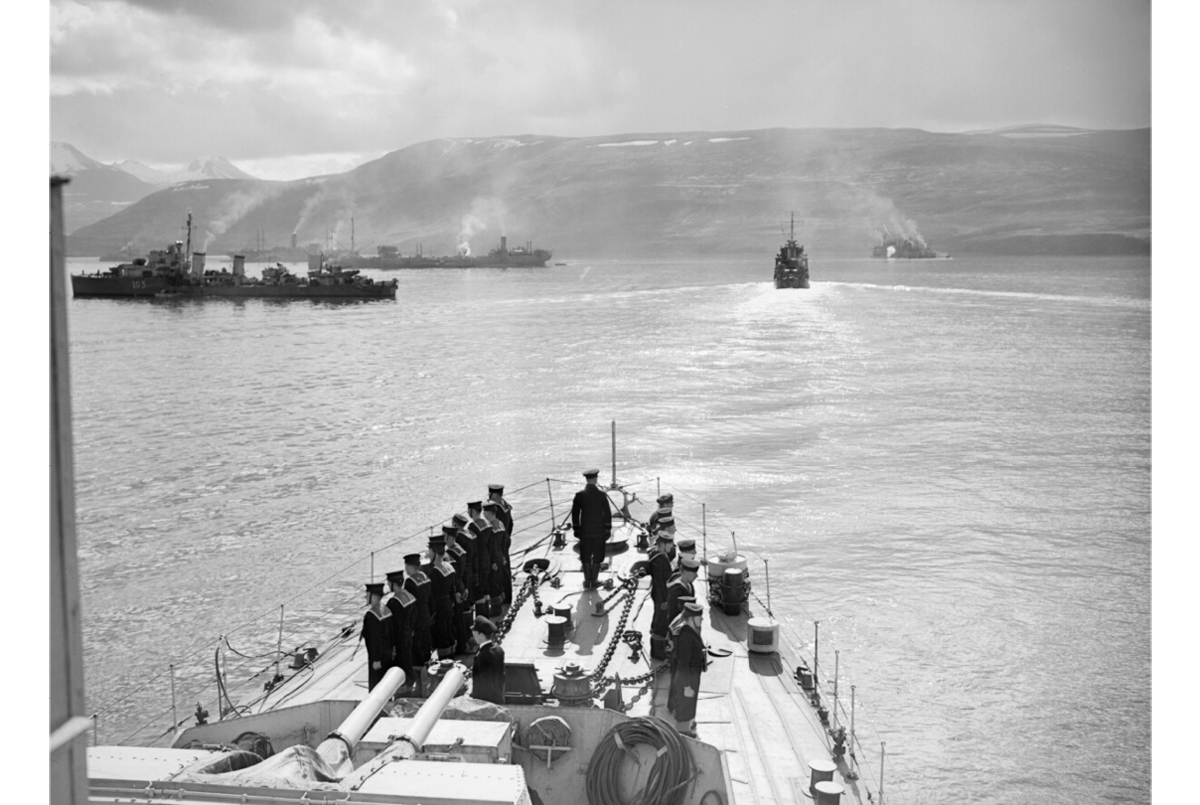
 A Navy sailor and the guns of his naval vessel keep watch over a merchant convoy as it plies rough Atlantic seas, early 1940s. LOC
2. The Fall of France: Democracy’s Dark Hour
The venerable republic of France—a substantial military power—succumbed to German domination on June 22, 1940, only six weeks after the Nazis launched their “lightning war” on the country. A new collaborationist regime based in Vichy, France, soon replaced the French republican motto “Liberty, equality, fraternity” with the slogan “Work, family, fatherland.” Now it was clear: no Western democracy could consider itself safe.
Franklin D. Roosevelt made the fateful decision, against the advice of top military brass, to marshal American resources to defend an isolated Britain rather than keep them at home to bolster security in the Western Hemisphere. He also maintained ties with the Vichy government in the hope of weakening its alliance with the enemy. Just as the French defeat in 1940 dealt a critical blow to the Allies, four years later, Allied landings on the beaches of Normandy, France, would signal the beginning of the end for Nazi Germany.
 In a fort on the Maginot Line in France, a British sentry of the 51st Highland Division keeps watch wearing a gas mask, November 3, 1939. France was relatively well defended on the Maginot Line, a system of fortifications along its border with Germany. But the Germans would focus their 1940 invasion just north of the line. © IWM (O 229)
 Nazi motorcyclists pass through a destroyed French town, 1940. The Germans subdued their French neighbors with alarming speed. The invasion began on May 10; on June 14, Paris fell; by June 22, the country was in Nazi hands. Deutsches Bundesarchiv/German Federal Archives
 German prisoners of war being marched through the streets of Paris after its liberation by the Allies, August 25, 1944. In the beginning, many French people had accepted or even supported the collaborationist Vichy regime as a means to maintain some independence for France, but as the war progressed, French public opinion turned against the regime. FDRL
3. Neighbors and Allies: United States–Canada Relations under FDR
Franklin D. Roosevelt remarked in 1936 that Americans and Canadians didn’t really think of one another as “foreigners.” In fact, rising international tensions in Europe and Asia in the 1930s and 1940s motivated FDR to draw America’s nearest neighbor closer than ever. FDR was the first American president to address the Canadian Parliament and people, and he developed a close rapport with Canada’s long-serving Liberal Party prime minister, William Lyon Mackenzie King. During World War II, FDR’s administration coordinated with Canada on war-related industrial production and the defense of North America. Canada, a member of the British Commonwealth, facilitated America’s “special relationship” with Britain in that period. At the same time, the United States supported Canada’s emergence as an independent nation separate from the British Crown, establishing a full-fledged embassy there in 1943 and becoming the first country to receive a fully accredited Canadian ambassador in January 1944.
 Franklin D. Roosevelt looks on as U.S. Secretary of State Cordell Hull (left) and Canadian prime minister William Lyon Mackenzie King sign a reciprocal trade pact reducing tariffs between their nations, 1935. The Liberal Party Canadian leader was a regular visitor at the White House and the Roosevelt home in Hyde Park, New York. He even saw FDR at his home-away-from-home in Warm Springs, Georgia. LOC
 From left to right: William Lyon Mackenzie King, Canadian prime minister; Franklin D. Roosevelt; Winston Churchill, British prime minister; and the Earl of Athlone, then governor general of Canada, a representative of the British monarch in Canada. Hosted by the Canadians in Quebec City, the leaders were gathered for the August 1943 Quebec Conference in which they discussed preparations for an invasion of France. IWM (TR1347)
 Louis St. Laurent, Canadian foreign minister, signs the United Nations Charter at the San Francisco Conference, June 26, 1945. Canada, a strong supporter of the UN, was active in the work of drafting its charter. UN Photo/McLain
4. The Good Neighbor Policy: Promoting Respect and Unity in the Americas
As much as Franklin D. Roosevelt believed that the United States was inexorably linked to the distant continents of Europe and Asia, he knew that America’s home was in the Western Hemisphere—the New World. With this in mind, FDR devoted himself to forging stronger ties between the United States and its mostly Spanish-speaking neighbors to the south. With his so-called Good Neighbor Policy, formally announced at a 1933 Pan-American Conference in Montevideo, Uruguay, FDR rejected a pattern of U.S. military intervention in the affairs of Central American and Caribbean countries, often to protect American economic interests. Instead, FDR joined the leaders of other American republics in pledging to resist aggressive incursions into the hemisphere from without and to uphold the sovereignty of all American nations. His administration promoted economic ties by negotiating trade agreements with Latin American countries. And he fostered cultural exchange by traveling to Latin America often, including on a “Good Neighbor Cruise” to South America in 1936.
 A Works Progress Administration poster promoting the Good Neighbor Policy. “We, the citizens of all the American Republics, are, I think, at the threshold of a new era,” Franklin D. Roosevelt said in Colombia in 1934. “It is a new era because of the new spirit of understanding that is best expressed in the phrase, ’Let us each and every one of us live and let live.’” LOC
 Franklin D. Roosevelt reviews the Argentine fleet on his trip to South America aboard the USS Indianapolis, November 1936. During the upcoming Inter-American Conference for the Maintenance of Peace in Buenos Aires, Argentina, on December 1, 1936, FDR would contrast the American states with aggressive movements gaining traction in Europe and Asia. “This is no conference to form alliances, to divide the spoils of war, to partition countries, to deal with human beings as though they were pawns in a game of chance,” he said. “Our purpose, under happy auspices, is to assure the continuance of the blessings of peace.”
 Franklin D. Roosevelt with Mexican president (since 1940) Manuel Ávila Camacho during a state visit to Monterrey, Mexico, April 20, 1943. After a decade in office, FDR had secured good relations with Mexico, and when he died two years later, the Mexican government would announce an official three-day mourning period unprecedented for a foreign leader. FDRL
5. Arming Democracy: Franklin D. Roosevelt in the Lead-Up to War
Franklin D. Roosevelt’s leadership as United States commander in chief during World War II was critical to the Allied victory that came shortly after his death in April 1945. But FDR’s leadership in the years before America entered the war in December 1941 was arguably just as crucial to the outcome. In the 1930s, the American public and U.S. Congress were highly wary of sending American boys to fight in another foreign war, and supported neutrality laws to prevent the country from being drawn into the fray. It was FDR who, acting in the realms of politics, public communications, and diplomacy, carefully turned the nation to face the awful threat developing in Europe and the Pacific—to face it by reinstating the draft, launching an arms buildup of staggering scale, and opening the floodgates of war aid to sustain Britain and other friendly nations fighting for survival. “We must have more ships, more guns, more planes,” FDR said in a 1940 fireside chat, nearly a year before Pearl Harbor. “We must be the great arsenal of democracy.”
 Students at the University of California, Berkeley, take part in a peace strike, April 1940. Franklin D. Roosevelt faced a major political challenge in urging Americans to prepare for war. In the summer of 1940, six in ten said staying out of the conflict overseas should be the country’s most important aim. National Archives
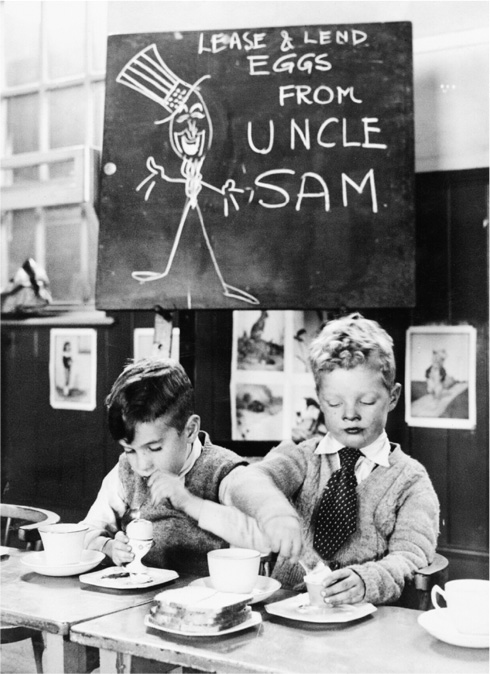
 American-built howitzers, shipped under the country’s Lend-Lease program, at an ordnance depot in Britain, around 1941. Toward the end of 1940, Franklin D. Roosevelt had come to believe the United States could no longer simply invoice cash-strapped Britain for war supplies it desperately needed to defend democracy in Europe. FDR saw Britain’s survival as vital to American security. He devised the Lend-Lease program to rush aid to the British without concern for payment. National Archives
 A window display at the J. L. Hudson Company Department Store in downtown Detroit, 1943. Though Americans had been reluctant to enter World War II, once the country was committed, government and industry collaborated in a major effort to convert American production capacity to manufacture war supplies instead of consumer goods. Factories operated day and night. Detroit Historical Society
6. FDR’s Four Freedoms Speech: A Call for Human Rights “Everywhere in the World”
In January 1941, the Axis powers having launched unprovoked and alarmingly successful assaults on three continents, FDR took the occasion of his eighth State of the Union address to warn Americans that their own way of life was in peril. In the process, he articulated the American idea as a humane and universal one—the very antithesis of the dictators’ racist, violent lootings and suppressions. In the future world FDR envisioned, four fundamental human freedoms would prevail everywhere: freedom from want, freedom from fear, freedom of expression, and freedom of religion.
Though the address was given with the specific aim of hardening Americans’ resolve to oppose the Axis and prepare for war, the Four Freedoms portion—which FDR himself composed—brought together the most important values of his presidency. It expressed the New Deal’s core principle that freedom can never be complete without basic economic security (“Necessitous men are not free men,” as FDR said), held up as sacred the individual liberties guaranteed in America’s Bill of Rights, and offered these same cherished freedoms as the basis for a just, secure, and peaceful world.
 A page from the fifth draft of Franklin D. Roosevelt’s January 1941 Four Freedoms speech. FDR and his speechwriters had worked on the critical address over the December holidays, composing numerous drafts. FDRL
 In the summer of 1943, the Stars and Stripes flies next to a flag representing the twenty-six-nation alliance opposing the Axis powers; its four bars symbolized Franklin D. Roosevelt’s Four Freedoms. LOC
 A commemorative five-cent postage stamp honoring the recently deceased Franklin D. Roosevelt and his Four Freedoms, 1946. The Four Freedoms concept captured the essence of FDR’s values: his remaking of the federal government into an instrument of common purpose that could promote citizens’ basic security and protect their individual rights, as well as his perception of the world as inevitably and, he hoped, peacefully interconnected.
7. The Atlantic Charter: Would-Be Allies Define Their Cause
For four days in August 1941, Franklin D. Roosevelt and British prime minister Winston Churchill conferred in a dramatic shipboard rendezvous on the frigid waters off the coast of Newfoundland, Canada. It was their first face-to-face meeting as heads of state and would-be allies in war, though the United States had yet to officially join the fight against the Nazis. The two leaders quickly developed the rapport they considered critical to the work ahead. And together they composed a document, the Atlantic Charter, which let the world know what it meant to stand with them against the invading enemy: the Allies would fight, not to expand their own dominions, but to defend the right of people everywhere to choose their own governments and live free.
 A standing Franklin D. Roosevelt, supported by his son Captain Elliott Roosevelt, grips Winston Churchill’s hand in greeting as he receives the prime minister’s welcome aboard the British battleship HMS Prince of Wales, August 1941, Newfoundland, Canada. It was their first meeting as heads of state. © IWM (H 12739)
 In a Sunday morning prayer service aboard the HMS Prince of Wales on August 10, 1941, Franklin D. Roosevelt, Winston Churchill, and British and American military chiefs and crewmen gather around an altar draped with their countries’ flags, the Union Jack and the Stars and Stripes. Led by British and American chaplains, the service was designed to be a powerful expression of unity between the two nations. Churchill chose the hymns himself, closing the ceremony with “O God, Our Help in Ages Past.” FDRL
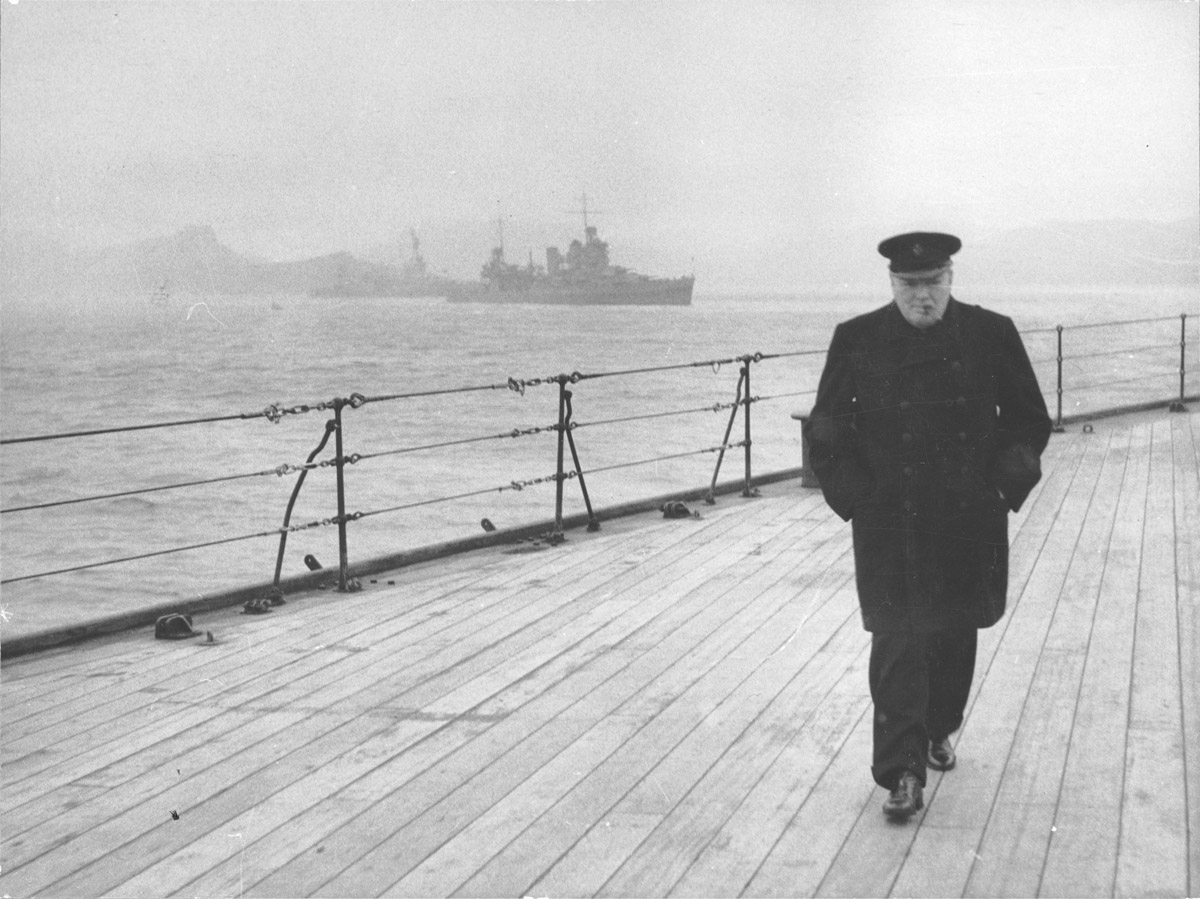 Winston Churchill walks the deck of the HMS Prince of Wales as it journeys back across the ocean to England after the Atlantic Conference in August 1941. Churchill had FDR’s assurances of goodwill and military aid, but no promise that the United States would enter the war. The British leader returned to the grim task of defending his island nation against Nazi forces that now occupied much of Europe. LOC
Download PDFs
Download the in-depth history as a pdf to print, save, and share.
1.The Battle of the Atlantic: Peril on the Seas
2.The Fall of France: Democracy’s Dark Hour
3.Neighbors and Allies: United States–Canada Relations under Franklin D. Roosevelt
4.The Good Neighbor Policy: Promoting Respect and Unity in the Americas
5.Arming Democracy: Franklin D. Roosevelt in the Lead-Up to War
6.Franklin D. Roosevelt’s Four Freedoms Speech: A Call for Human Rights “Everywhere in the World”
7.The Atlantic Charter: Would-Be Allies Define Their Cause
III. Four Freedoms:
Preparing for War,
Envisioning Peace
1939 – 1941
Four Freedoms contains seven chapters, on topics
ranging from the Nazi conquest of France in 1940
to FDR’s famous 1941 Four Freedoms speech laying out
democratic aspirations for a better world.
click the “In Brief” button at upper right.
click the chapter arrow at lower left.
1. The Battle of
the Atlantic:
Peril on the Seas
The Battle of the Atlantic is perhaps the most underappreciated theater of World War II. This six-year struggle to keep critical supply routes in the Atlantic safe for Allied shipping was the war’s longest campaign. It was also among its most brutal, with the merchant seamen responsible for transporting goods suffering a higher casualty rate than any branch of the armed services. To Allied sailors, military and civilian alike, that silent, invisible, underwater predator known as the U-boat (a German submarine) became one of the most potent symbols of Nazi terror.
The fight for supremacy on the Atlantic began within hours of the start of the war, when German U-boats and surface raiders began roaming the waters of this vast area in search of the merchant ships that supplied the British Isles with the millions of tons of imported material they needed to survive. In this initial phase of the battle, U-boat numbers were small. Much of the damage inflicted on Allied merchant shipping—which was most often grouped together for safety in escorted convoys—was carried out by small armored ships and other vessels, as well as by mines planted in the approaches to British harbors.
By 1940, however, German strategy in the Atlantic began to change. The German navy suffered major losses during the invasion of Norway in April 1940, which, coupled with the sinking of the massive German battleship Bismarck a year later, effectively ended Germany’s use of its surface vessels as a primary weapon in the Atlantic. Instead, the Germans turned almost exclusively to their U-boats. Thanks to German successes on the battlefield, these combat submarines were now in a much better position to enter the Atlantic. Indeed, the fall of Norway and France in the spring of 1940 meant that Hitler’s regime possessed nearly the entire European Atlantic coastline, giving the Germans new U-boat bases and unhindered access to the ocean despite the naval blockade on Germany the Allies had imposed at the start of the war.
Moreover, Britain now stood alone against the Axis, making the island nation extremely vulnerable to this type of naval warfare. In these new circumstances, the German navy began a concerted effort to try to drive the British out of the war by massing submarines into so-called wolf packs. In this new and highly effective tactic, German submarines would form a line across the likely route of a convoy and, once the latter had been detected, would come together to attack it, usually on the surface at night and often with devastating effect. In October 1940, for example, one slow-moving eastbound convoy lost twenty-one of its thirty ships.
AThe Allies Fight Back
BAmerica Faces the U-boats
CThe Casablanca Conference and Defeat of the U-boat

 1. The Battle of the Atlantic: Peril on the Seas
CLICK titles for text and images for captions
1. The Battle of the Atlantic: Peril on the Seas
CLICK titles for text and images for captions
2. The Fall of France:
Democracy’s Dark Hour
In September 1939, the British and French declared war on Nazi Germany in response to its invasion of Poland, as promised. There followed a so-called Phony War; for months the Allied democracies hesitated, reluctant to plunge into combat. But on May 10, 1940, the day of reckoning came: the German army launched its much-anticipated attack on France and the Low Countries. Now the cream of the French army and ten divisions of the British Expeditionary Force (BEF) rushed forward to meet the German threat in prepared positions along the Dyle, Maas, and Meuse rivers in eastern Belgium and extending south along the Maginot Line, a system of fortifications the French had constructed in the '30s to ward off attack by their aggressive German neighbor.
This beginning, so long in coming, proved inauspicious for the Allies. By midsummer France, America’s oldest ally, would lie in Nazi hands.
AThe Battle for France
BThe Establishment of
the Vichy Government
CCharles de Gaulle and
the Free French Movement
DFranklin D. Roosevelt and Vichy France
EFranklin D. Roosevelt and Charles de Gaulle: An Uneasy Relationship
2. The Fall of France: Democracy’s Dark Hour
CLICK titles for text and images for captions
3. Neighbors and Allies:
United States–Canada Relations
under Franklin D. Roosevelt
CAPTION
ANorth American Allies
3. Neighbors and Allies: United States–Canada Relations under Franklin D. Roosevelt
CLICK titles for text and images for captions
4. The Good Neighbor
Policy: Promoting Respect
and Unity in the Americas
In his famous first inaugural address of March 4, 1933, Franklin D. Roosevelt committed his administration to “the policy of the good neighbor.” The good neighbor, FDR explained, “resolutely respects himself and, because he does so, respects the rights of others.” FDR was referring to the tenor of U.S. foreign policy in general, but the phrase “good neighbor” soon became associated specifically with U.S. policy toward Latin America.
In embracing the Good Neighbor Policy, FDR and his secretary of state, Cordell Hull, signaled their intention to move away from a pattern of heavy-handed intervention in the domestic affairs of Central American and Caribbean nations, often in small-scale “Banana Wars” to protect U.S. economic interests. Instead the United States would take an approach based on mutual recognition and cooperation.
While promoting nonintervention, free trade, and mutual defense, the policy raised the profile of U.S.–Latin American relations in general, for the first time emphasizing the New World as an important locus of international exchange. FDR made frequent visits to Latin American countries, becoming the first sitting president to visit South America when he traveled to Cartagena, Colombia, in 1934. “We, the citizens of all the American Republics, are, I think, at the threshold of a new era,” FDR said in Colombia. “It is a new era because of the new spirit of understanding that is best expressed in the phrase, ‘Let us each and every one of us live and let live.’”
Though America’s predominance in economic and military affairs meant it would continue to hold the upper hand in the Western Hemisphere, the Good Neighbor Policy was popular in the United States and Latin America alike, vastly improving relations between the two.
The Roosevelt administration held up this policy, coupled with the strong relationship it cultivated with Canada, as an exemplar of international cooperation among sovereign states—and a sharp contrast to the aggressive foreign policies of Italy, Germany, and Japan in the years leading up to World War II. FDR hoped this example might help to head off world war. “Can we, the Republics of the New World, help the Old World to avert the catastrophe which impends?” he asked at a 1936 diplomatic conference in Buenos Aires, Argentina. “Yes; I am confident that we can.”
It was not to be. But the principles established in the Good Neighbor Policy did help lay the basis for the United Nations, founded after the war. In 1948 this policy would find new life in the establishment of the Organization of American States, which continues to foster neighborly relations among nations of the Western Hemisphere in the twenty-first century.
ARespect Among Neighbors
BTrade among Neighbors
CSecurity among Neighbors
“In this Western Hemisphere the night of fear has been dispelled. Many of the intolerable burdens of economic depression have been lightened and, due in no small part to our common efforts, every Nation of this Hemisphere is today at peace with its neighbors.”
Franklin D. Roosevelt, at the Inter-American Conference for the Maintenance of Peace in Buenos Aires, December 1, 1936
DThe Good Neighbor Policy and Mexico
4. The Good Neighbor Policy: Promoting Respect and Unity in the Americas
CLICK titles for text and images for captions
5. Arming Democracy:
Franklin D. Roosevelt in
the Lead-Up to War
In the late 1930s, as Nazi Germany, Fascist Italy, and Imperial Japan began to wreak havoc in the Eastern Hemisphere, American president Franklin D. Roosevelt faced a leadership challenge of bedeviling complexity.
Most Americans, recalling the country’s apparently fruitless sacrifice in World War I, adamantly opposed entry into another foreign war. As late as the summer of 1940—just a few months before the Japanese attacked Pearl Harbor—fully 61 percent said staying out of war should be America’s most important objective. Congress had served this aim with neutrality laws that cut off the flow of American money and arms to warring nations.
For years the president, engaged in domestic issues and two hard-fought reelection campaigns, was loath to confront isolationists. His own oft-repeated hope for humanity was widespread disarmament and commitment to nonaggression. But as events unspooled on the other side of the world, FDR became convinced that the United States must, in the interest of its own security, prevent the collapse of its allies abroad.
At first he advanced this cause with a rhetorical and legal finesse that left some doubting his sincerity. Ultimately, FDR made a forceful case to the American people, asking them to embrace the country’s role as “the arsenal of democracy”—funneling aid to desperate combatants.
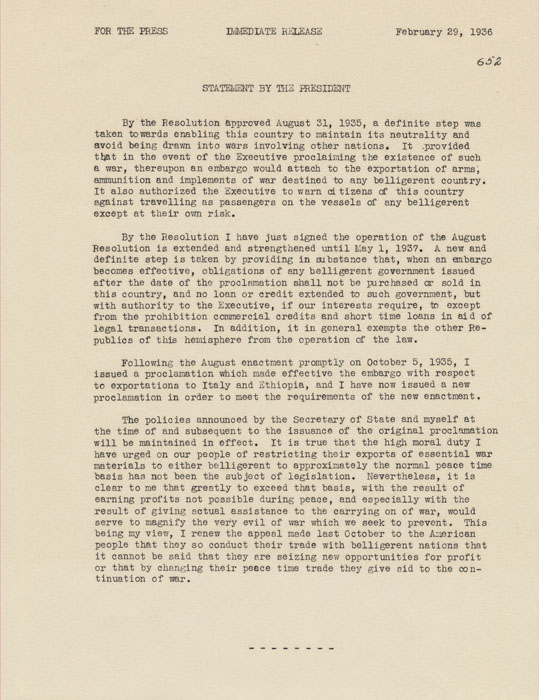
In the election year of 1936, when Congress voted to extend a ban on arms sales to nations at war, FDR accepted the bill without protest. He feared that a loud debate on neutrality would only encourage Congress to place tighter constraints on his discretion, hurt his chances in the election—and possibly spur Italy to even bolder depredations in Ethiopia than those launched the previous year. “These are without a doubt the most hair-trigger times the world has gone through in your lifetime or mine,” FDR lamented to his ambassador in Italy.
Tensions mounted with every passing month. In June 1940, with the Nazis bearing down on Paris and hatching designs on the final European prize—England—British prime minister Winston Churchill sent word to FDR: “If we go down,” he warned, “Hitler has a very good chance of conquering the world.”
But at home FDR faced indignant accusations that he was leading his countrymen into a war they wanted no part of. On the campaign trail that autumn, he insisted, “There is no secret treaty, no secret obligation, no secret commitment, no secret understanding in any shape or form, direct or indirect, with another Government, to involve this nation in any war.”
Near the end of ‘41, the Japanese would bomb Pearl Harbor and put an end to debate over whether America would fight. In the meantime, that was the question on Americans’ minds. Was the country on a path to war? Could it stay clear of the conflagration? “To that,” Eleanor Roosevelt told one audience in 1939, “my answer is always the same and the only answer I can make: Nobody knows. We hope so with all our hearts.”
AMarch of the Aggressors: A Timeline
BThe Isolationists
CLegislating Neutrality
D1940: Neutrality amid the Gathering Storm
EPeacetime Draft
FFranklin D. Roosevelt on War
“We are not isolationists except in so far as we seek to isolate ourselves completely from war. I have seen war. I have seen war on land and sea. I have seen blood running from the wounded. I have seen men coughing out their gassed lungs. I have seen the dead in the mud. I have seen cities destroyed. . . . I hate war.”
FDR in an address during the 1936 presidential campaign
GLend-Lease
HFireside Chat:
“Arsenal of Democracy”
5. Arming Democracy: Franklin D. Roosevelt in the Lead-Up to War
CLICK titles for text and images for captions
6. FDR’s Four Freedoms
Speech: A Call for Human
Rights “Everywhere in
the World”
Not long past noon on Monday, January 6, 1941, Franklin D. Roosevelt locked his leg braces into place and mounted the podium of the Capitol’s House of Representatives to deliver his eighth State of the Union address. Newly elected to a third term, FDR was by now a seasoned leader. Indeed, on that winter day in 1941, he was arguably the most experienced and most important statesman in the world.
And the world was falling apart. The Nazis had swallowed Austria, Czechoslovakia, Poland, and France, the Fascist Italians had invaded Ethiopia, Egypt, and Greece, and the Japanese had sacked China and Indochina. In September the three powers had signed the ominous Axis Pact, pledging mutual support in establishing “a new order of things.” Great Britain, a last line of defense against totalitarianism in Europe, had held fast during months of German bombing and U-boat attacks, but was now much depleted of armaments and out of money.
FDR had a great deal to accomplish in his speech. Most immediately, he asked Congress to authorize and fund “a swift and driving increase” in American arms production. He also asked listeners to support his plan (the “Lend-Lease” program) to give the British and other Allies ready access to American airplanes, ships, tanks, and other munitions without having to pay for them in cash.
But FDR went beyond these short-term goals to explain to a country deeply troubled at the prospect of sending its sons into combat on foreign soil just what was at stake for Americans in this war.
He first made an eminently practical case, drawing a picture of Britain vanquished, the Axis tyrants holding dominion over all of Europe, Asia, Africa, and Australasia. Nothing resembling an American way of life would be possible in such a world, he argued. Under a “dictator’s peace,” a “new one-way international law,” Americans could not long enjoy independence as a nation, nor should they expect to exercise their traditional liberties.
FDR went further still, arguing that Americans’ very identity—their most cherished values—hung in the balance. In so doing he defined American identity as a universal idea to which any and all might cleave, something very different from the tribal and even racist nationalism that fueled the Axis powers’ pitiless expansionism. It was no mistake that in FDR’s description of his nation’s values, the word “freedom” rang out again and again.
In the famous conclusion of his speech, he named four “essential human freedoms”—freedom of speech and expression, freedom to worship as one chooses, freedom from fear (of armed aggression, for example), and freedom from want (for destabilizing “social and economic problems,” he pointed out, had birthed the appalling political movements that now threatened American security). In each case the president pointedly added that these freedoms must prevail everywhere in the world.
FDR’s message married the New Deal values that had helped sustain democratic life through turbulent times in America to an impassioned defense of “democratic existence” around the world. He proposed a broad “moral order” that would protect the individual but inspire the multitudes—and thus prove mightier than the militaristic “new order” the Axis powers sought to impose. “Freedom,” said FDR, “means the supremacy of human rights everywhere.”
AIsolationism
in America
BPreparing the Four
Freedoms Speech
CThe Legacy of
Four Freedoms
6. FDR’s Four Freedoms Speech: A Call for Human Rights “Everywhere in the World”
CLICK titles for text and images for captions
7. The Atlantic Charter:
Would-Be Allies Define
Their Cause
Of all the critical meetings Franklin D. Roosevelt conducted during his twelve years as president, none was more dramatic or more consequential than his first face-to-face encounter with the man who would be his partner in global war and statecraft, Prime Minister Winston Churchill.
The meeting took place on the icy waters off Newfoundland during four days in August 1941. Both leaders assigned the rendezvous utmost importance and took extraordinary pains to get there, Churchill traveling incognito across an Atlantic infested by German submarines, FDR shaking the Secret Service and telling the world he was on a fishing trip around Cape Cod. He even had a crewman sit on the presidential yacht impersonating the commander in chief with the help of a floppy hat, pince-nez, and long cigarette holder.
The British prime minister and American president were quite different types—Churchill was a moody, hard-drinking night owl, while FDR tended to exude an even-tempered joviality. But they had this in common: each trusted in his own ability to communicate directly, to take the measure of another man, and to bring him around to a point of view.
To confer in person was, as much as anything else, their errand in the North Atlantic. As soon as the parties reached their meeting place on August 9, FDR pressed his advisor Harry Hopkins, who had been traveling on the battleship HMS Prince of Wales with the British contingent: What were the prime minister’s “moods and wishes”? As for Churchill, he had quizzed Hopkins so avidly about FDR on the ocean voyage that, as Hopkins would later remark, “You’d have thought Winston was being carried into the heavens to meet God.”
A great deal was at stake. Though the United States had recently pledged itself to the Lend-Lease program funneling war supplies to Allies, it remained officially neutral in the great clash of power taking place in Europe and Asia. And the war was not going well. In the spring Adolf Hitler’s forces had overrun Yugoslavia and Greece. The Nazis were making inroads in North Africa and, in June, had invaded Russia. They now occupied fifteen nations, controlling all the territory between the Arctic Circle and the Mediterranean. Japan, meanwhile, occupied parts of Indochina, strengthening its blockade of China.
Churchill wanted FDR to bring the United States clearly, definitively to Britain’s side; he wanted a declaration of war. He also hoped FDR would agree to threaten retaliation against Japan if it continued its southward advance in Indochina.
FDR, on the other hand, wanted the leaders to issue a joint statement describing a vision for the future—one that would give comfort to a besieged Britain, while at the same time reassuring war-wary Americans that the Allies’ ultimate goal was a just, nonviolent world, not endless quest for empire.
FDR got his statement, dubbed the Atlantic Charter. And Churchill, though frustrated in the near term, would have his declaration of war soon enough.
The summit met a less tangible objective, too. Before the leaders of Britain and America steamed back to their respective seats of government, they had established the personal rapport both considered critical to the work before them. That was something no telephone call or transatlantic cable could have achieved.
A“How Do You Do?”:
An Envoy to Britain
“Whither thou goest, I will go; and whither thou lodgest, I will lodge; thy people shall be my people...even to the end.”
Harry Hopkins, quoting from the Book of Ruth during his 1941 trip to England
BAn Envoy
to Russia
CAid Until Victory
“From now on, that aid will be increased—and yet again increased—until total victory has been won.”
Franklin D. Roosevelt, days after signing the Lend-Lease bill to provide aid to Allies, March 15, 1941
DThey Meet at Last
EThe Atlantic Charter
FImpact of the Atlantic Charter
7. The Atlantic Charter: Would-Be Allies Define Their Cause
CLICK titles for text and images for captions